
In a career that has spanned roughly fifteen years, Ernesto Neto has shown no signs of his creative energies waning. While each of his exhibitions has changed sufficiently to demonstrate an ongoing evolution in technique and ambition, there has been a thematic and visual logic throughout his artistic permutations.
Neto’s recent exhibition at Tanya Bonakdar Gallery is literally three sculptural works, but they flow together as one complete installation that transforms the entire space of the gallery. By now Neto seems to have firmly established himself as an environmental sculptor rather than as the sculptor of discreet objects that he once was. This installation shows a departure from his earlier exploration of intricately interwoven, soft organic forms, culminating in large bulbous shapes. Neto still works with fiber-based materials, however, a solidified Styrofoam-type material has replaced the nylon of previous installations. Titled, The Silent Cliff: The Gate, the House, the Garden, the People, Neto’s new work continues the dialogue he established between landscape and the body, but this time landscape seems to be winning out.
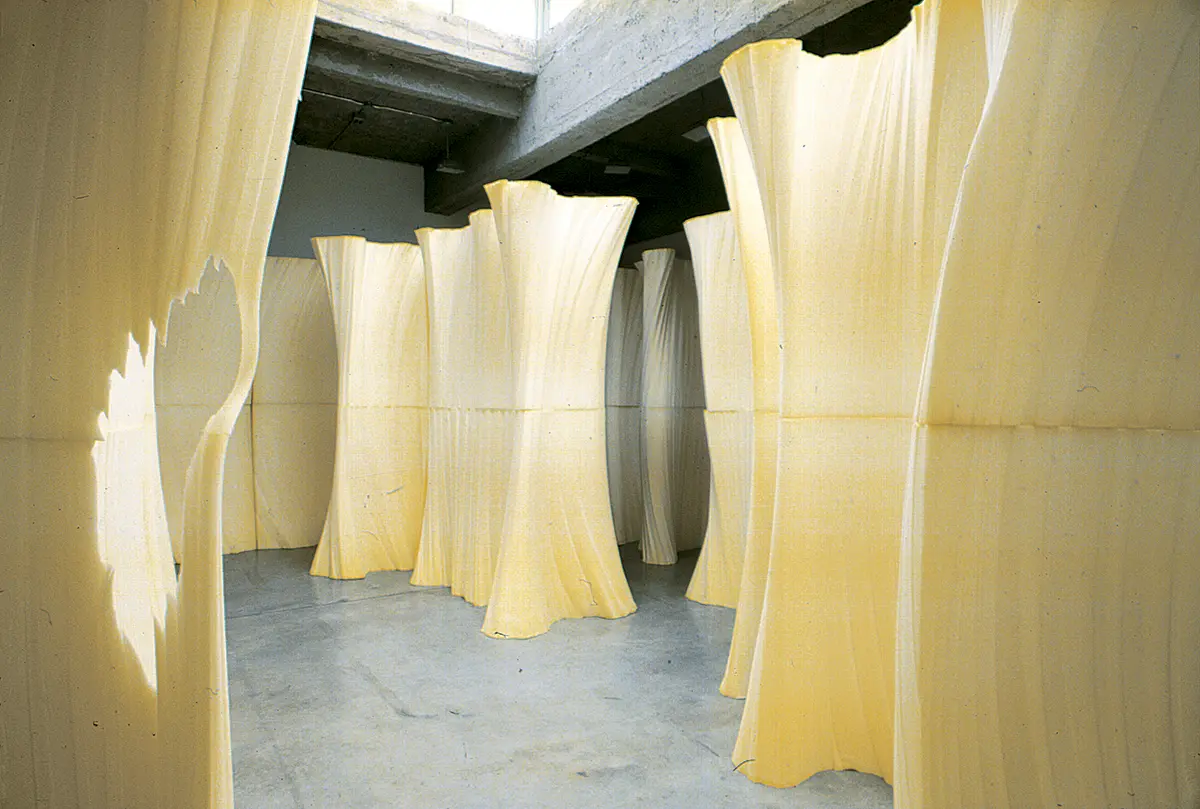
Passing through the first section, subtitled The Gate, one notices the rough-hewn edges of the foam and the ways the striations and ridges of its surface cast various tonal shadows on the neutral material; illumination from the skylights calls attention to the translucency of the material. Walking through Neto’s propylaea, the initial experience is as if passing through a cavernous space complete with stalactite formations. There are two openings that one can choose; each one essentially leads to another part of the installation. This double opening makes for an unavoidable fallopian experience: to pass through the gate is more than moving through a tunnel, it is to be born into the artwork.
The next two spaces offer experiences that are similar yet inverted. The larger of the two, The Silent Cliff/The Forest, spreads out through at least half of the gallery space. The dimensions and the specific parameters of the gallery are warped and negated by a continuous unfurling of the sculpted foam. This tall, ridged environment is sometimes spacious, sometimes a bit confining. Certain folds in the “walls” suggest a new passageway, only to result in a dead end. At times one feels enveloped within folds of flesh; other passages suggest palisades or cliffs. The foam can seem hard and unyielding or billowing like a curtain. The scale and uneven spatial relationships evoke a sensibility not unlike that of Richard Serra’s Torqued Ellipses; the main difference is that while Serra relies on many tons of cold hard steel, Neto’s material is more in danger of being harmed by the viewer than the reverse.
The final component, The House, is also spatially engaging but plays on the sense of confinement. The House fills the gallery, but it is a distinct structure with perceivable, finite dimensions. To enter it, one basically crawls through a small aperture after donning a special outfit that adds to the potential discomfort of the experience. Thus, what might be akin to exploring a cave, assumes the sensation of being institutionalized, or confined in an asylum. There is also the connotation of attempting to re-enter the womb, a physical impossibility for which we create substitutes like homes and asylums.
After the almost baroque visual complexity and multisensory experiences of Neto’s installations of the past few years, one cannot help but acknowledge a feeling of something lacking in his current work. But given the remarkable breadth and scope of Neto’s activities and his obvious willingness to continue to experiment and evolve, The Silent Cliff… stands as a crucial moment marking a new shift in what has thus far been a highly engaging body of work.
JOHN ANGELINE