
Fernando Varela’s superb exhibition at Santo Domingo’s Lyle O’ Reitzel gallery is not only an expression of the ascending development of this artist’s work in recent years, but, above all, an important signpost in the history of Dominican painting, inasmuch as it is a painting of ideas at a level of quality unseen since the days when Fernando Peña Defillo created his exceptional series about Matter and Spirit, or his exhibitions “Ánima Mundi” and “Parallel worlds.”
Varela’s works would be enough on their own to believe the rumor —a rumor that some people have an interest in promoting— that Dominican painting is dead, and that only in media like photography and installation —certainly of increasing vitality, and capable of attracting important talents— will we find genuinely contemporary expressions, worldviews complex and sophisticated enough to illuminate for us the world as it is today and drive us to the necessary catharsis of postindustrial-age demons.
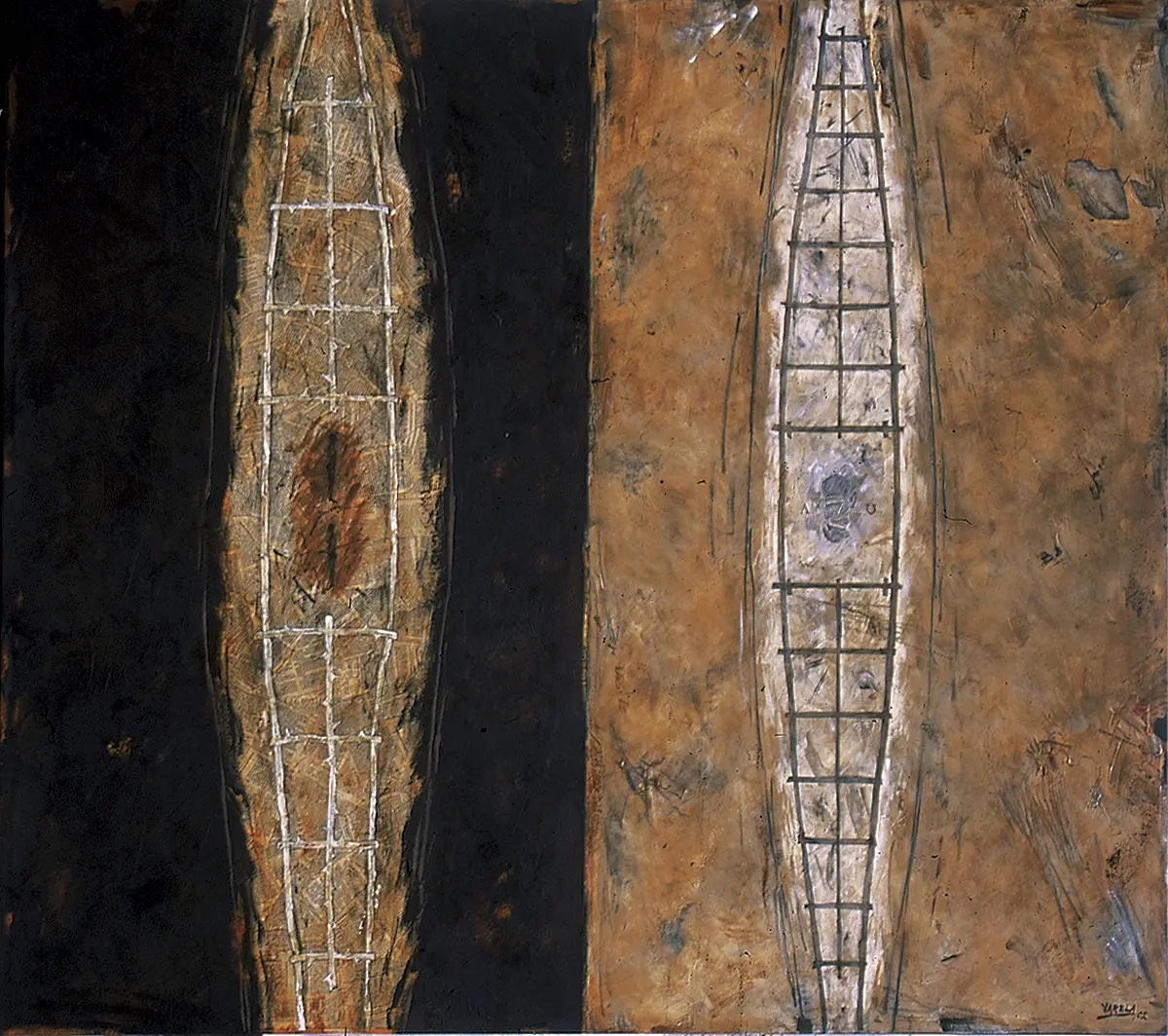
Myth, mysticism, and philosophy shape an art that, despite its intellectual complexity, incessantly appeals to our senses with its distilled sense of form, technical excellence, composition, and color. Varela is properly an artist, not a philosopher. But he is not an illustrator, either, but someone capable of handling with great rigor and depth the resources of visual thinking, which is, on the other hand, and precisely, the kind of thinking that, operating with images, reaches the highest plateaus of creativity.
Just as Varela established an authentic ritual of space in that fantastic Altar of Fear shown as an installation at the Spanish Cultural Center, the mythology of travel, resignified in the Caribbean context with the geographic, historical, ethnic, and cultural connotations of the innumerable migrations that make and re-make our insular universe, incorporates the characteristics of symbol, myth and archetype though a formal essence that brings us close to pictograms, to the common origin shared by painting and writing. In some of his most interesting pieces, Varela attempts a gesturality, a new freedom of form derived from the rational clarity and purity of a renewed spontaneity, all the while avoiding the pitfalls of an excessive intellectual dryness.
But it is in two exceptional paintings, devoted to exemplifying Man’s worlds, created through his own systems of language and thought, verbal and mathematic, where Varela’s most interesting quests of recent times are better expressed, as his visual investigation of the human condition coincides with some of the most profound ideas that, from Heidegger to Lacan, have placed language at the center of all psychological, humanistic, anthropological-philosophical or existential considerations.
From a purely formal point of view of his history of explorations and public shows, it is in this exhibition where Fernando Varela achieves his greatest freedom, while still letting us discern the solid compositional concept that internally supports his images, the implicit order guaranteeing the visual intelligibility of his most faded images as well as his cursive characters, his traces, his stains. A compositional language capable of just as well using rhythm and seriality as it uses concentric movements contrasts between form and background, or the pure entropy of the flat surface, and capable also of turning drawing, above all else, into an element of spatial composition, of definition by force vectors, by closed energy systems, in the same way in which letters and numbers are both a resource of compositional and plastic seriality and a symbolic referent.
Nevertheless, letters and numbers are language’s self-referential signs, since, rather than to sounds or meanings that are alien to the signifier itself, attributed by linguistic convention, they allude to linguistic capacity as an active power, not a passive feature of the mind, as an instrument of consciousness, a web of coordinates useful to capture the world, even to construct it. A linguistic-tautological conceptualism is able then, to paraphrase that Heideggerian characterization of Hölderlin’s poetry, to poeticize the essence of poetry, inasmuch as poeisis is, in the widest possible sense, all art, all creation.
LAURA GIL