
Venezuelan artist Gabriela Morawetz (Poland, 1956) recently exhibited her latest work in Saint-Valéry at Caux, a small port town of High Normandy. The exhibition titled No ser (Not to be) was presented at Maison Henri IV, –a well-preserved building originally restored in the XVI Century —producing many interesting results. Due to the enclosed layout of the unique space, the sixty-one pieces were displayed in four small halls where one found a range of works spanning from an installation titled El tiempo era un río tranquilo (Time was a Quiet River), through various works on paper using different techniques and formats (photography, emulsion, and drawing), to inventions on glass and stone, various fabrics in different formats, and finally arriving at an installation of children’s garments suspended in space. Owing to the strong character of the building with its medieval architecture and its dark pieces of hard rock where roughly hewn silex with black and gray tonalities predominate, assembling the works in a way that would allow them their own place and room to breathe became a challenge. Instead of the impeccably cold “white cube” or the ravaged industrial lots, a place like this house (to become an old residence to a rich ship-owner of the time) offers the advantage (or disadvantage, depending on how you look at it, for the artist as well as the curator) of having to organize the exhibition in its relation with the command that such a construction, charged with history, poses. In this last exhibition of Morawetz, we find more than a simple fit between the space and the work. There is the creation of dialogue, of symbiosis, that suggests a discourse, visually as much as emotionally, where water, darkness, and light interfere. Listening is also required since, at moments, the distant singing of the seagulls announces the proximity to the sea.
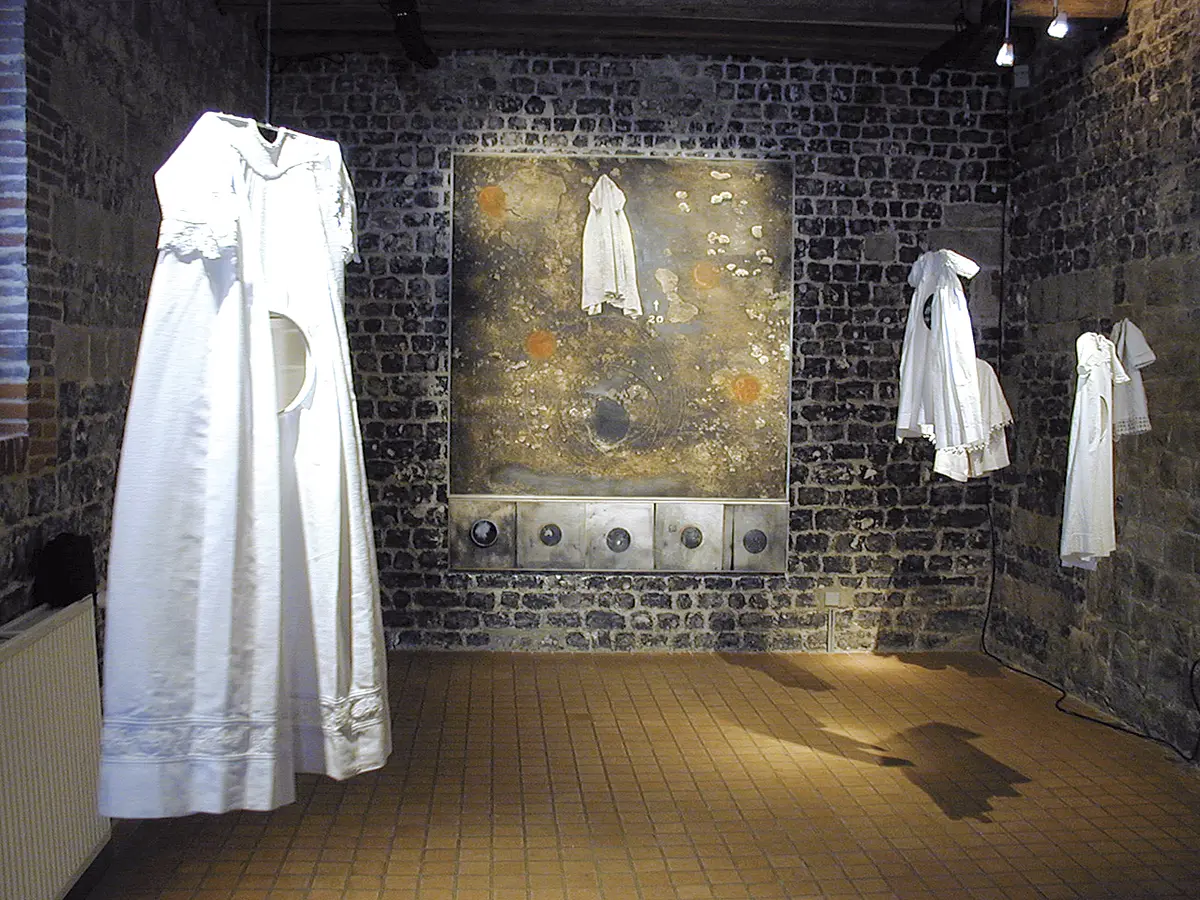
The exhibition that Morawetz titled No ser (Not to be) [in which the artist establishes a play between the French word nâitre (born) and the neologism n’étre (no ser) that has the same sonority and that expresses the negation of the verb to be, which in Spanish would translate into the wordplay of nacer (to be born) and no ser (not to be)] responds to the dialectic that the artist has maintained for a few years between the fact of combining materials and techniques (painting, engraving, drawing, and photography) with various supports —with a marked predilection for glass— and of questioning the man and his relationship with the world in that “volcanic” fusion that originates the essence of her work. Her latest exhibitions such as Materia prima (Raw Material) and Variations of the Double, showed a torn and tormented nature in which the human figure was still very much present. It seems that today, evidence transformed into transparency, and the choice, as much plastic as reflexive and conceptual, provides her with a new freedom to think out her space. The intensely physical texture, where the artist suggests more than what she says, does not search for an eruptive world in constant mutation but rather an invitation to meditation. The exhibition in Saint-Valéry at Caux, responds to this depuration process of the image as much as of the text and matter, in which the preeminence of the object inscribes the work with a new relation with time and the world. Through the clash of the ages, an intrusion of one inside the other, of co-existence or cohabitation of one history and various memories, time is questioned, deflected, re-visited, and revivified through a child’s garment.
Be it as pretext, deviation, or manipulation, the object has been the focal point of art since the beginning of the twentieth century. Mystified, allegorized, and ritualized, the object acts –through the other’s gaze that it itself induces– upon our imaginary and our unconscious and allows us to construct or deconstruct the plot of our thought. It’s been a few years since Gabriela Morawetz chose objects whose histories she would rather ignore in order to better appropriate them. The departure point for her reflection, intellectual as much as pictoric, is time. The immaculate child’s suit —chosen as the object of the plastic search and also as a symbolic vector— inserts itself in a natural way in this concept to crystallize, as a metaphor of the sensitive, presence as much as absence, being as much as not-being. Privileging everything that could be a trace or indication, Gabriela Morawetz plastically examines and declines her object in a rhythm cinematographic-like sequence. She realizes her mise-en-scene (image inside the image) through different situations, formats, and techniques, stages through which, image and non-form complement each other and respond before experimenting with the uncertainty of the space.
The plastic universe of the artist is inscribed in intense proximity to the earth-matter (blacks, browns, ochres), worked on, kneaded throughout the years, a living response to the human figure and its origins. But this last one has vanished here to give up its place to the dress, transitory and protective cover, memory of an extinct ritual. The omnipresence of a wax coat on the surface of the majority of her supports creates a distance at the same time that it mediates between the object and the observer. Its opacity neutralizes the overly imposing reality and, in this kind of restless blur that she suggests, time seems not to exist anymore.
It is within this same perspective that the artist has used, for many years, photography on her fabrics, sculptures, or drawings. The mastering of this technique, joined to an acute sense of the pictorical, allows her to form that type of “skin,” of “cosmos,” in which the principals of air, water, and earth converge. This founding trilogy dialectically constructs the nature and depth of a visual and conceptual discourse that doesn’t search, most of all for the nostalgia of childhood but rather questions, parting from the witness dress and along with it, those zones of shadow and light in which the accidents of life happen.
It is according to another recurring principle in the work of Marowetz, that of circularity, that carries out, evoked by the theatrical staging, the ritual, and the phantasmagorical round that seems to drag the objects. The discovery of dark zones on the fabric, a sort of aperture that takes in the sight, takes us to the departing point of her existential reflection, towards “those places in which energy is more concentrated.” Regarding the photography cycle, where eyes or weird faces emerge, and the mirrors, inlaid at the heart of the garments, these produce an echo, plastic as much as conceptually, to the apertures of shadows. The immaculate whiteness breaks away the heaviness of the earth and introduces a breath in that eternal cycle that is at the same time “to be born” and “not to be”.
Gabriela Morawetz has probably taken her time to give “life” to those uniformly white dresses and coats, in embroidered pique, decorated with lace, intrigued by this other world, this other childhood, these other games for dresses of an undefined gender that chance placed in her history. However, it is with much subtlety and refinement that the artist proposes to lose and find herself in that fetichized labyrinth, to better communicate to us the inevitable passing of time. For the first time, she takes part in this challenge and shows her face, even if it’s a fragmented or partially hidden face. She appears and disappears at a whim and this sudden interruption of the real allows us to understand with a higher consciousness the essence of her starting journey.
CHRISTINE FRÉROT