
On Tuesday, April 8, 2003, the inhabitants of Colonia Roma in Mexico City encountered a surprise in their everyday urban landscape: a flashy red structure that penetrated and surrounded one of the houses on the busy Álvaro Obregón street.
Héctor Zamora (Mexico D.F., 1974) intervened at the Galería Garash with a large geometric tri-dimensional body. Of variable circular cut, it entered the space through the main door and went around it in one direction through the entrance corridor, crossing through the central yard and up through the skylight where it bumped against the back wall of the lower level. The trajectory continued up to the third floor, where the structure was divided to exit through two different windows and to be able to continue its path outside the building, joining back together on the roof, and coming down the façade to connect with itself through the door to complete its cycle.
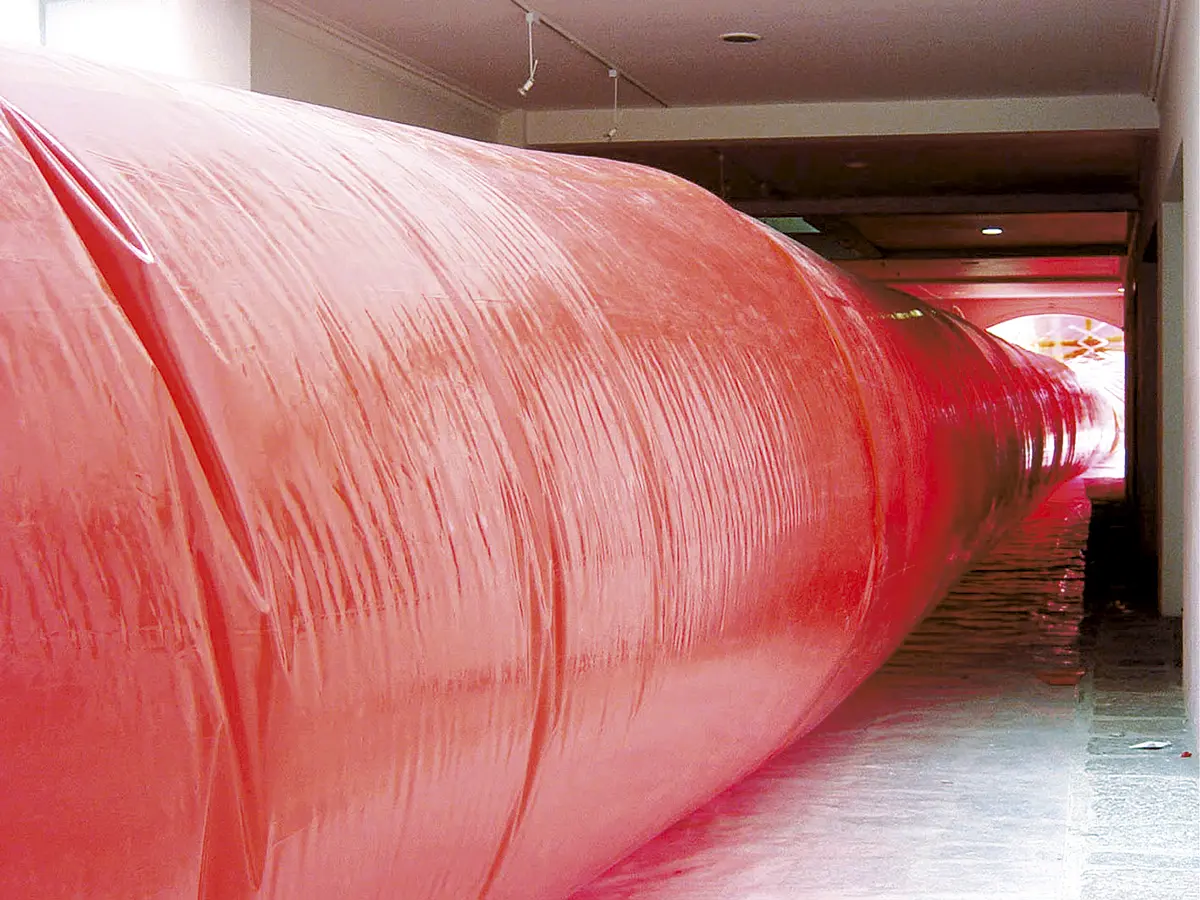
With a length of approximately 130 linear meters, 2 meters in diameter, and 270 cubic meters of contained air, Pneu invaded the building at the same time that it engulfed it in a type of embrace evident to those who transit the adjacent streets to the gallery. Upon approaching the door and entering the house, the noble and heavy movement could be observed while the sound of the fan that inflated the piece could be heard, giving the impression that the piece was alive. Its external trajectory could be followed and observed by segments when going up the stairs to the third floor of the house and through another access to the roof. However, the audience found that the internal trajectory could only be suggested when sheltered by the density and color of the surface in some way, allowing them to intuit something intimate and private.
An obsessive researcher of the process of definition, understanding, apprehending, and description of space, the artist takes nature as the axis for his experiments, in which he fuses genuine scientific and personal experience. Based on specific analysis and precise calculations, his pieces are usually directed toward the public’s sensitivity and capacity for perception. These are the results of the analytical study of organic forms in dialogue with specific architectural structures. With the economy of energy as a fundamental principal, his special interactions pursue the objective of enriching and refreshing our coexistence with the everyday environment.
The case of Pneu —this type of living being with an organic trajectory that resembles a plant that enters and climbs a building— constitutes Zamora’s first experiment with a pneumatic. When the red plastic structure is filled/fed with air, Zamora gives life not only to the pneumatic itself but also to reactivate the construction that contained it as well as the urban environment in which it was situated. In a city, more chaotic every time and drowned in the gray inertia of day-to-day [life], it is interesting to find a true act of love in the middle of the street. Pneu was not only a demonstration of affection towards the building it was surrounding but also to the large city that contains it.
Upon entering and penetrating the building, Zamora not only continued his study and reflection about urban spaces and how to make us aware of them, but he also appropriated a little corner of the metropolis. In an infinite kiss that feeds from the air contained in the penetrated structure, Pneu went beyond the gallery space to meddle with the exterior environment in which it was positioned. It is a rest for sight in the urban route.
TANIA RAGASOL VALENZUELA