
The exhibition has the feel of sterility —the aloof, cool, and lab-like precision typical of much of Manglano-Ovalle’s work. Yet it is confused and unsure of itself as if someone well-dressed and proper were drunkenly lurching down a hyper-realistically clean street. Has art become a research lab named Purgatory because experiments are beyond reason, a virus transmitted via the white noise of technological sanity? Purgatory is reportedly a place for cleansing souls bound for a heaven of minor sins; Dante called it a Commedia because it ends happily. But with no Virgil to lead me, I am forsaken. Is this intentional, or because the exhibition seems more sketched than well-conceived?
The knowing viewer will find several of Manglano-Ovalle’s concepts evident in the five works here: time and repetition; sound and duration; and references to grand cosmic cycles hidden inside the transient and the microcosm, with a whiff of the ominous, a dash of despair, and a large dose of artistic intention.
Clouds appear in three of the five pieces. Manglano-Ovalle has declared clouds one of his several metaphors for the transience of an unfettered journey; the dream of the displaced person for the promise of a postmodern world without borders. The problem is that postmodernism has been postponed indefinitely due to a train wreck somewhere up the line, as Manglano-Ovalle reveals in Cloud Painting, a small, minimally painted world of blue and wispy white clouds with the lettering: “This cloud chokes….” But the promise of postmodernism, big and shiny in the form of the detail of a large cloud, a thirty-kilometer thunderhead, is rendered here in two other works.
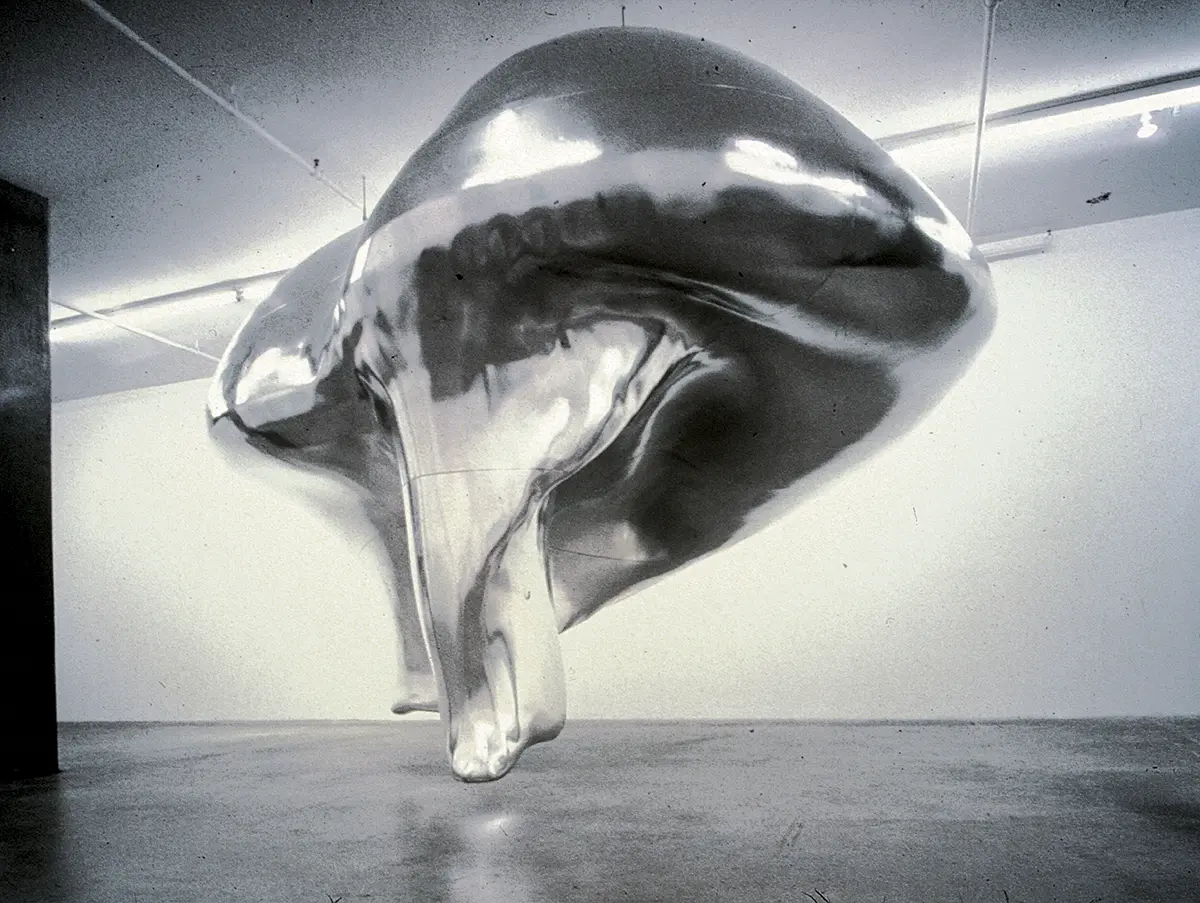
Dominating the gallery space is Cloud Prototype No. 1, the star or at least the bruiser of the show, suspended from the ceiling but stationary, its irregular contours (its “muscles” and its vapors, perhaps) wrapped in standardized, rectangular pieces of shiny silver foil, the mechanical precision of engineering applied to the blustery biomorphism of nature, a bit like the tiles of the space shuttle prior to its destruction.
To the right of this gallery space is a DVD of the work’s birth entitled Storm Hangar, a two-minute digital animation by Douglas Garofolo of a cloud detail in an enclosed hangar-like grid space. The viewer looks at the detail in slow, 360-degree rotation that uses close-ups and long shots. Viewing it is like walking around the Hindenburg parked in New Jersey before it sails out into its fate, or the bit of an iceberg just below the water’s surface that is an unseen part of the shipping lanes of life. Sound vibrations shape the ominous quality of the image as it swells and recedes; one of Manglano-Ovalle’s true strengths is creating sound spaces.
In the next partition, directly behind the cloud animation is another plasma screen, physically arranged to remind us that concepts can and do pass through mere walls: an assumption of artistic intention that is particularly problematic and demands a constant balancing act. Here in a four-minute video entitled Accelerator, the hangar motif continues in real time, as unseen individuals spin an upturned wreck of a car on the concrete floor of a large warehouse. Off to one side and randomly interjected, a boy rhythmically bounces a ball, and the viewer is left to determine the meaning. This kind of open-endedness is a constant of Manglano-Ovalle’s aesthetic.
To the left is another placard piece titled Time, which comprises a phrase painted in Sanskrit, from the Bhagavad-Gita, the Hindu holy text of the epic struggle that made the Hindu gods manifest in human form. It is here to remind us of another of the artist’s themes —time on an epic scale. The selected text reads: “I am time, destroyer of worlds.” The exhibition label explains that it corrects Robert Oppenheimer, the American physicist who oversaw the Manhattan Project and the U.S. development of the atomic bomb, who misquoted the Gita (“Now, I become death”), but who nevertheless cast nuclear annihilation in appropriately epic terms. The artist steps into the lab coat of the scientist to become a cataclysmic soothsayer, whose orbits are both precisely calculated and lurch drunkenly, like bombs over Baghdad.
Manglano-Ovalle didn’t get this exhibition quite right. It is not fine-tuned: artistic intention is dispersed and unfocused, despite the delightful continued deployment of his themes, and the open-mindedness provided to his viewers. The dispersal property of clouds —or artistic intention— is not an excuse, but rather a vague promise to those of us whose molecules are more tightly bound and rendered in real time. He will get it right, the Commedia that is. Remember that the Divine part was a graffito added several hundred years after the death of an author who lived in exile and dreamed.
RICHARD LESLIE