
The Maison de l’Amérique Latine has unveiled in recent months a new artistic strategy, bringing in significant artists from the generation immediately following that of Matta, Lam, and Tamayo. Yesterday with Fernando de Szyszlo, today with Jorge Camacho and Gina Pellón, next September with an important cycle on the history of modern Latin American art and its links to French surrealism. We should not forget that important chapters in the history of Latin American art were written in Paris, before and after WWII. This sequence of exhibitions, plus those by Antonio Seguí and Herman Braun-Vega held in recent years, will bring back to the French capital some of that old aura that drove so many artists, after peace had been restablished in the continent, to settle here instead of in New York, where triumphant abstract expressionism was becoming dictatorial.
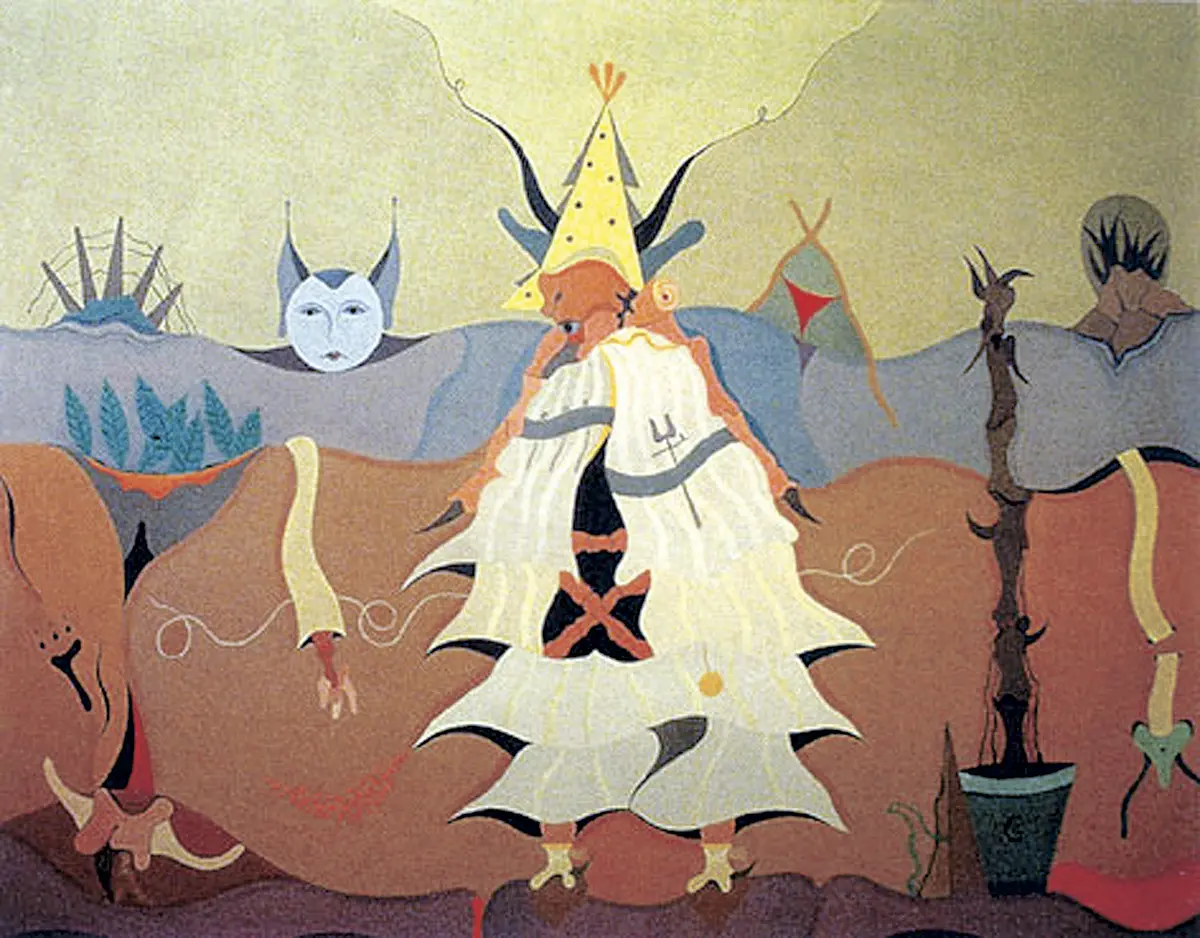
A painter like Camacho must feel deeply nostalgic at a time when an emblematic public auction held at the hôtel Drouot generates such vivid debate: the sale of an eclectic collection of paintings, art objects, popular art items, primitive art pieces, and other curiosities put together, with characteristic ingenuity and imaginative power, by André Breton. The collection was inherited by Aube and Elisa, Breton’s daughter and wife, respectively, and the French government was unable to preserve it. In this way, and despite its great significance in the history of art, the collection will be dispersed throughout the world, losing its spiritual and temporal coherence. It was precisely Breton, a free-spirited collector of objects and words, poet, and inventor of ideas, who facilitated Camacho’s integration into the Surrealist group after they had met in 1961; Camacho was to take part in Surrealist exhibitions until 1970.
The show at the Maison de l’Amérique Latine is almost a mini-retrospective, with nearly 40 large –and medium–format paintings as well as works on paper (inks and pastels) of excellent quality, covering almost four decades, from the 1960s to the 1990s. A quick tour through the two floors of galleries could provoke two opposing feelings: on the one hand, a feeling of closeness and warmth thanks to the sumptuosity of the drawings and their refined polychromy in muted tones; on the other hand, a feeling of contained explosion and implosion giving structure to a skillful weaving of forms and lines. Camacho’s polyfacetic personality (traveler sensitive to deserts, writer, expert in alchemy and heraldry, photographer, editor, collector, and translator of Stéphane Mallarmé, Arthur Rimbaud, Verlaine, and Magloire-Saint-Aude) allowed him to make quick friends with poets and writers such as Henri Michaux Joyce Mansour and, later, Reynaldo Arenas, whom Camacho met in Cuba. After taking part in the May Salon organized in Havana in 1967 by Wifredo Lam and Carlos Franqui, and after a long stay on the island, The artist denounced publicly the dictatorial, police-state character of the Cuban regime. That same year, Camacho broke with Cuba.
Camacho’s polysemic vocabulary remains alert to an insatiable curiosity, the same curiosity that made him into a fully surrealist artist, navigating the surfaces of a furious, menacing inner sea or sliding sensually on unending sands that will not be disturbed by any animal form, by fire, by any aggressive plant. Multiple traditions intermix in his mysterious paintings, from disincarnations of Matta’s Grands transparents (1942) to horror-inducing jungles of Lama’s last decade; from certain monsters that also attracted, in the 1930s, Dalí, Ernst, and Miró, to Yves Tanguy’s somber and disquieting landscapes of the 1920s. But these references are only signposts, partial and incomplete, to guide us into the mysteries of a body of work with a strong symbolic content.
This “mirror of mirages” guides our inner gaze towards a universe of images that are both mental and realistic, a telluric, organic, raw universe. At times they seem to amount to anamorphoses where aggressive figures overlap and intertwine, figures whose dramatism is accentuated by a very precise “sharpened graphism.” Despite the velvety gray-blue tones, the soft parts, ochres, almond green, and softened pinks, Camacho’s art is devoid of tenderness. It speaks of torture, of exile, and it shows recurring warlike images of shields, totems, ossuaries, spears, and whips, with the presence of more or less threatening animals. If an alligator or a crocodile appears next to a fish to indicate the tropicalism of a distant island, the snail appears as the transposed symbol of exile, carrying with him everything he possesses. Fire, omnipresent in Camacho’s work, has multiple functions: it gives warmth but it also destroys, illuminates, and devours, and it refers to life as much as it does to suffering and death.
Camacho’s paintings are landscapes. But they are landscapes set as a theater stage on which, through metaphors, magic or cabalistic acts unfold. La huaca grande (1987) shows a rather architectural landscape clearly differentiated from more mineral constructions where the vestiges of other times lay. In El desierto (1982), Camacho’s figuration is more explicit; here the jackal and the bird of prey are menacing, but they are after the carrion that lays on the ground.
The oldest works in the show, dating from the 1960s, such as Personaje humillado (1960), help us understand Camacho’s development and take us back to a reconstruction of his progressive synthesis of the image, the narrowing of the drawing, the controlled densification of color. Le bon petit diable (1963) and Le crâne de nuit (1964) —two works on loan from the Thessa Herol gallery (Paris), where the artist is simultaneously showing paintings and pastels of floral variations, under the title Le livre des fleurs— exemplify the way in which Camacho was still working with fine, almost faded and translucent layers, while drawing starts timidly to take its place. But it is especially in his beautiful China inks on cardboard where we can fully appreciate Camacho’s exceptional draftsmanship. The freedom of metamorphosis, magical trajectory, controlled chance, and surprises between tenderness and violence in his images. The same impression emerges from his five beautiful pastel-on-paper works of 1994, 1996, 1997, and 1998, where a single look is enough to peel away the many skins that cover and build the image.
Three emblematic canvases whose titles refer to death, madness, and metamorphosis, Danse de la mort (1976), Le fou (1971), and La métamorphose, open to the “meat of silence,” as Cuban author Zoé Valdés writes in her introduction to the catalog, the doors of a night on which all dreams are permissible. Our anxious loneliness dissipates for the benefit of a delirium where the real and the magical become one, in a shamanistic ruckus echoing frantically in the distance.
CHRISTINE FRÉROT