
There have recently been a number of group exhibitions about painting in the U.S. and Europe that can be referred to off-handedly as the “return of the return to painting.” Although this is akin to Nietzsche’s “eternal recurrence” and is possibly no less apocalyptic, these exhibitions inadvertently responded to the “death of painting” polemic espoused in the 1980s by ideologically-vested North American critics. The critics who sounded this death knell during what has been termed in the U.S. the “Reagan era” rode the wake of other theory-based fatalities from both the political right and left, including the “end of history” and the “death of the author.” Shifting away from the nihilism and totalization of “painting’s death,” these exhibitions operated in ostensibly engaging curatorial frameworks. With titles such as Painting: Division and Displacement (2001), Painting at the Edge of the World (2001), and Trouble Spot Painting (2000), for example, the exhibitions sought to rethink the medium's more focused agendas. Some, like Painting as Paradox (2002), were more general in curatorial scope and looked at painting through its reaction to, and influence by, what has been fashionably called new media. Digitization, computer imaging, the web, and video to name just a few examples, were the formal and conceptual points of thematic departure for that exhibition.
Urgent Painting (2002) similarly focused on the convergence of painting and new media. Its curatorial impetus reflects the theme of “Painting as Paradox” and according to the press release, explicates the “urgent need to…return to an art form threatened with eclipse by the omnipresent new media… rediscover that other time frame inherently specific to painting, in an age marked by the rapid acceleration of the communication and production processes [and] reassert painting’s tangibility in an age marked by the proliferation of the virtual.” The curatorial premise that cutting edge image-producing technologies may “eclipse” painting is, however, a thesis which had already been attended to in a different guise in the nineteenth century. Discussion of painting’s reaction to new media parallels what it had confronted after the invention of photography circa 1839. In fact, the political stakes were much higher with the painting/photography discourse; epistemological lines were drawn on one hand, between photography’s claims to “truth” and “objectivity” based on its mimetic capability to reproduce the world like no other medium before it. The only problem with this assessment that became exceedingly clear to just about everyone but the most retentive of positivists was that painting was not only about mimesis but also about the artist’s subjective vision of the world as translated onto canvas. On the other hand, painting’s historic shift from the hegemony of Renaissance illusionism, as exemplified in Manet’s emphasis on a flatness that foregrounded painting’s two-dimensionality was, for the formalist critic Clement Greenberg, a vital break with the old order giving way to the beginnings of modernist painting.
If one looks closely at the recent debates about painting, one can see a myriad of responses to them by a wide range of painters, both abstract and representational. Artists not only grappled with the medium within the context of Walter Benjamin’s famous essay The Work of Art in the Age of Mechanical Reproduction, but also between the era that first signaled painting’s supposed “demise” in the 1980s, and its “re-emergence” as evinced in recent exhibitions, art fairs, and lecture halls, as well in painting-oriented tomes such as Vitamin P (2002). Jorge Tacla is an artist at the center of these discussions, who has responded to all their hydra-like manifestations with aplomb.
By the time Tacla appeared on the international art scene in the early 1980s, he was well-engaged with issues around painting. Tacla was born in Chile in 1958 and moved to New York City in 1981, a pivotal year that saw the publication in Artforum of Thomas Lawson’s “Last Exit Painting.” Published that same year in October were Benjamin Buchloh’s “Figures of Authority, Ciphers of Regression,” and Douglas Crimp’s “The End of Painting.” Lawson’s essay convincingly argued that one should not abandon painting, but engage it intelligently with the intention of cultivating it as a critical practice. Painting’s historical trajectory from mimesis that culminated with ontological disintegration in pure abstraction linked it to its purported demise. For the teleology of painting was not only construed as the art historical counterpart to the totalizing narratives under attack in other intellectual arenas, such as philosophy, history, and literary studies, but the nomenclature of the post-modern inevitably engendered other notions of rupture from the past that, by default, were associated with painting and the specificity of its practice: post-studio, post-medium, post-disciplinary. It also didn’t help that in the midst of the post-modern turn, certain painting styles of the 1980s such as Neo-Expressionism and the Italian Transvanguard were exhuming archaic artistic forms, including nationalist imagery. Buchloh had rightly argued that the historical appearance of nationalist iconography was generally coupled with shifts to the political right in the broader cultural and political landscape; yet there were artists who were heeding Lawson’s call-to-arms about painting’s critical potential, and one of these was Tacla.
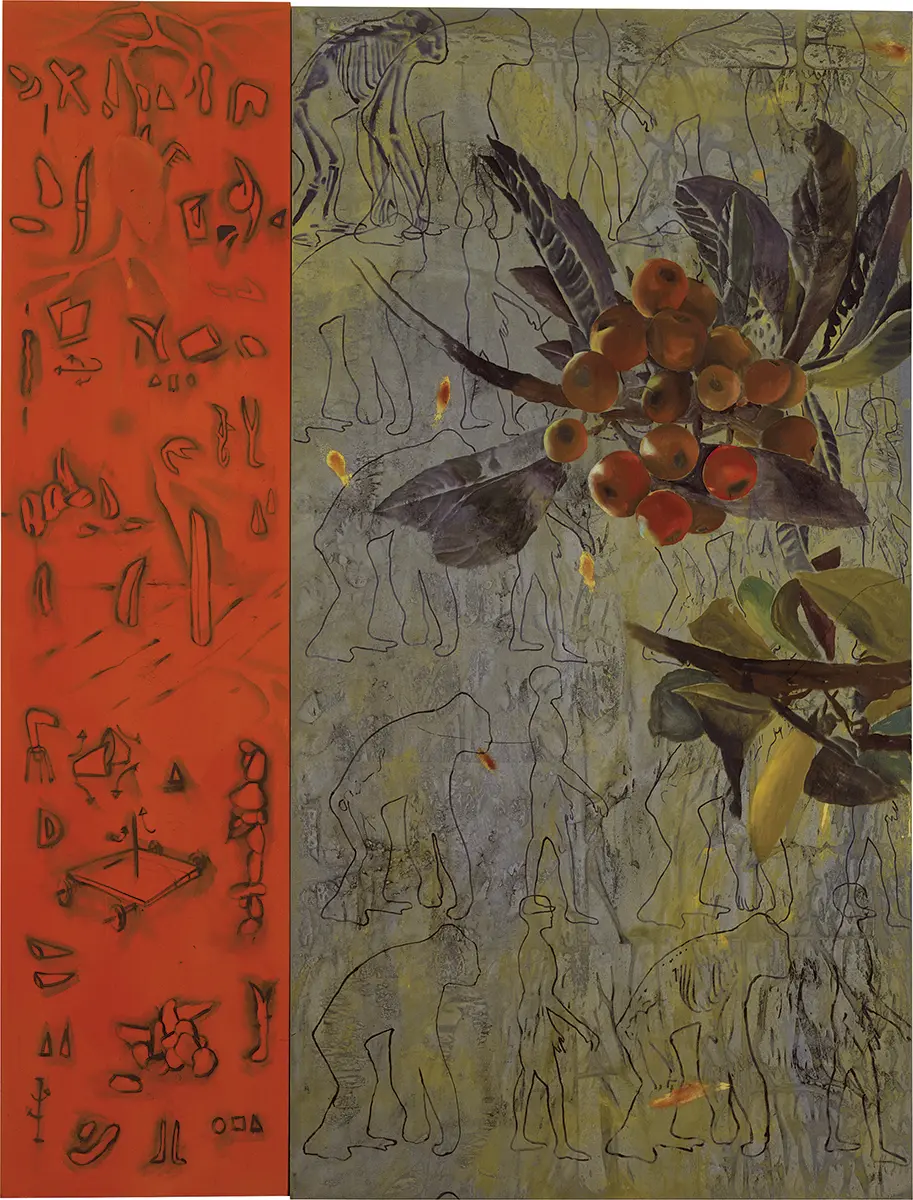
Tacla’s first paintings made in New York are an amalgamation of sources that plundered a historical and global image bank without erasing their own fluctuating locality, be it Santiago or New York City. The manifold trajectory of his artistic excursions elided the trappings of the “death of painting” rhetoric, exposing it as the possible equivalent of art historical, millennial hysteria. Although Tacla was already exploring a multiplicity of formal and conceptual avenues under the rubric of painting before his arrival in the U.S., these early investigations hinted at what would become his aesthetic and thematic trademarks: architectonic paintings infused with topographic phantasmagoria and landscape transmogrifications that are polysemous and driven by a critical impulse and philosophical engagement. The critical nature of Tacla’s work stemmed from coming of age during the Pinochet dictatorship, and it is this experiential context that helped cultivate and constitute his artistic discourse. Wrong Memory (1989), painted two years after the Wall Street crash called “Black Monday,” at the end of a decade of excess manifests this all too well.
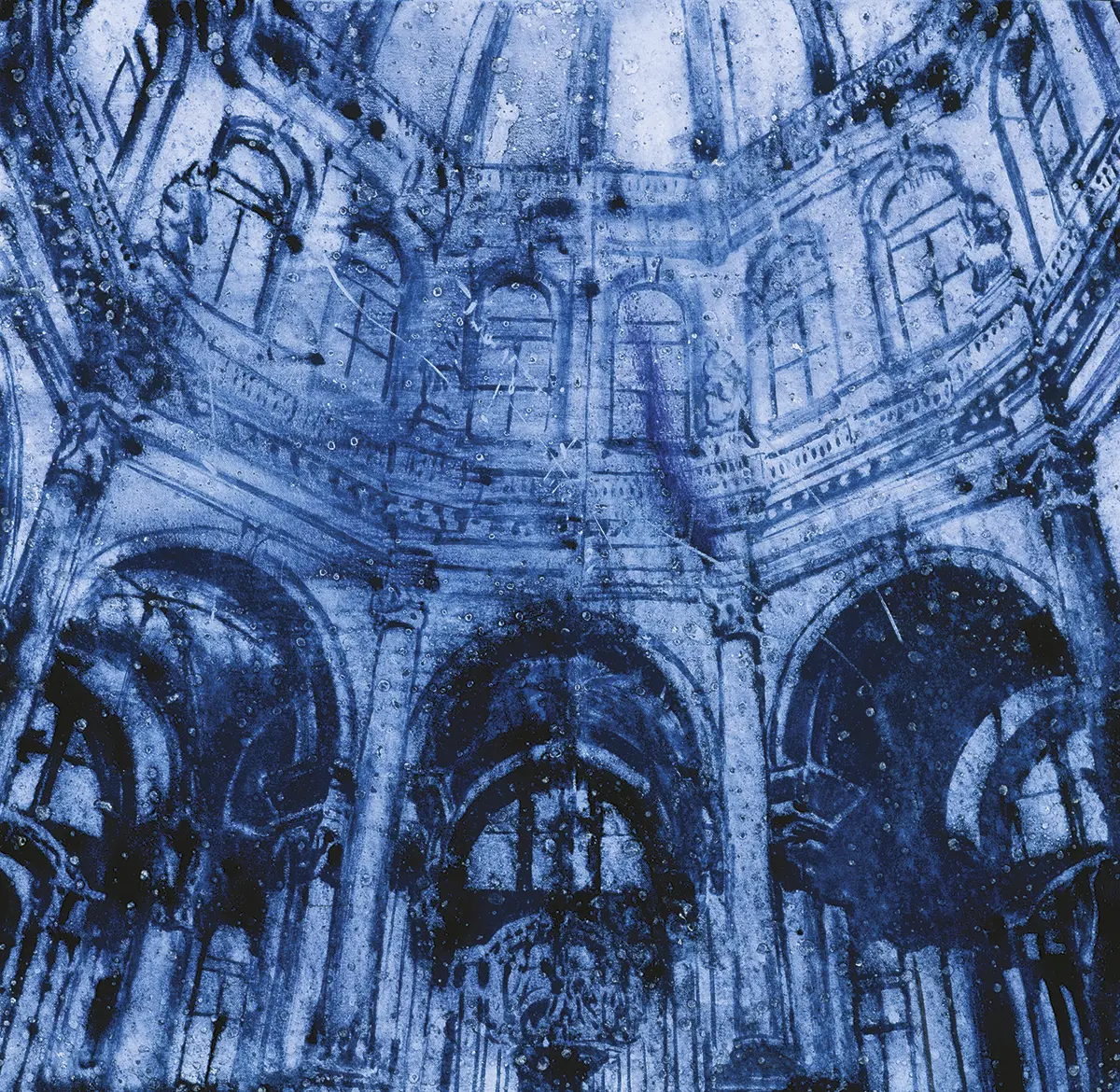
Wrong Memory is configured in a quasi-diptych fashion and mines an array of iconographic sources that underscore a semiotic understanding of the image. In the top panel is an orange background with silhouettes of stencil-like imagery; this is in counterpoint with the bottom panel filled with an array of simian figures commingling with human beings. The dialogue between the upper and lower registers is offset by the prominent still-life in the foreground. Taking our interpretive cues from the etymology of the still-life, that is to say, its original appellation of nature mort or “dead nature,” it is interesting to see how the memento mori quality of Tacla’s later work is already in place in this picture. One can also see his manipulation of formal and conceptual dichotomies. The simian figures that formally interact with humans allude to old treatises on natural evolution and the modernist utopia of progress. Compounding this narrative thread is the realism of the still-life arrangement that is vertically composed, in contrast to the amorphous figures in the background scattered in horizontal disarray. The tension between form and content, and figure and ground is also evident in Tacla’s recent paintings of architectural interiors and facades. Here, presence collides with absence, abstraction with representation, inside with outside, and an emphasis on negative space morphs into its other in a Möbius-strip effect of formal, pictorial energy. These couplings are also evident in such works as Liquor Store (1998), Santa Maria del Giglio (2001), and Camuflaje (2002).
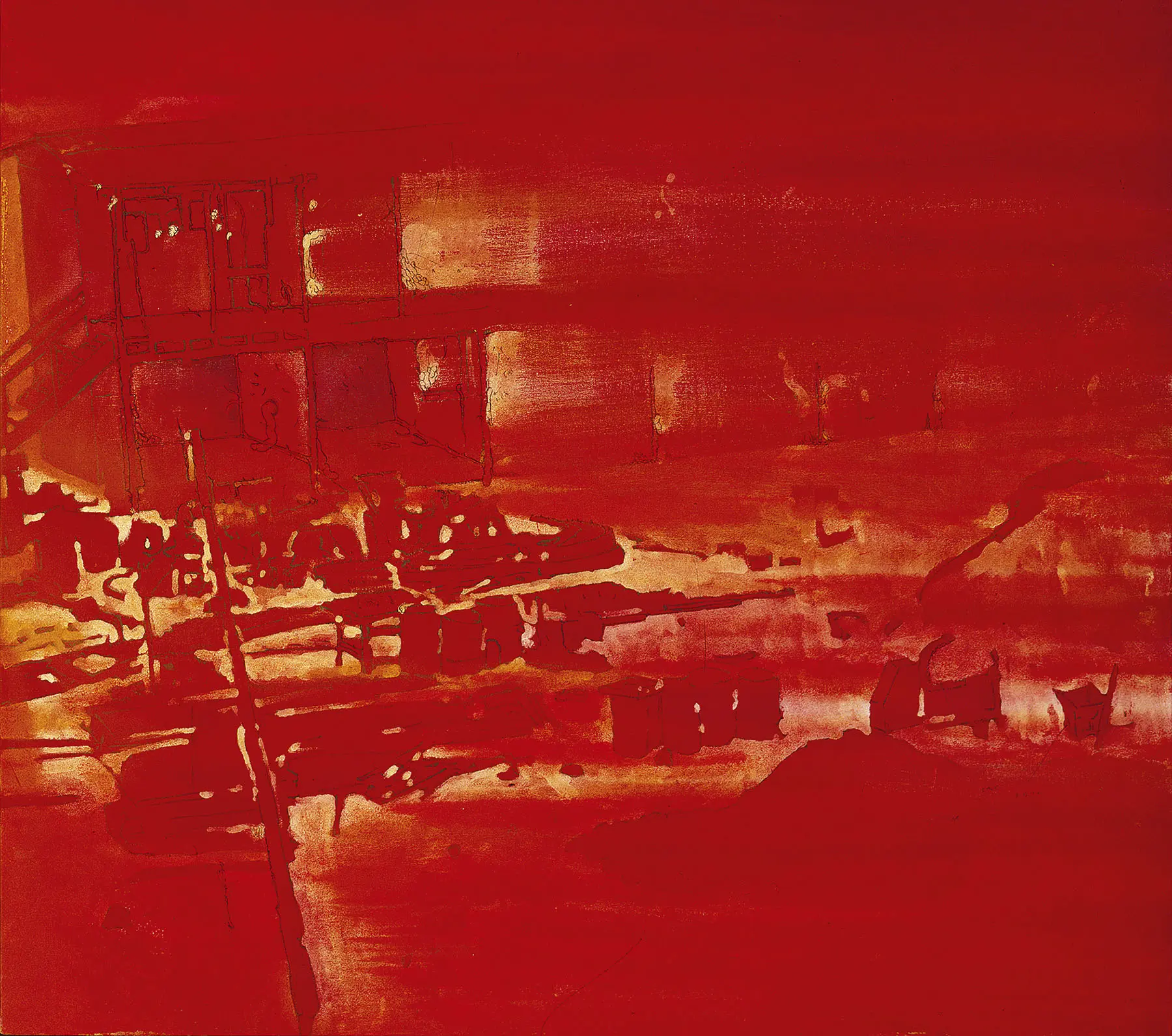
Liquor Store’s seemingly banal subject matter is situated somewhere between pure abstraction and hallucinatory representation. Like other artists who sought to taint modern formalist purity with the world beyond the frame and the pedestal, Tacla interjects the social into his abstractions, forcing us to think of form and materiality along different lines. Tacla’s insistence on the impurity of the medium was a move against pure abstraction’s pretense of universality via the erasure of any recognizable referent in the work of art. Thus in one sense, Tacla is very much a formalist, although one cannot mistake his formalism for the transcendent, meta-discursive variety that seeks to sever form from the world of which it is a part. One can find in Tacla a myriad of artistic strategies that are in sync with a certain type of critical aesthetic operation: the Russian formalists and the Prague Circle structuralists, for example, argued that the social is already inscribed in materiality, regardless of whether its initial attraction is aesthetic in nature and used solely for artistic ends.
Rubber, for instance, is used by some artists because of its malleable property. Think of certain Rachel Whiteread sculptures or those of Eva Hesse. Even Robert Morris’s use of rubber is a response to what the feminist art historian Anna Chave called Minimalism’s “rhetoric of power;” thus rubber’s formal qualities can signify the antithesis of masculinity. In the work of other artists, rubber can also refer to pre-Hispanic cultures, an inscription in matter as telling as any other sign. In short, rubber, as the material can be construed strictly as a formal element chosen for its aesthetic qualities, or these same qualities, can be framed as already being imbued with social meaning. Formalist analysis is thus heterodoxical; one strand among many is the critical maneuver that situates form within a social network; another is metaphysical in nature, and propagates the notion that form exists somewhere beyond the realm of human endeavors. An anecdote by Jan Mukarovsky, the leader of the Prague Circle structuralists, may be of help here. In a book titled Theory of Prose, its author uses the textile industry as an analogy for his literary theory and states he is more interested in the types of yarn and its weaving. Mukarovsky replies to this by stating the techniques of weaving reflect the needs and pressures of the market and the law of supply and demand. While this is strictly a Marxist reading of form, it is apt to convey that materiality is woven with signification. The same thing could be said of other materials such as marble, a medium traditionally associated with the fine arts. It too has meaning at the level of materiality by virtue of its historical emergence. Tacla has, in fact, used marble powder in his paintings. One could argue that Tacla’s decision to use marble powder is strictly a formal decision concerning a particular question about painting that can only be resolved with this material; for Tacla, however, there is an additional narrative element in materiality that he manipulates as both signifier and signified.
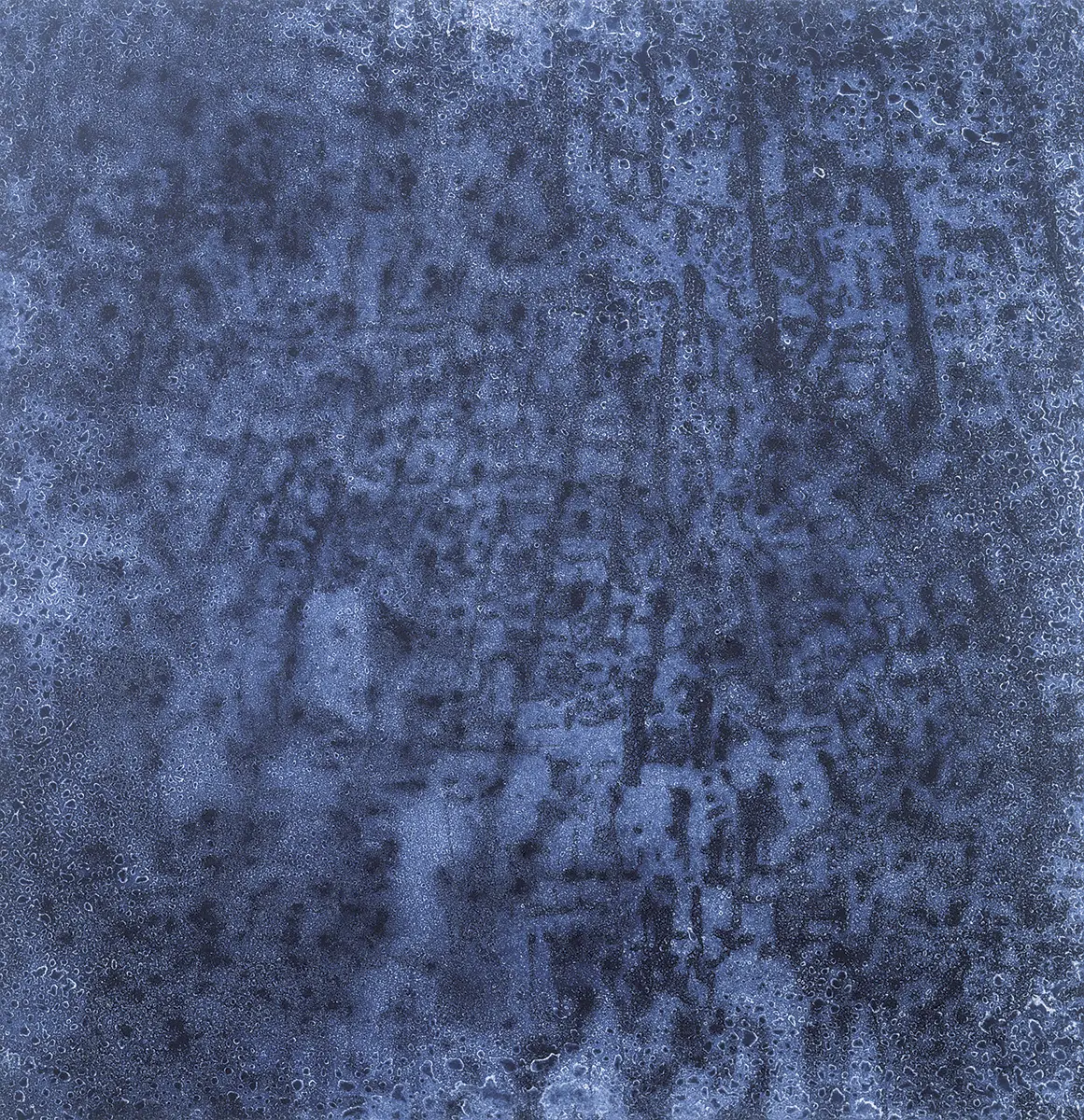
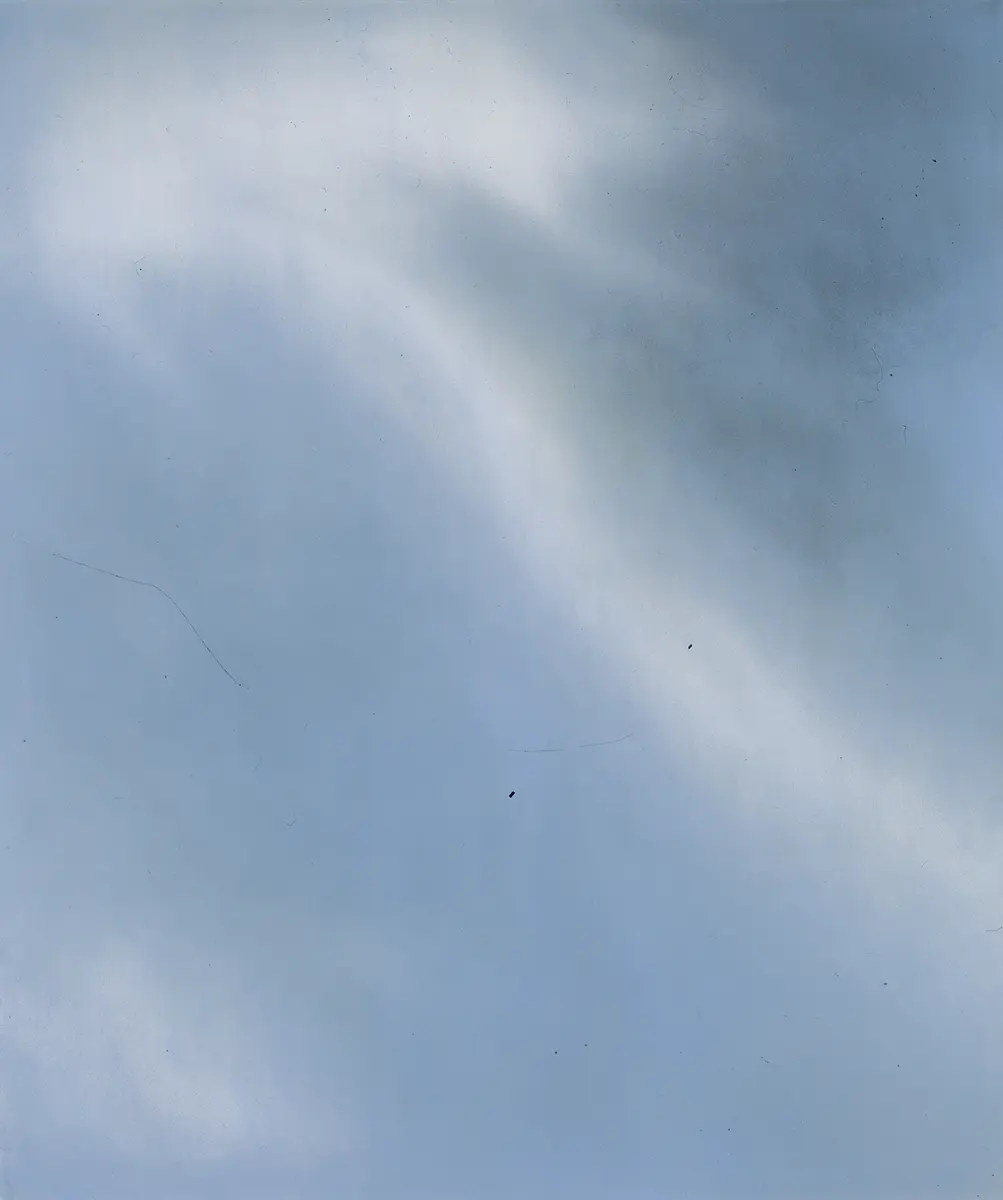
Tacla’s formalism derives from a critical notion that materiality is pregnant with meaning. Although he uses pigments in tandem with composition as vehicles for his iconography, he is also interested in form’s narrative capacity. In Mass of Vapor #2 (2002), a work that depicts an ethereal body of gas, it is difficult to tell where form ends and content begins; or, for that matter, where representation dissolves and pure abstraction emerges. As a material that pictures something almost imperceptible to the human eye that can be detected more by the sense of touch or smell, paint as a formal property serves well what it represents. The work has a fleeting quality that poetically encapsulates vapor, a substance that can only be represented through abstraction. Tacla offers us a profound philosophical conundrum in this work, for the concomitant erosion of representation and pure abstraction is analogous to the polarity of being and nothingness. We are thus confronted with life and death. The paradox of this work, which is a testament to Tacla’s artistic intelligence, is that it philosophically teeters between a myriad of existential dilemmas articulated through dichotomies. Yet the vapor can also convey what the artist states is a mass of toxic gas; a gas that no matter how beautiful could also be a grotesque harbinger of death. Tacla’s collapsing of materiality into narrative, exquisitely evinced in Mass of Vapor #2, also subverts the antecedents of this sort of painterly effect; that is to say, Color Field.
Tacla’s citing of Color Field as a historical style could be misconstrued as a parallel to Buchloh’s observation of Neo-Expressionism’s unabashed recycling of imagery as reactionary. Tacla, however, avoids this by rerouting the “return to painting” dictum into a snake biting its own tail. For painting, in one sense, has never left those who engage it as a critical artistic praxis, unlike those who succumb to trend-driven cycles that give the appearance of painting’s ebb and flow, of its departure and return, of an apocalyptic “eternal recurrence.” This is also true concerning painting’s possible “eclipse” in the face of new media. There have been painters who have met the challenge of new media without being lured by the spectacle that produces technophilia; artists who, ironically, achieved this in ways that idiosyncratically mine the past: Gerhard Richter and his figurative paintings that resemble blurred photographs; David Reed and his pictorial insertions into the films of Alfred Hitchcock; and Miguel Ángel Ríos’s recent “digital paintings” that are an extension of his multi-channel DVD projections. Tacla also pilfers from the past to comment on contemporary visual culture.
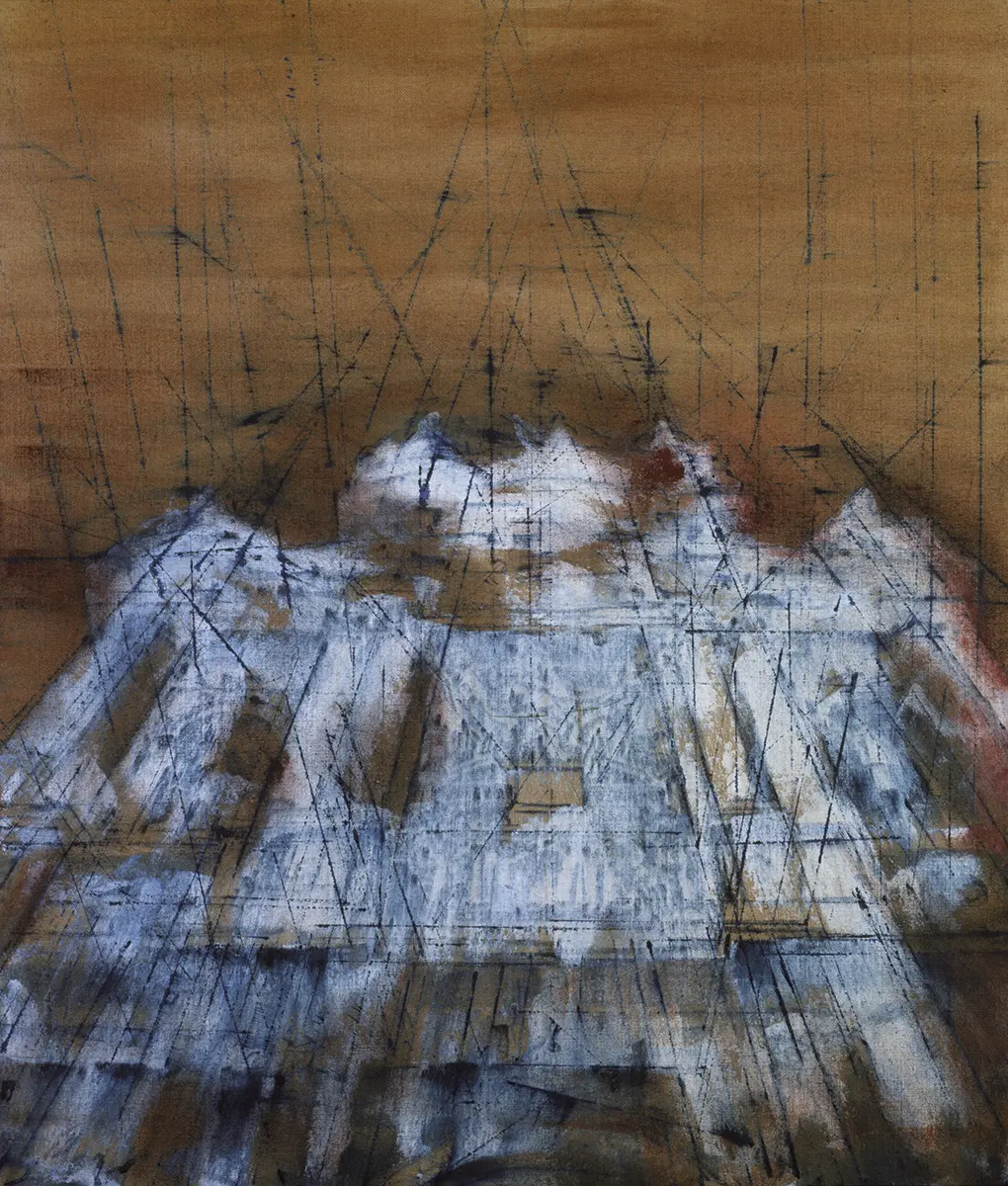
In his Santa Maria de Giglio, the radical foreshortening of the church’s facade is in direct confrontation with the abstracted flourishes that appear flat on the picture plane. This creates a tension between the traditions of the Renaissance perspective and high modernism’s penchant for flatness. The graphing of one historical paradigm onto another exemplifies how Tacla’s artistic foci are not only concerned with issues around painting per se but that he addresses new media and painting as a question of the historicity of vision and visual presentation. This seems to be the case with his recent Mass of Cement series. These works depict aerial views of Manhattan, some of which were created after the tragic events of 9/11. Like Tacla’s paintings in general, one can approach them in a variety of ways. Some of the paintings are based on a 1933 photograph of Manhattan, offering altogether different contexts in which to read them. Taken together, the paintings allude to a variety of formal sources including the panorama, landscape traditions, cartography, architectural representation, and blueprints.
Like the above-mentioned painters who have responded to the problem of vision and visual presentation in eclectic ways, Tacla also addresses this, but through the lens of the observer and the social reverberations between the observer, what is being observed, and the screen between them. The screen is constituted of an array of visual technologies including new media. In his paintings, Tacla shows us that the only way to approach the old/new media debate is with a qualification transposed from the observation that the philosopher Gilles Deleuze had about machines: “machines are social before they are technological.” It is at this level of critical discourse fused with visual poetics and a high sense of the aesthetic, that Tacla’s work is differentiated from painters who were targeted in the “death of painting” polemic. Jorge Tacla reminds us of what the critic Yve-Alain Bois asks in Painting as Model (1993), “What does it mean for a painter to think?” It is this sort of question that Tacla has always asked of himself and of his painting and one that confronts the viewer of his work as well.
* All images illustrating this article are courtesy of Galeria Ramis Barquet.
RAÚL ZAMUDIO
New York-based art historian, critic, and independent curator. Curatorial director at the White Box, New York, 2003-2004. Doctoral candidate in Art History at the C.U.N.Y. Graduate Center.