
In these pluralist times in which subjects of moral interest are not exclusively human, it is a delicate task to make art about bullfighting without raising some eyebrows. Nevertheless, this most Spanish ritual of the cape and the sword has an impressive history of celebrated admirers, from Pablo Picasso, Federico García Lorca, and Ernest Hemingway to filmmakers like Francesco Rosi and Pedro Almodóvar. The painter Fernando Botero has produced works about bullfighting in his well-known adipose style, as well as photographer Javier Silva, in a documentary mode that is almost poetic. More recently, photographer Ruvén Afanador has produced works with unabashed eroticism. Only José Gabriel Fernández has treated bullfighting with a degree of abstraction.
Prima facie abstraction would not seem to be an appropriate strategy for representing such a passionate, sensuous, and brutal activity. Fernández himself has not always used it. But if there is something in the ritual of bullfighting that has led many to call it an “art” it must be the plasticity of the costumes, the beauty and precision of its movements, and its emphasis on performance. Indeed, in his recent exhibit at Sicardi Gallery in Houston, Fernández has focused on the bullfighting cape and its movements.
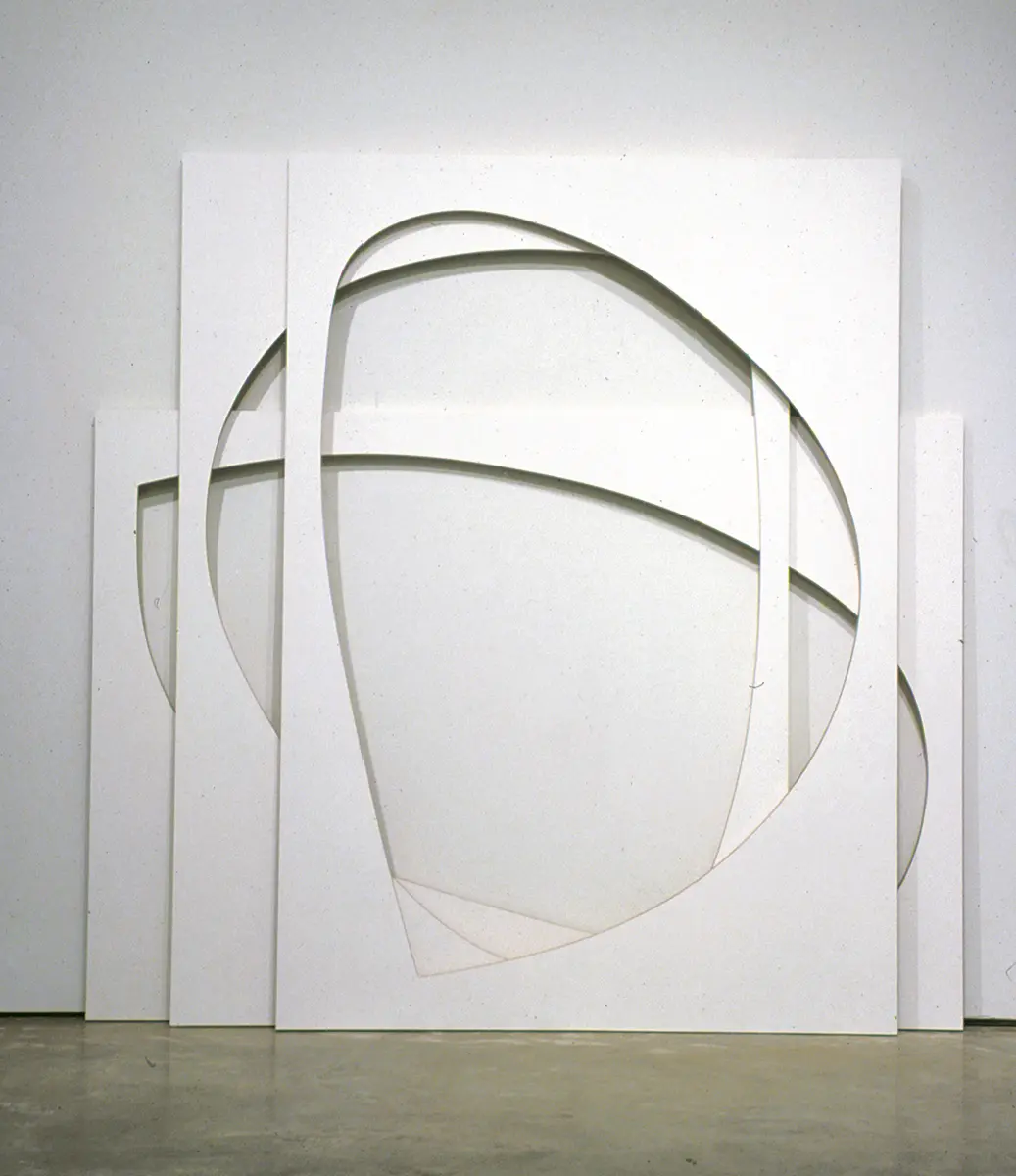
Fernández’s works freeze the figures of the cape —verónica, molinete, chicuelina, and others— using two strategies. Mariposa, 2002 and Chicuelina, 2002 are two sculptural works that exemplify the first strategy. However, the gravity and volume of traditional sculpture are not advantageous for representing what is the lightest and most airborne element of bullfighting. Fernández’s second strategy offers a better solution to this challenge. Revolera, 2003 and Molinete, 2003 consist of four or five sheets of one-inch-thick plywood seventy-two inches high by sixty-eight inches wide, coated by a thin layer of gesso. A shape cut inside the first sheet vaguely suggests an isolated moment in the movement of a particular figure of the cape. The next sheet has a slightly different cut, as does the third, fourth, and fifth sheets. All five rest on the floor and a wall, one on top of the other, and give the impression of consecutive frames on a film strip.
Fernández turns to vapor what is solid, and makes solid what is vaporous. The wood represents the air suspending the cape as it flows across space; whereas the empty spaces of the cut-outs draw the fabric of the airborne cape. Nothing is lighter or more abstract than emptiness. These works give rise to a paradox: the very visual and sensuous aspect of bullfighting is portrayed by the nothingness of empty space, while their exquisite white beauty hides death behind the cape.
FERNANDO CASTRO