
Validity is a key word for the work of art —this also applies to politics, fashion, and almost all subjects that make up life, because life itself is validity, continuity, and an alert presence. People in the city recognize José Luis and are as interested as they are in movie stars or famous musicians. José Luis knew how to manipulate this unusual situation, at the same time that he executed and still executes works of art filled with intrinsic value, that support themselves with quality and validity. The inauguration of José Luis Cuevas. Obra Gráfica 1962-2002 (José Luis Cuevas. Graphic Work 1962-2002), at the Ramón Alva De La Canal University Gallery, in the city of Xalapa, State of Veracruz, summoned the usual spectacle that the artist and master provoke.
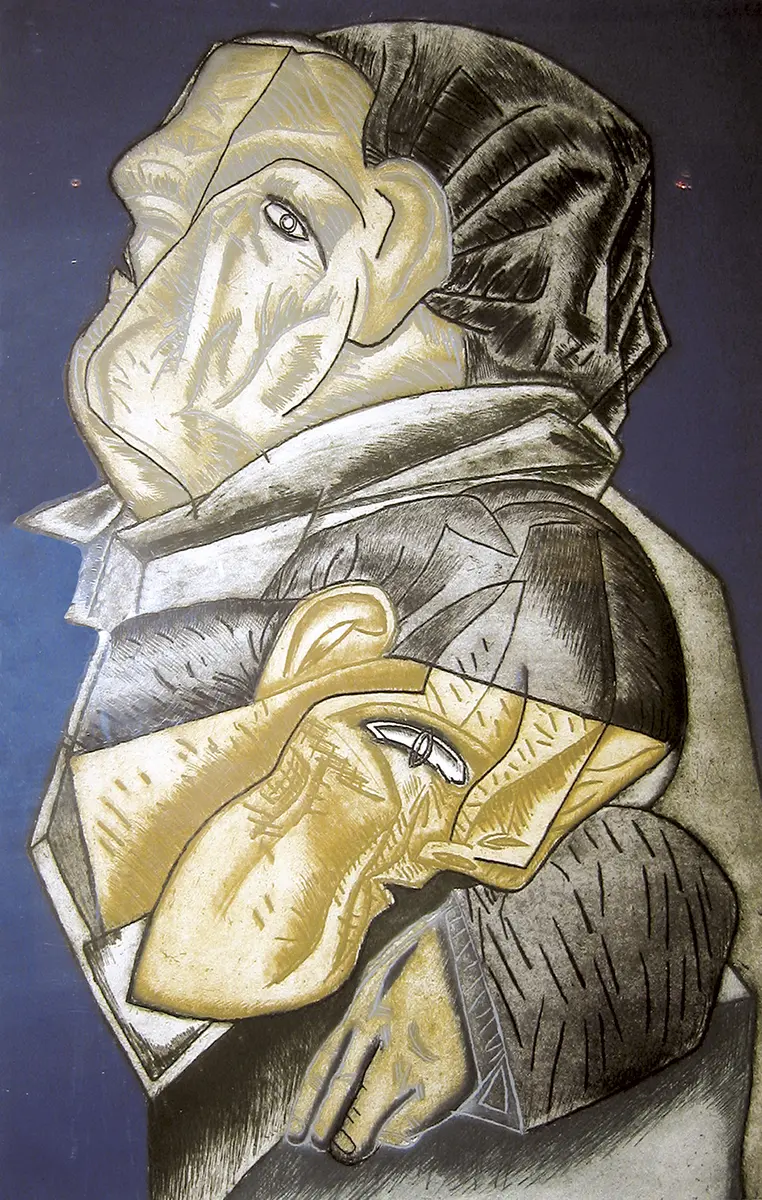
In Xalapa there is a beautiful university campus of complex urban planning, situated in a State of Pre-Columbian cultural magnificence in which a young population boils, interested in breathing creative activities. For this reason, the presence of José Luis –the ever-young one with the leather jacket —(chamarra de piel, as they call it in Mexico), the enfant terrible of Mexican and Latin American art of the '60s— caused a commotion in that university space where local personalities assisted, headed by the own Headmaster of the Universidad Veracruzana. The presence of “the star artist” Cuevas was a parallel attraction next to the seventy-four pieces that could be appreciated in the rooms of the lower and higher levels of the gallery. Graphic work done in a span of forty years (between 1962 and 2002), in different workshops, with a variety of techniques and printing methods, in different countries, with different supports, intentions, times, emotional situations, and diversity of demands… and there isn’t even one piece that indicates any variation in quality, they are all solid works technically as well as creatively.
Some of the isolated pieces and some of the series done by the artist are renowned either for their tragic intensity or because of their revision of art historical and literary subjects. From the series Cuevas Charenton, Visiones del Marqués de Sade (Visions of the Marquis de Sade) is a 1965 lithography to which the master frequently refers to because it is a subject that troubles him. In versions I and II of El Tambor (The Drum) the author manifests the richness of the serigraphic process by using a medium that allows him to experiment, and once the initial process is completed, he then elaborates with different solutions through the incorporation or alteration of color. Tira cómica (Comic strip), 2002, is a color serigraphy uncommon in the whole of the artists’ work. Cuevas exercises his lasting admiration for cartoons on tragic subjects and social inequalities. In Tira Cómica (Comic strip) he seems to be closer to film and representation —which he has always exercised from the point of view of the character looking at the audience, and from his own point of view as the subject of incredible and imaginative situations. In 5 horizontal overlaid registers, Cuevas develops his characters in various colors, in small formats grouped like peculiar comic strips, covered by yellow arches. We can say that Cuevas, as an exception, has forsaken all of the problems of his life, that have engulfed him from childhood, in order to allow himself another language. There are deformities, but only with the projection of shadows, of the Movement, and the self-portrait. Greens, reds, oranges, light blues, pinks, grays, undulating lines, and colors– it is a body of work that makes us smile.
Coincidentally, at the Drawing Center in New York, part of the collection of drawings from the Tate Gallery in London has been exhibited. The selection was made by the British artist Avis Newman and curated by Catharine de Zegher, Director of the Drawing Center. The geographical jump in this note is motivated by coincidences and differences between the values developed by an adolescent Cuevas that started in the seventies and by some of the concepts expressed by Avis and Catharine when they worked on the actual project for New York. The recognition of drawing as an entity in and of itself, with its own independent value, and the fact that is “a generative space for thought,” are two of the aspects of this concurrence. The discrepancy is based on the fact that José Luis Cuevas with his drawings and his engravings punctually registers —through self-portraiture and autobiography— the chapters of art history. Despite José Luis Cuevas’ hypochondriac habit, the exhibition makes evident that the artist is healthy.
GRACIELA KARTOFEL