
In the mid-1970s, Liliana Porter, Luis Camnitzer, and José Guillermo Castillo created a New York City-based group devoted to installations and conceptual projects. Together they took part in important exhibitions, such as the Information Show at MoMA —among the world’s very first conceptual art exhibitions.
The group worked to transform photography into a three-dimensional or conceptual experience, abolishing art’s (particularly painting’s) romantic, private status. They generally used the technique of installation in their projects. The group broke up after some time, and each of its members went on to accept or reject the limitations that exist between art and social reality.
Porter has since experimented with photography’s ability to move between real and unreal spaces. Magritte, for instance, is an important referent for her. Through Magritte and Morandi, Liliana Porter approaches a metaphysical sensibility, which she complements with readings of José Luis Borges.
With her interest in Borges, as well as in Lewis Carroll, Porter’s work does not materialize into a visual body; rather, the narrative becomes the fundamental support of her ideas. Within this context, however, she has also developed an interest in the work of Lichtenstein, whom she treats as a classic akin to Caravaggio or Vermeer.
A feeling of vagueness makes it difficult to apprehend the true nature of her work in this show. Paintings, objects, and photographs seem to move towards the space of the theatrical —theatricality being perhaps the most audacious move available to contemporary artists. Available to contemporary artists
This may lead us to conclude that in Porter’s work, the visual aspect depends on the narrative aspect. As an artist, Porter is not interested in the tradition of painting (as Magritte or Lichtenstein were.) However, the paintings on display here appear as yet another resource to expand the medium’s limits. Every Porter project ends up as an amalgam of surfaces; photographs, paintings, and installations appropriate to the gallery’s walls, as if attempting to anchor ever more securely their relationship with real space.
Porter has always been identified with printing, and this has been a good period for her, in that there has never been such a technological development in the field of graphic and printing arts. The new printing techniques offer magical solutions for her projects.
Photography seems the ideal medium for Porter’s work —a medium where the theatrical and the cinematographic have been always present. Thus, photography has been the support for all of Porter’s works.
In Porter’s installations of the mid-1970s, photography was the main element to which other graphic techniques were integrated, and the questioning of the identity of supports and spaces stemmed from photography.
Porter’s kind of interest in art is not common among painters. She seems to derive her attitudes from literature, and her work achieves the type of perfection that one associates with poetry.
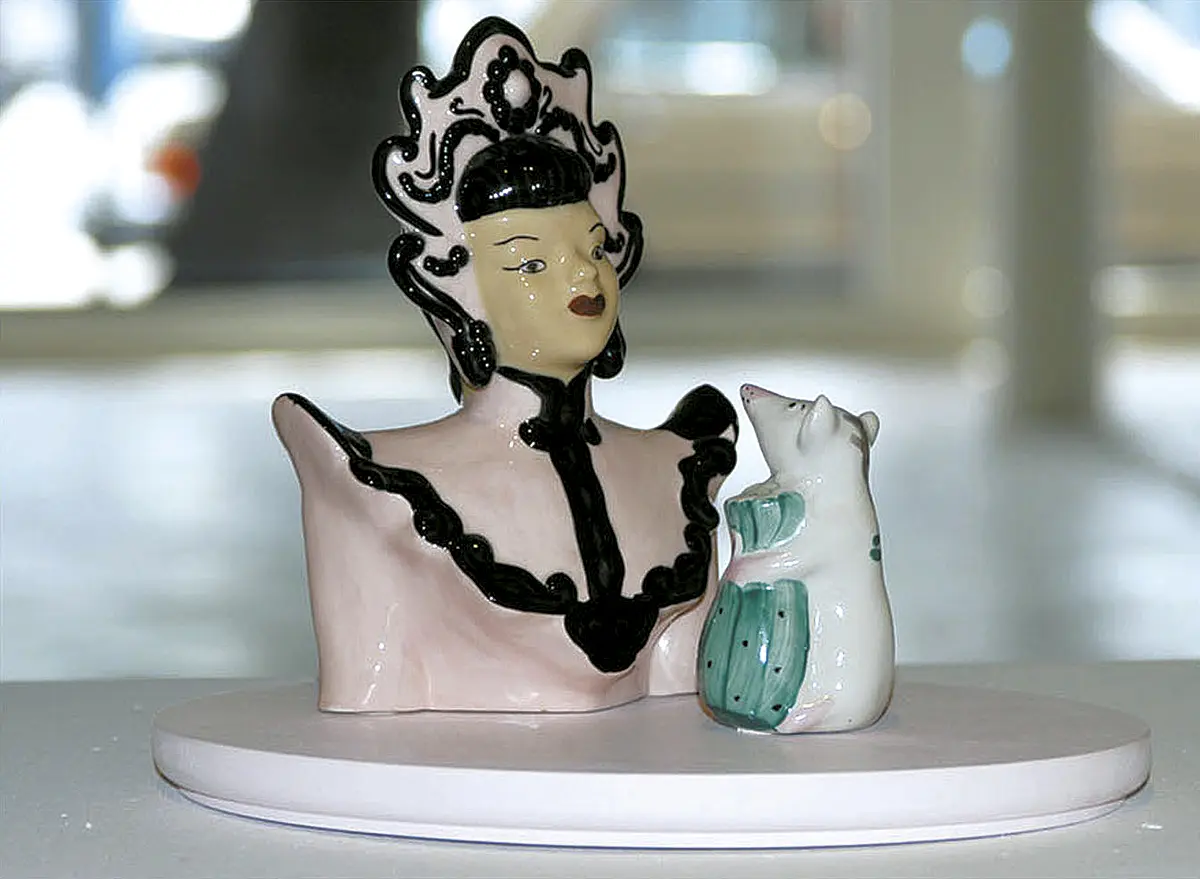
A common thread runs through Liliana Porter’s oeuvre: the fable. Her dolls and toy animals seem to recreate a constant dialog, in a parody of the absurd, pathetic, random quality of human relations.
Popular culture works here as a cohesive element, softening a possible conflict between Porter’s work and the optimistic spirit that characterizes this country.
In her videos, Liliana Porter seems to take part in a feverish meeting of Buster Keaton and Alexander Calder’s circus film. Her sense of humor appears as a solid mass of absurd and extraordinary possibilities. She has maintained the same elegance and the same organizational rigor that distinguishes her graphic work. Yet her works are completely independent, and they come charged with a highly sophisticated language, where satire suggests an exemplary mime, personified through the innocence of a child’s games.
In the videos we perceive an investigation into the nature of toys; toys seem to be more attractive to Porter, and more effective for the expression of her ideas, the more they approach innocence or the recent past. Most interesting is to note how they are subjected to social stratification, making it possible to distinguish toys or dolls of the “working class” from those of more privileged classes.
Porter develops a curious dysfunctional logic, generating ruptures in the surface and support of her paintings and her photographs, and creating the impression of yet more installations on her own surfaces. This is particularly the case when the central objects are toys or little dolls placed outside the frame so that the whole space of the painting is manifested as a monochrome image, soberingly cold. But it is precisely here that something special occurs; Luis Camnitzer has said it right when he attributes Porter to “an accurate eye for enchantment in the ambiguity of her charm and her magic.”
EUGENIO ESPINOZA