
Argentinean artist Luciana Abait’s new series of works at the Jean Albano Gallery in Chicago address the theme of absence —an ongoing subject in her work. Abait adopts the surrealist techniques of juxtaposition and association, adding personal meaning to her depiction of unlikely encounters on the canvas. Her themes create illusionary worlds of private memories within common yet emotionally disquieting settings. Abait produces these encounters within familiar landscapes, an important aspect of her oeuvre. An example is found in her Golf Windows (2000) series, where the golf courses she portrays remind us of the vast empty spaces found in the psychologically-charged landscapes of Dalí and De Chirico, serving both as universal and as personalized symbols.
In her previous paintings, Abait has depicted architectural spaces and landscapes seen from different points of view in skewed perspectives. The grayish and quasi-claustrophobic spaces in which everyday objects create unexpected encounters seem to be metaphors for the isolation of the human mind. This mental solitude is emphasized by the presence of a futile ladder and windows and doors that hinder any possibility of access to the rooms. In her most recent work, Abait applies the technique of painting over scanned photographs thus conveying an illusory hyperreality. Together with the brightening of her palette, the shift in her technique has been ascribed to the artist’s recent relocation to Miami.
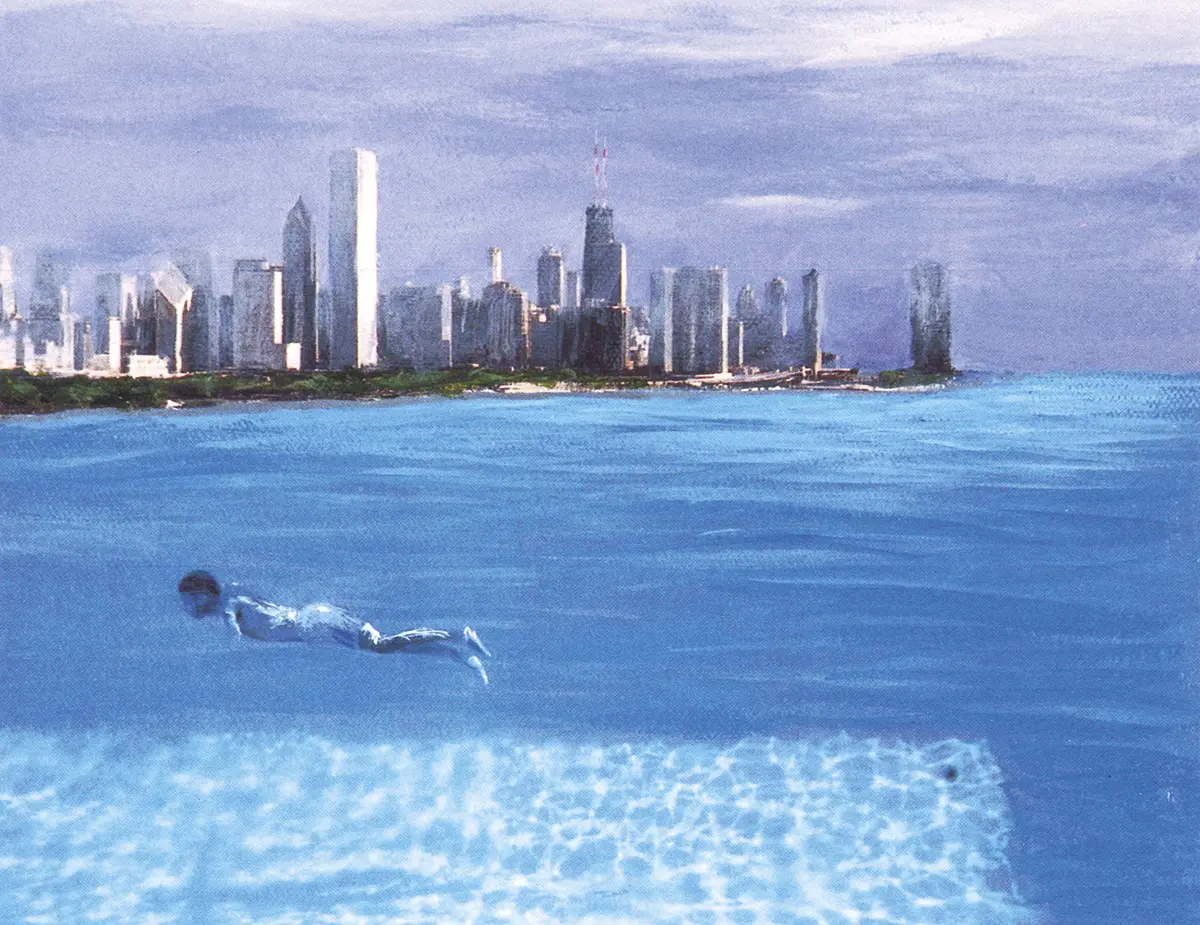
Psychological withdrawal is conveyed in the present series through underwater swimming pool landscapes. Sometimes anthropomorphic figures and their shadows appear functioning as imprints that record the passage of a human presence. The underwater scenes draw the viewer into a sense of timelessness and infinity where the duration of absence becomes painfully endless.
In Untitled # 9 (2003), a pool scene is inserted into the cityscape of Chicago; the pool has lost its frame and merges into Lake Michigan. The human figure that traverses the water space appears abstracted from the situation above: the presence of a recognizable landmark is an allusion to human activity and to the real world, yet the cityscape appears in a second plane and is distanced in terms of the viewer’s point of view. Instead of constituting a symbol for civilization or human activity, or a reference to a given place and time, the cityscape seems to represent an estrangement from everyday life and the world in which we live. The juxtaposition of two worlds leads us to question which one is real, and if the two can ever be reconciled.
Untitled # 6 (2003), also combines the image of a pool and a cityscape. This time, however, the record of human presence or activity is marked by the pool’s lamp. Unlike Untitled # 9, the pool does not merge with the surface of a lake but becomes the lake itself. This coalescence of two distinct worlds functions as a metaphor for the opposition between interiority and exteriority, the isolated mind, and an inaccessible outer world.
In Abait’s most recent paintings, pools are disproportionately rendered in terms of the cities they support, and the perspectives of the cities and the pools appear skewed and divergent from each other. The use of distorted perspective serves to create illusionistic spaces that contrast with the hyperreal quality of the imagery, emphasized by the careful reproduction of the sunlight reflected in the swimming pool’s foundations. At first glance, we are able to empathize with the images. But because of Abait’s particular rendering of perspective, and because she presents the opposition of two irreconcilable worlds, the paintings alienate the viewer. The depiction of seemingly everyday spaces, alludes to specific personal fragments of memory rather than to specific geographical spaces, conveying a sense of the uncanny that disorients the viewer.
IRMGARD EMMELHAINZ