
Carvings and paintings created by Luichy Martínez Richiez in Paris in the 1960s and 1970s were recently presented at the French Embassy art gallery. It has been a long time since the artist last had an individual show —and while the current art scene in Santo Domingo is fertile ground for shows by young artists, it is a different thing altogether when it comes to exhibiting better-known artists. It’s a pity. Older Masters are already a part of the history of modern Dominican art, even when they don’t display contemporary propositions. It is to this lineage of artists of great technical learning —nonexistent today— and rigor —not found today, either— that Luichy Martínez Richiez belongs.
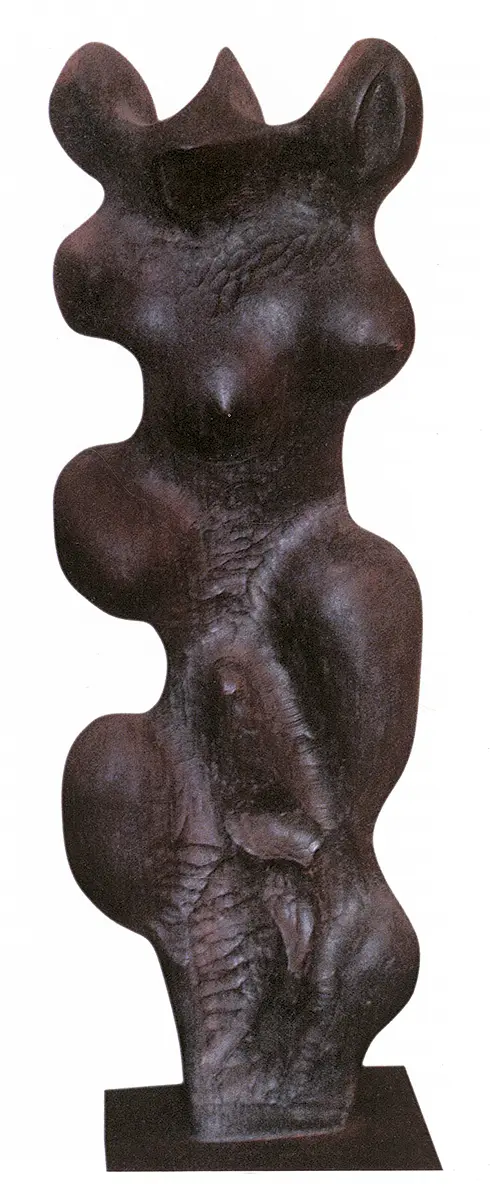
Wisdom, passion, and precision carried by a perfect control of both hand and tools, produce incomparable textures. Beyond the volumetric and formal mastery, the carving of these surfaces makes us “feel” each secondary volume, each plane of detail, and each point of the work. His pieces in precious wood communicate sensuality and demand to be appreciated physically. A singular communicative phenomenon occurs, which incorporates the sense of touch.
Luichy Martínez Richiez, born in 1928, entered the National Fine Arts School during the first year of its existence in 1942 while still an adolescent; interestingly it took him only three years to become a professor. After an internship and a number of exhibitions in Buenos Aires, the precocious artist settled in Paris, and it was there that he was to take part in his first international show of importance, the “Salon de l’Art libre,” in 1953, only a few months after his arrival in the city. To this day, Luichy Martínez Richiez remains the only Dominican artist to have won a First Prize in an international Biennial: the Paris Biennial, in 1959.
Group and individual shows followed, as well as a presence in numerous high-prestige events, many in France, before his definitive return to the Dominican Republic in 1979. Luichy Martínez Richiez had Denys Chevalier as his friend and mentor, the best-known sculpture critic and curator in France in those years, who wrote beautiful pages for him. A feast of awards signaled his return, and the artist was invited to create a piece for the Sculpture Garden at the 1988 Seoul Olympics.
Luichy Martínez Richie hasn’t ceased to create and exhibit his work. His greatest satisfaction has been the return, very recently, of important works he conceived and executed in Paris in the 1960s and 1970s. One of these pieces won the publicity that comes with the scandal at the “Salon de la Jeune Sculpture,” in Paris, and it was removed, transferred, and hidden by the authorities behind a bush in the Champs-Elysées. Seeing the piece in this show, it seems unreal that in 1979 the authorities decided to censor it; the only fault we could possibly find in this female anatomy lesson is its perhaps excessive baroque.
In the gallery, Luichy Martínez Richiez presents 11 sculptures —six of them on loan from the Bellapart Museum— and 13 paintings. The artist has also been an enthusiastic painter. In his essay for the catalog, the poet José Marmol writes that “...the Dominican artist represents that virtuous duality explained by George Braque as a need for tactile space alongside a need for manual space.”
Luichy Martínez Richiez’s sculpture is unique, although it belongs to the tradition and ancestral legacy of Modernism; according to María Rosa González1, Martínez rethinks Taino forms and takes away their archaism, while preserving their original magic. There aren’t any imitators, either: his skill and the subtlety of his direct carvings, tenacious, perfectionist even in their eroticism, cannot be imitated. By presenting significant pieces, this show highlights these distinctive characteristics. Although he has worked with equal virtuosity marble and bronze, Luichy Martínez Richiez is a wood artist, in love with oak, ebony, and mahogany. His inspiration does not come from natural forms, nor does he seek to take advantage of them, except for the vertical position of a supporting beam or the width of a trunk. It is in metamorphosis where his virtue resides; he attacks brute materials, organizes cuts, extracts volumes, and multiplies textures.
All too frequently, people insist on emphasizing the erotic nature of Luichy Martínez Richiez’s work, in its reproduction —realistic or merely allusive— of male and female sexual organs. This is a first reading suggested by the works, yes (the artist invented the self-definition of “erotica-fantastic”), but the figurative aspect inscribed in the purity of forms should not obscure an appreciation of these works’ exceptional visual quality. Luichy Martínez Richiez was in Paris when this city was the epicenter of painting; in those years in Paris, abstraction bloomed between expressionism and informalism, giving priority to rhythm and color. Two oils from the 1970s are shown, and they could be taken as part of the work of a full-time painter. His most recent paintings from the year 2000 do not seem to come from the same artist’s hand. In these medium-format works in acrylic, overflowing with light and sensuality, Luichy Martínez pays homage to women, through a very personal figurative scheme. His curved forms insist on vivid colors, a true artificial fire of tones and hues. Backs and behinds bubble with joy, and the luxuriantly tropical chromatism signals, beyond any doubt, the geographical origin of these paintings.
As the only Dominican in the New Dictionary of Modern Sculptur,2 Luichy Martínez Richiez is defined thus: “With his straight lines, his geometric volumes, his frank carvings, his concise style, he has a natural place in modern sculpture.” Certainly, an admirable piece, of medium height and distilled form, carved in African mahogany, seems a sculptural transcription of that dictionary entry.
NOTES
1. Nouveau Dictionnaire de la Sculpture Moderne. Multiple authors, Fernand Hazan, Paris, 1970.
2. Ibid.
MARIANNE DE TOLENTINO