
The work of Luis Luna has an undeniable richness in terms of technical and thematic elements. In the field of painting —which is the one that interests him the most, rather than the literary or drawing resources— the artists use a diversity of supports such as canvas, metal, glass, or wood. He ingeniously resolves every one of them without betraying his previous methods but with the interest of challenging the restrictions of any classification. His primary motive is to provoke an explosion of interpretations without a defined conducting thread, faced, in addition (in a good sense), to traditional easel painting.
In the exhibition at Galería Diners, the presence of aura of works from Desierto pródigo (Prodigal Desert), from the production of El carnero (The Ram), concerning Caridad del cobre (Copper’s Charity) or the cathedral archives, remains. But all these previous works evolve as the artist converts them into the ancestors of his current work. Looking at them from a different dimension, they are still lively works in constant transformation but apprehensive of a shared essence.
The diversity of materials and the unlimited inclusion of quotes as personal notes could provoke mental chaos in the viewer who faces his work for the first time. But Luna is the creator of a work as controlled as it is charged with meanings.
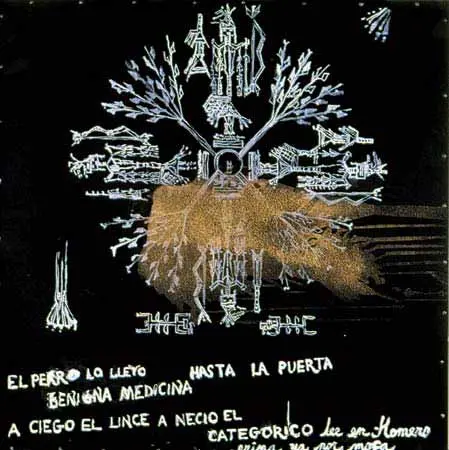
I mention now a work with meticulous white strokes, similar to dry weed and at the same time, similar to small bones that form some kind of concealed semiotic. They are positioned in a diamond shape on a flat metallic surface achieved with black and bright industrial paint. Below, a spontaneous calligraphy presents a particular episode: El perro lo llevó hasta la… (The Dog Took Him to The…). During one of his trips through a sand whirlwind of an abandoned town —maybe of the Arizona desert or maybe the tundra of Villa de Leyva— the artist followed the trace of what seemed like small bones covering the ground. He got to a point where a dog came out of nowhere to greet him. After what seemed like an inviting gesture from the animal, Luna followed the dog until they bordered a ravine where winds from all directions converged and collided with him as if it were the final scene of a fantastic story. This piece, as are others, is based on a real moment that he relates with some passage of Chicano literature. Exploring what he has read —like methodically searching for a coincidence with physical experience, acquired knowledge, and the work itself— seems to be a recurrent practice of the artist.
In a different facet of his work, the results are simpler. His small-format glasses supported by a metallic structure and hung at a distance from the wall capture the effects of the linseed oil on pigment. The variations in light produce a changing perception of each glass and placed in different points of the room they provide rest for the eye. They are akin to the slow movement of a celestial cloud or the curious sight of a microscope. They reiterate the dynamic character that the artist wants to imprint on his work and they relate as much with scientific meticulousness as they do with the imaginary extent.
On the other side, we find large format canvases with a subtle handling of color and texture. Among yellow, orange, and pink mists we find desert atmospheres. It’s as if the artist trapped some fleeting breeze mixed with sand and the luminous glimmer of sunset. He achieves a whole abstract landscape departing from key elements of the environment that he tries to portray.
But Luna is not interested in mere representation. What remains on the canvas shouldn’t necessarily be the result of the painter with the brush, the oil, or the canvas in a studio in which the environment loses its context. He is interested in meddling with it and in this way, he searches for other mechanisms to “paint”. He takes upon the task of dragging an enormous piece of the canvas through the infiernito (Little Hell) desert in Villa Leyva. The canvas is filled with granulated textures, with earthly yellows, of dry soil and dusty winds in order to remain saturated with aridity, a difficult sensation to communicate with more “orthodox” processes. But the artist enjoys this exploration that more than mad, becomes daring, unusual, and brilliant.
It is not as fascinating for the audience if they are not familiar with the methods that the artist uses to create his pieces. And to those of us who have listened to Luna’s version, the question arises if it had been possible to glimpse his methods without previously having a conversation with him. In fact, that is not important and it would be frustrating to the artist to fall into such obviousness. I suppose that is the reason why there are so many loose elements in his work. They are like open doors that demand subjective interpretation to keep on feeding on a plurality of meanings. There is nothing to understand. Actually, one has to play the piece’s game and see up to what point one can adjust it to a personal reality. Isn’t this what every artist desires to achieve? In that measure, Luna’s formal tools have a clear purpose that reflects the maturity of his work.
To conclude, I mention other objects with a strong presence in the exhibition. They are the enormous wooden beams located among the bi-dimensional works, engraved in black and vigorous calligraphy. Personally, I think its inclusion is unnecessary, although surely some of the visitors to the exhibition spent a good amount of energy trying to decipher its hidden relation to the rest of the works. It is worth a try to relate them with representations inspired by engravings by Goya as it happens in the piece Dios la perdone… (May God Forgive Her) in which the image, at the level of a reinterpreted drawing, plays an important role. But what Luna rescues and what fascinates him about Goya is the language of the engravings in which the expressions are colloquial (for the time) and indicate any situation where human misery remains visible. In some way, these texts inspired the inscriptions that the artist engraved on the beams whose presence is also clumsy and almost bothersome within the context of the exhibition. In the end, this is only about a simple interpretation of a piece that possibly, in a future exhibition, will have a completely different significance.
MARÍA JOSÉ RAMÍREZ