
Homer tells us in his Odyssey that Penelope devoted the day’s hours to knitting what she would devote the hours of the night to un-knit, in a sort of ritual designed to keep her suitors at bay. It was a ritual of faithfulness to the absent husband, yet it centered around her own creativity. Time after time Penelope created a weaving about the female condition, and her private world was made public.
Other aspects of myth and of ritual —not only geographic or temporal— are what concern Marta María Pérez Bravo. For a number of years, Pérez Bravo has been approaching in her photographic work a belief system derived from Afro-Cuban religion, which she relates to herself from a variety of interrelated points of view. One of them is her own biography, such as the time when having became pregnant, she used the myth of the ibbeyis, deities that symbolize the jimagua and are to a degree parallel to the Greek gods Cástor and Pólux.
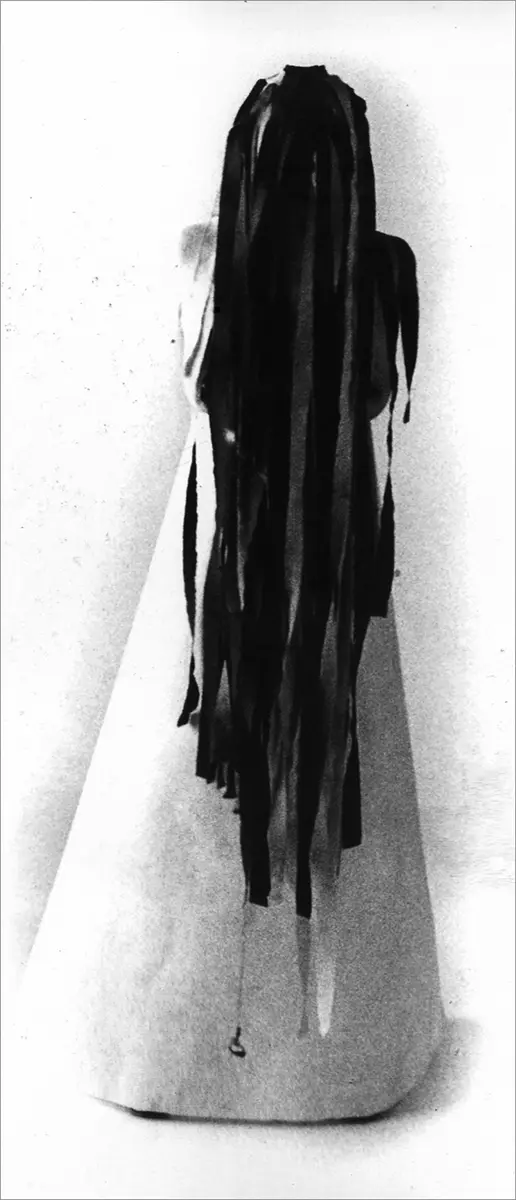
This discourse about the feminine is linked to motherhood: Pérez Bravo selects objects from that liturgical universe and marries them organically to her gender-marked vision and condition. She plays with hair, with a doll-like appearance, with fingernails and toenails... all of which can be the subject of a more general anthropological projection. This was made evident in Pérez Bravo’s March 14-April 26 show at La Casona, with photographs from the period 2001-2003.
In this show, Martha María Pérez Bravo revisits several of her private ghosts. One of them is the ego, related to her anthropological view and channeled through the very process of creation. As the artist says in the show’s catalog: “I situate myself in front of the work as in front of a mirror, facing not only the difficult task of defining who I am but also how other people see me or who they think I am, and I enjoy the creative act in a deliciously egotistic way.” Yet she also routes the expression of the ego through (self)portraiture, turning herself into a shifting but always recognizable subject, object, and attribute of representation.
Her body takes part in a kind of “self-art.” It centers and organizes the work’s elements, and the work comes to resemble a static, photographed staging, isolated by a gray background. In these images, the elements that accompany the artist’s body can be seen as appendices —parts that project outwardly— or as organic insertions. The artist recreates religious references to the point that her interpretations acquire a degree of expressive autonomy, becoming relatively independent of their original meanings. In fact, even when she tries to preserve the pristine colors of the ritual objects, they are lost in the black and white of her photography. These manipulated images are coherent with the author’s work of spiritual and cultural re-elaboration.
Pérez Bravo tends to show her own nude body, sometimes in frames that mutilate it, but in these photographs, she seems to play a game of veilings. Partially at times, thanks to the manipulation of her hair, and more fully when actual veils cover the subject’s head.
In essence, Pérez Bravo’s work is a continued effort to unveil and reveal images and meanings, a constant remaking of the self —in her own eyes and in those of the viewer. Unlike Penelope, Pérez Bravo is a theme for her own work, which is invented anew on every occasion without ever ceasing to be. Her physical image and her artistic and existential interest are Pérez Bravo’s personal mark.
ISRAEL CASTELLANOS