
Throughout a long and varied career, Miguel Ángel Ríos has found many ways to explore issues of place and its relationship to power. Initially through paintings, then most effectively in his series of pleated maps with countries and central points redrawn, Ríos has made a poignant and visually rich body of art that has served as a commentary on postcolonial geopolitics and ethnic identity in an increasingly globalized world and has maintained indigenous traditions with contemporary modes of expression. With Ni Me Buscas… No Me Encuentras he makes a bold move into video.
Ni Me Buscas… consists of two main parts. The first is a three-channel DVD projection that was recorded in the desert region of San Luis Potosí, Mexico. Each side image is slightly tilted, rendering the normally flat horizon line as a broken curve. The vastness of the view, the bend of the horizon, and the sharp boldness of the colors and forms are a reference to Northern European painting; that region was also highly regarded for its map-making. Ríos’s video depicts a sort of vision quest or spiritual journey, as a lone figure (the artist himself) walks through the landscape. The straightforward banality of the action is broken by the intermittent appearance of a marching band, and the use of erratic camera movement and some digital effects.
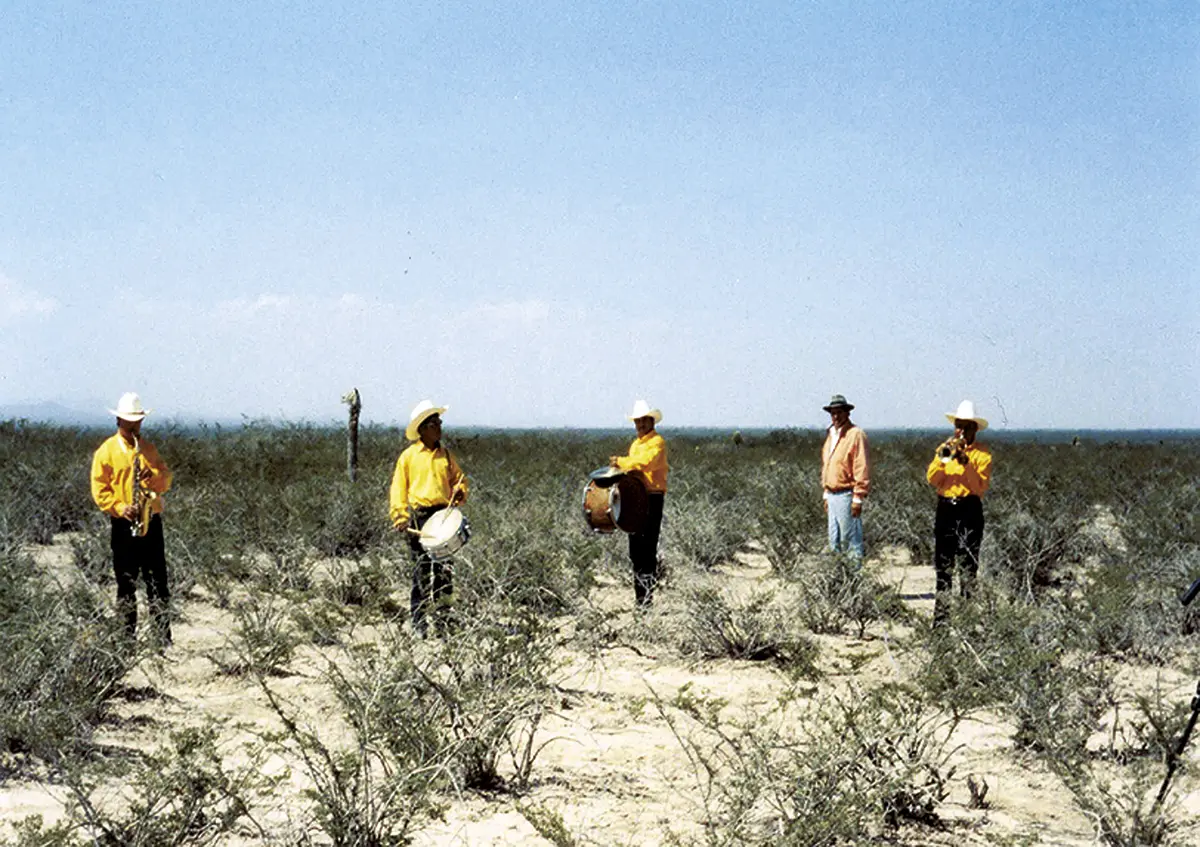
A series of graphic works that further the surreal quality of the video are also part of the exhibition. These works play with scale and monumentality: they present themselves with the scope of vast panoramas but are quite intimate in size, almost like elongated postcards. It is in these works that the viewer sees the full extent of manipulations that Ríos employed in this project.
Although themes of geography, ethnicity, and destiny are all consistent with Ríos’s work in the past, there are some real departures with this show. Artistically this is a new medium for an artist whose map-based works are a strong body of art with a real following. Conceptually, Ríos seems to be making a much more personal statement here: the terrain he is engaging is as much psychological and biographical as it is socio-political. Ríos makes his statement in the video in a relatively short period of time (as opposed to some artists who use video time far too self-indulgently) and this encourages viewing the work several times and challenges its apparent simplicity.
Once again Ríos is updating a traditional means of representing nature and place. In the past, he used the long-established craft of map-making, and by presenting his maps with more contemporary, scientifically accurate land distributions, or by shifting the customary focal points, he was able to offer a worldview different from the standard views to which we are accustomed. In this current work, some nineteenth-century artistic conventions are also referenced. In the Romantic landscape, the standard beauty of the picturesque is transformed into a more actively engaged, potentially violent view of the sublime in nature. Although the arid land Ríos has chosen to depict seems to be in sharp contrast to the overcast, lush abundance of the European landscapes, the sense of the power of landscape is still evident in the strength of the sun and presence of the sky, and in the active wind that animates everything.
Also invoked is the convention of the panorama. Traditional panorama paintings were huge canvases that cast the viewer into another realm. This work has much the same effect, with the projections filling one entire wall of the main gallery space. The physical layout of the gallery itself, a sunken cavernous space that is cut off from the world outside, helps to complete this sense of transposition.
Ríos’s shift in medium is provocative in some ways, and initially a bit disappointing. His previous projects were a brilliant synthesis of political subversion, conceptual engagement, and material, aesthetic richness. His use of varied formats and media in the map works kept what could have been a very repetitive project quite lively and interesting. The colors, folds and pleats, and the scale of his works made them physically alive and stimulated thought while offering something quite visually enriching. The knotted thread works were an interesting variation on traditional craft and contemporary installation and mined some of the same territories as the work of artists like Cecilia Vicuña. Ni Me Buscas… No Me Encuentras, for all its presentation of space and its use of digital stereo-optics, comes off as somewhat flat by comparison, and one cannot help but miss the object-ness of Ríos’s previous art. Moreover, for an artist who seemed to question master narratives and usually allowed the viewer his or her own path of entry into his works, the video seems like a very linear, dictatorial medium.
Yet, even though the tactility and material panache of Ríos’s previous works are regrettably lacking in this new exhibition, it is always exciting to see an artist beginning to explore new directions in his or her art. The new medium may have seemed necessary to Ríos because of the more personal, intimate themes he begins to explore in this work. Although it has a somewhat tentative quality, he seems to be honest about his limitations with the medium. Given his track record thus far, if this is indeed a course he has chosen to follow in the future, it will be interesting to see where he goes from here.
JOHN ANGELINE