
Puerto Rican artist Miguel Trelles’ engravings and large-format paintings, shown at the Institute of Puerto Rican Culture’s Arsenal de la Puntilla, in Old San Juan, remind us that landscape is not something that exists, but something that is thought of. Trelles’ landscapes are ideas or “mental spaces” inspired by the work of China’s amateur/men of letters landscape artists of the eleventh and twelfth centuries, followers of the Tang-dynasty painter, poet, and calligraphy artist Wang Wei (699-759). Wei’s followers developed an artistic style infused with the spirit of Nature conceived as an echo of the artist’s own character. The philosophic and artistic vision with which they approached Nature clearly separated them from professional courtier artists. They rejected the principles of attentive execution and detailed drawing, preferring instead to use stereotyped elements to identify the locations, as well as a variety of styles within a common artistic vocabulary.1
Trelles titles this show Chino latino, and creates his landscapes on the basis of an “erroneous reading” of his sources. He puts it in these words: “I pursue a wrong, very creative reading of my pictorial sources. I think it would be most fortunate for this process to result in an innovative recreation of the Caribbean milieu. Columbus set sail to the Indian subcontinent and disembarked in the Caribbean; I am trying to get to the Caribbean, with a detour through China.”
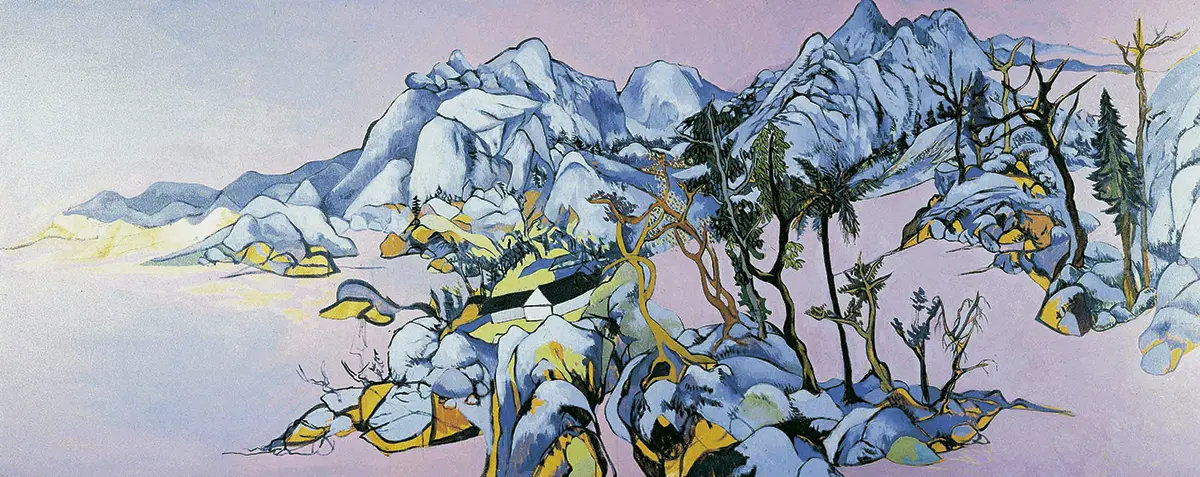
Western philosophy has traditionally seen Nature and Art as separate and distinct. According to the philosopher Mortimer Adler, Nature, unlike Art, has roots in a time before any human presence —a time without artifice, a time without art. Art, on the other hand, is a purely human activity that transforms, adds to, and subtracts from Nature.2 Nature, in a painted landscape, becomes art or artifice; as such it can either be turned into a kind of stage for human beings or re-oriented to function as a frame of reference for understanding the meaning of images. In the work of art, Nature, and Culture are conceived as related but separate spheres. Many authors have pointed out that in the historiography of art the concept of ‘landscaping’ has been used indistinctly, and confusingly, to refer both to painted nature and to the process of “seeing” a landscape.3 More recent developments in the historiography of art, and the work of Miguel Trelles, eloquently present the idea of nature in art as a construction achieved through learned pictorial conventions. Artistic landscaping, far from being a neutral genre, gives structure to the Nature/Culture dyad and poses an infinite number of possible relationships between both terms.
According to Michael Sullivan, in the oldest Chinese ideas about Nature, natural elements were understood as part of the set of cosmic forces, manifestations of the universe’s energy and renewal. Ancient China’s popular beliefs included the idea that the earth’s mountains were the body of the cosmic being; earth’s rocks, its bones; earth’s water, the blood that ran through its veins; and earth’s trees and vegetation, its hair. A walk through the woods writes Sullivan, was an act of meditation and adoration of the forces that made up the cosmic being. To know Nature intimately allowed human beings to know Nature’s immanent reality.4 Painted landscapes were vessels for the expression of that intense psychic and visual experience, made objective first by isolated emblems and later by motifs tied together in a composition. The importance of painted landscapes in Eastern cultures transcends the objectification of a feeling for Nature or of an instinct for landscapes, of the kind Ruskin described in Modern Painters. Chinese landscapes possess a deep meaning, as they are vehicles for the expression of those philosophical and religious ideas other cultures expressed through metaphysical or theological writings. We could even say that Chinese landscapes are the equivalent of a philosophical treatise on Nature. Wei’s followers, then, formulated a philosophy of nature that was to be communicated to subsequent generations of artists.
The theorist, painter, and critic Dong Oichang (1555-1636) belonged to this tradition and copied important masterpieces in the amateur-men of letters canon in an album he titled Xiao Zhong xian da, or “Bigness Emerges from Smallness.” Dong Oichang’s followers formed what came to be known as the Orthodox School. Miguel Trelles, in consonance with both Dong Oichang’s followers and with postmodern practices, used copies of the aforementioned album as his sources of inspiration. Trelles’ stereotypical emblems and motifs remind us of the fashion for japoniaserie in the works of Whistler or Van Gogh. The motifs of Chinese landscape art, reinterpreted by Trelles, are brought together in the composition by means of fields of solid bright colors, which function as their counterpoint. According to Trelles, the colors in these solid fields are the magma that links mountains, rivers, trees, and clouds, all of them taken from the small landscapes in the Xiao Zhong xian da. Natural elements of the Chinese environment and the magma of tropical colors warn us about the metonymic determination of all painted landscapes: Nature made objective is a fragment, taken as a whole in the representation.
The artistic organization of those elements is a re-presentation intended to reconstitute what has been seen, charged with the meaning the artist gives it. Trelles’ landscapes are described in calligraphic strokes suggestive of ancient practices such as those found in Chinese scrolls of calligraphy art; however, their meaning differs from traditional Chinese meanings. By taking as his starting point the conceptual and philosophical study of landscapes, Trelles situates himself within the tradition of the artist as a man of letters, posing a conceptual theory of the landscape that differs from the mimesis of referents.
Despite its title, in this exhibition of Miguel Trelles’ work, we don’t find traces of “Latin” compositions, nor any typically Caribbean iconographic motifs. Trelles’ paintings seem to signal an absence, only ameliorated by those intense bright colors that remind us of a tropical chromatic range. Colors that instead of emphasizing the subtleties of color, the atmospheric density, or the transcendental aspirations of Chinese landscape painting, move closer to a pop and kitsch sensibility as they highlight the artificiality of painted landscapes, the material nature of pigments, the boldness of the brushstroke. The most significant element in Trelles’ works, such as El beso del atardecer or Evening Kiss, is their daring break with the trite iconography associated with the landscape of Puerto Rico. He refuses to articulate pictorially the essentialist identity assumed by neo-nationalist historiography of all made-in-Puerto Rico art. Miguel Trelles approaches the relationship between art and identity from the angle of estrangement. The result is the marriage of natural motifs from Chinese landscape art with the colors of the tropic, made possible in the pictorial plane by the coupling of two distant topographies. The point of encounter for Chino and Latino is that magma of bright colors brings together the loose fragments of a Chinese landscape: mountain, trees, land, and sky, giving them the unity and harmony that characterize modern works of art. However, the unity thus imposed does not eliminate the natural referents’ fragmentary character. There are indications, in Trelles’ paintings and engravings, of how in art bigness can indeed emerge from smallness. Confronted with El beso del Atardecer or Evening Kiss, we cannot forget the strength and precision of the outlines that separate the trees and mountains from the magma, forming a hybrid topography, an imaginary place, a grafting that indicates the potential for a different relationship between human beings and Nature and for a multi-cultural conception of identity. In the antipodes to the Chinese and the Latin spaces, a painted landscape rises as a result of a reflection on the theme of the question of landscape.
NOTES
1. John Findlay, Chino Latino (New York and San Juan: Boricual Gallery Workshop and Institute of Puerto Rican Culture, 2003).
2. Adler Mortimer, The Great Ideas. A Lexicon of Western Thought (New York: MacMillan Publishing Company, 1992), p. 560.
3. Gina Crandell, Nature Pictorialized. The View in Landscape History (Baltimore and London: The John Hopkins University Press, 1993), p. 4.
4. Michael Sullivan, The Birth of Landscape Painting in China (Berkeley and Los Angeles, University of California Press, 1962), pp. 17.
INGRID MARÍA JIMÉNEZ