
Face to face and front to front, Pepón Osorio places us in a dilemma that surrounds us. The conflict of a real family in transition is the motor that generates this great installation in which all the possibly implicated are included. The journey starts in a small room with a table, four chairs, and a video where a young man covers his ears. The scene takes place during a counseling session in which a woman and her son go to a social worker, once the young man, with no father, leaves a teenager pregnant. In front of this small waiting room, there are several rows of desks supposedly for social workers, and in each of the spaces, we can see the small world they have reproduced in their familiar surroundings. Each space talks about social status and the hierarchy of these other families, photos, souvenirs, toys, ceramic dolls, and personal objects, allow us to deduce who these people are and how they behave. The objects of the family are kept in the middle of a large box, which actually looks more like a cage, because at this moment the family does not have the money to rent a storage space while they wait to see what will happen with their destiny. Also inside, is a video that shows the celebration of a child’s first birthday surrounded by his family.
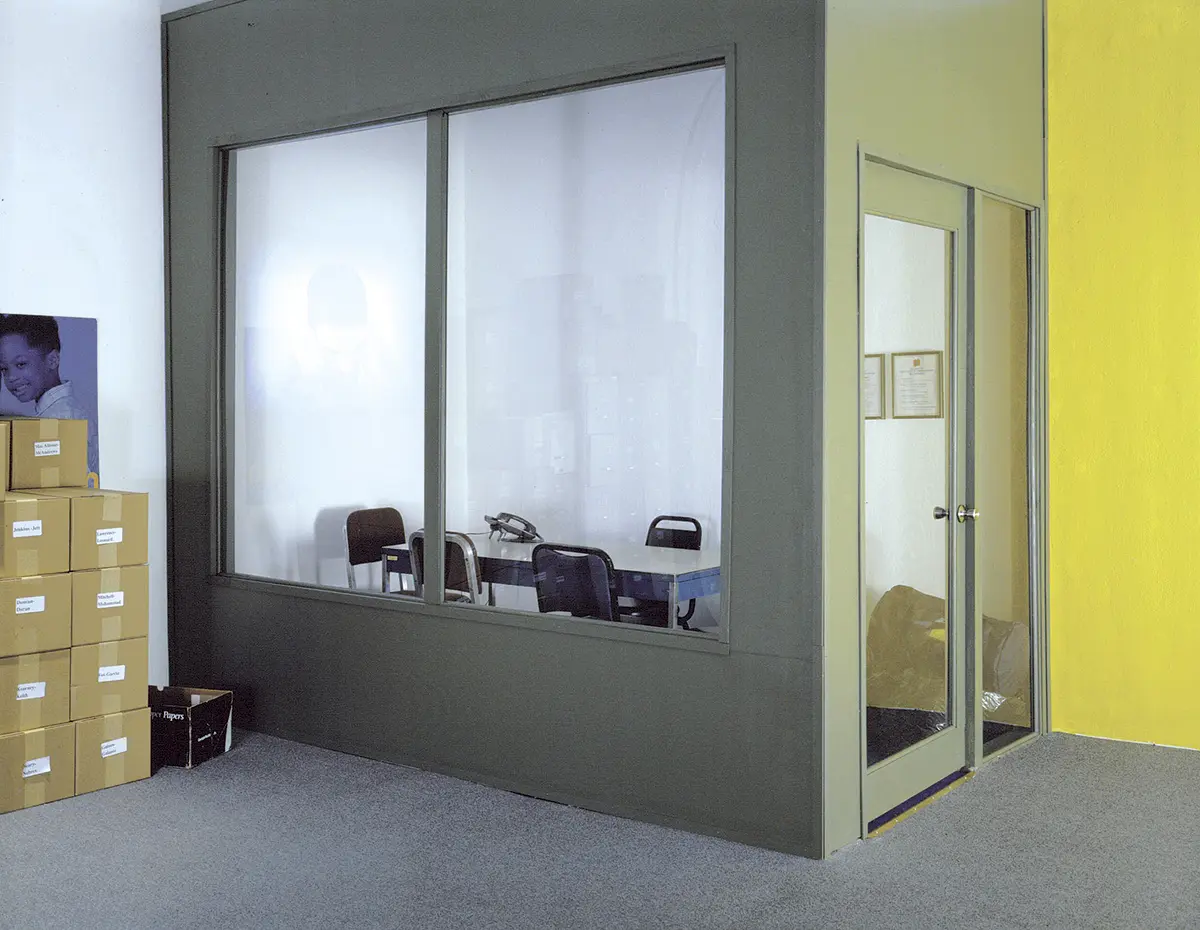
Pepón Osorio, once again, pokes at the social problem in order to establish the guides of a conflict that we don’t feel a part of and before which, like these social workers, we believe ourselves somehow immune. In front of the reality of a true problem, Osorio places those other families, who, in a very direct way, have to do (with the problem). However, there’s a distancing between them, a distancing that occurs on a social scale from individual to individual. In every one of the environments created by the artist, the intention of the separation of reality made evident by the tourism posters, the postcards, and souvenirs is manifested.
Face to Face, designs a social structure, on an individual scale. The exhibition brings reality to our immediacy making us vulnerable to its problematic. Relating to the experience of a real family points to the artist’s responsibility in society. The problematic incorporates the artist and the gallerist —who have transformed the space thus acquiring a commitment and forming part of the denunciation of the problem that these people face. The main statement of the exhibition is about how to get close and make ourselves sensitive to the conflict of the other, and it depends on our consciousness to get out of this and to see how society will assume it.
Another one of the achievements of the Face to Face project which was initiated in Philadelphia, where Pepón Osorio was in residency at the Department of Human Services until he was transferred to Miami where the recent scandals in the Children’s and Family Department are more evident and frequent —consists in utilizing real belongings of families with social problems. To look at these objects, that are part of somebody’s daily life, makes us reflect on who we are and how we behave socially; how we can help, and what role we must assume.
Pepón Osorio’s intention is to draw us closer to the problem from the problem itself. If many of us haven’t visited any of these services, he brings them to us. The installation succeeds in making us feel the coldness of these environments, the bureaucracy that surrounds every space exemplified by the filing cabinets and drawers labeled with names of families that have been left there in the darkness. The artist talks about the conflict, but more than touching upon it, he makes us feel, amidst that labyrinth and the doubt, what could happen if something went turning us into the subject that corners us.
MARISOL MARTELL