
This retrospective skillfully characterizes the career of the Nuyorican artist born in Brooklyn on October 30, 1922. The exhibition includes drawings, prints, paintings, objects, sketchbooks, letters, posters, preparatory works, photographs, and publications, as well as a continuous chronology next to the reconstruction of the artist’s studio and the video projection.
Those who know the life and work of Rafael Tufiño, know about the variety of approaches and activities that the artist has developed. Those who had access to Tufiño through the exhibition, observed six decades of intense work, next to a view of situations that refer to particular elements of the Latin America of that time. The exhibition —which celebrates Tufiño’s 80 years— started in 2001 at the Museo de Arte de Puerto Rico, and in 2003 is presented at the Museo del Barrio in New York. On account of the exhibition, a complete catalog was published with texts by Teresa Tió, Mercedes Trelles Hernández, and Antonio Martorell.
At the beginning of the exhibition of almost 400 pieces, which are not at all arduous to go through, there is a glass case for each book of drawings, sketches, holiday cards, mixed media, letters, and a variety of elements of Tufiño’s ample graphic production, resulting not only in an intimate presentation but also an orienting one. The letters to his two sons Nitza, also an artist, and Pablo stand out. In these letters, the most diverse, stylized, or abstract drawings can be seen, with subjects as images of the Virgin, self-portraits of the artist, and interior scenes accompanying the father’s sayings on legible typography, written with intercalated color pencils, which demonstrate the natural graphic inclination of the author, which by the way, is also characteristic of Puerto Rican art in the 20th Century.
Is Pintor del pueblo (Painter of the People) a subtitle for the exhibition of an artist born in New York? Yes, and it relates to the artist’s identification with the land where his mother was born, and where he was raised and lived through alternate periods of his life. The artist embraces the thematic of the people in regard to the works on the land —without exalting the sacrifice too much— to the songs, the popular holidays, the crafts and myths, and therein the relation with the valid thematic in Mexico and the rest of Latin America. The other facet is informed by the autobiographical. Multiple portraits of Goyita (Gregoria Figueroa, his mother) of his children, the pregnant woman, self-portraits, the models, the places where he listened to jazz, churches, landscapes of his personal history, as well as the image of the night, that focuses always through a luminous blue, characterize the open blue and crystal clear sky on the Island.
In the technical phase it is fair to notice his interest in the use of tempera, which requires less water than watercolor or ink. Using paper as support in such a humid place as the Island and also in New York, it gets less wet and thus it prevents some of the bubbling and wrinkling. Oil, pencil, tempera, casein, felt pen, fresco imitation, lithography, xylography, serigraphy, linocut, on paper, cardboard, fabric, and wood board, are a few of the techniques, materials, and supports used by Tufiño, to which gesso, sea stone, coquille, and glass —elements on which he has drawn and painted very detailed miniatures, almost all figurative— can be added. Here he develops the law of adaptation of the format to its support.
His travels connected him, among many other options, with the forest and military life during the war, when he was sent to Panama (1943-1945); with Mexico once and for all, during his years there, upon his entry to the Academia de San Carlos (1947-1949); with the TGP, Taller de la Gráfica Popular; with the Bienal Internacional de Pintura y Grabado (International Biennial of Painting and Engraving) of 1958, among other situations. Among the teachers that he studied within Mexico, the recently diseased Alfredo Zalce is mentioned and so is José Chávez Morado, both artists of remarkable social tradition, the first one most of all in printmaking and the TGP, the second one in mural and countryside figures. Printmaking in his multiple expressions always interested Tufo —a nickname he’s known by. But it isn’t until later that he decides to overcome his shyness and the complications to start devoting himself to this ample group of techniques in order to reproduce numbered originals. This will be in Puerto Rico, when CAP, Centro de Arte Portorriqueño, was created, together with Homar, Félix Rodríguez, and José Antonio Torres Martinó. The CAP (1950-1952) had a very important —however short— existence of only two years.
During 1952-1954 his stay at Loíza Village, where he developed a portfolio of six serigraphies —by commission of Narciso Rabell, director of the Colegio de Ingenieros y Agrimensor s de Puerto Rico— will reconcile the traditions of a particular area of the black population of the Island. Just with this group of work and his studies, one can extend an essay about the popular wealth that the artist treasures. Similar situations are found in every step of the exhibition, like with the portfolio Plenas (Wholes), in collaboration with another one of the pillars of the Puerto Rican plastic arts, Lorenzo Homar, with a design by Irene Delano; with the mural La Plena (The Whole) related to the film by Amílcar Tirado; when one is confronted with pieces like Homenaje a don Zoilo Cajigas y Sotomayor (Homage to Don Zoilo Cajigas y Sotomayor), serigraphy from 1962 in which the unique treatment and touch of Puerto Rican painting that Julio Rosado del Valle internationalized can be detected.
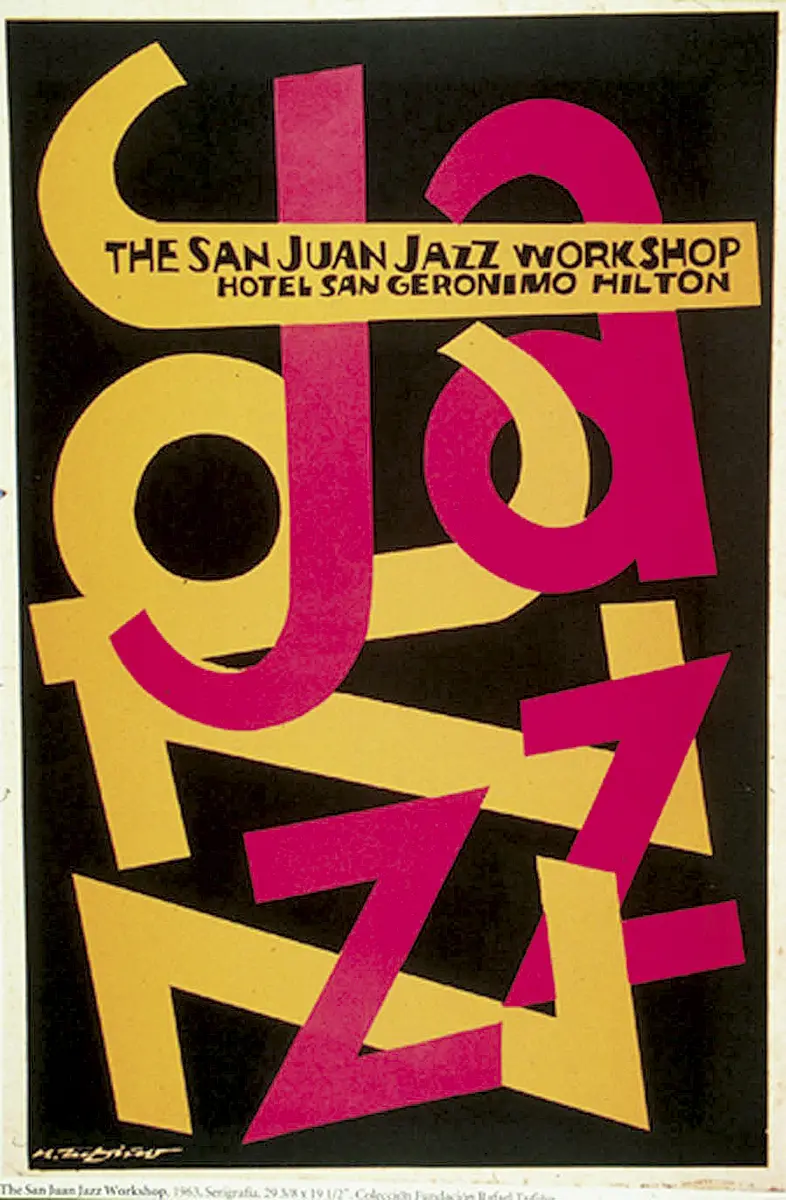
Regarding the subject of the posters, Tufiño is a key figure as much in Latin America as in Puerto Rico where he promoted the formation of the poster school. The artist auto-defined himself as a “man of letters” in his dedication to posters, typography, educational and film, theatre and chess matches, crafts, and popular art. Tufo also achieves a wide array of expression in the posters, just like in his paintings and prints. It alerts the spirit of every poster with higher or lesser figuration, depending on the situation that is referring to. Among the ones that stand out for their originality are the ones of Museo de la Familia Portorriqueña in 1964 and 49 Congreso Mundial de Ajedrez, in 1977. In a thematic balance in the exhibition, there are only a few drawings related to the United States, in particular, the Brooklyn Bridge, the area where the artist was born. Rafael Tufiño is a key figure in the history of the modern Puerto Rican visual arts.
GRACIELA KARTOFEL