
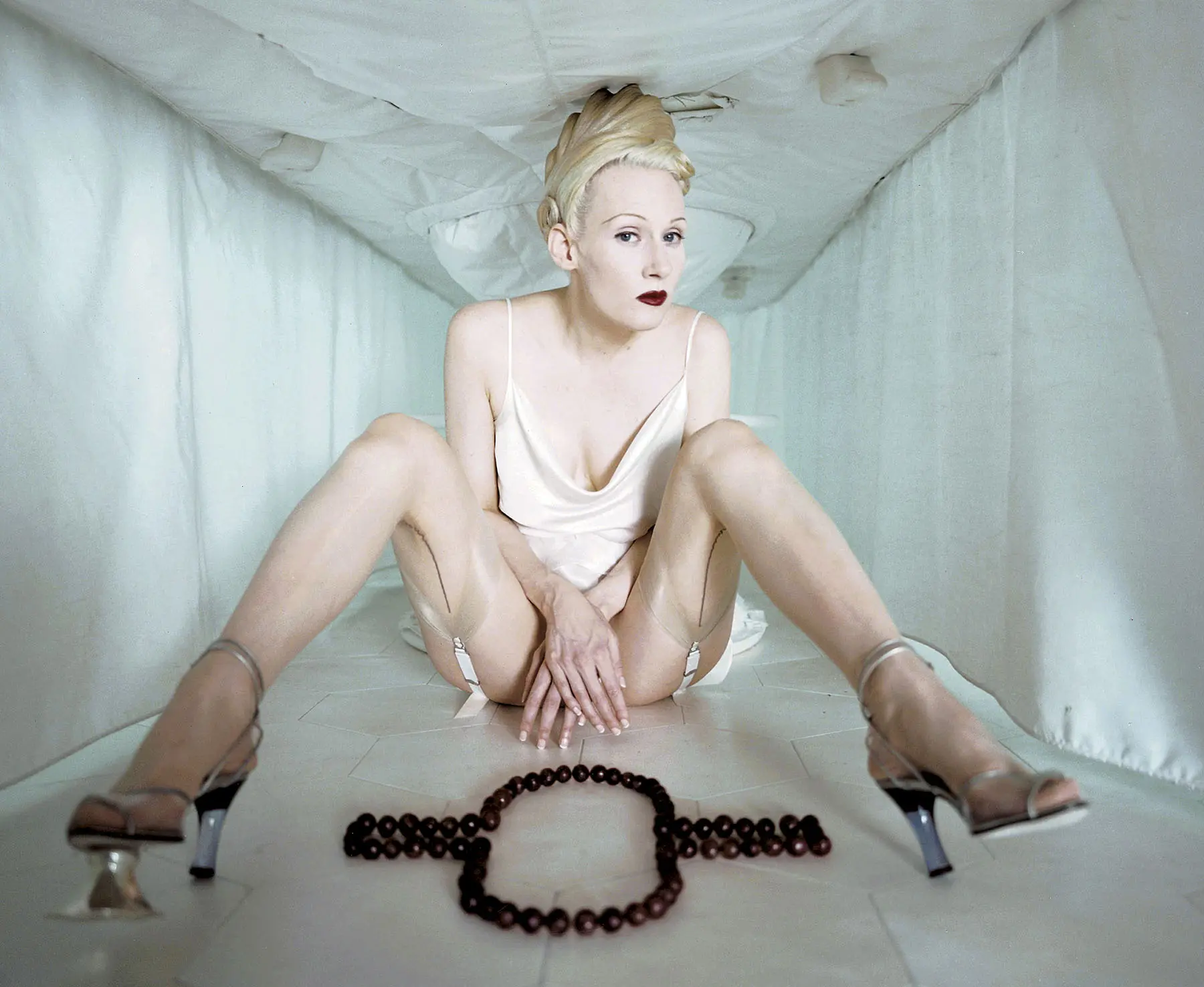
Matthew Barney creates visually stunning and opulent aesthetic puzzles that both indulge and often confound the viewer. His films, sculptures, drawings, and photographs incorporate esoteric referents to everything from biological processes and classical mythology to American football, freemasonry, and Harry Houdini. Generating a byzantine network of symbols, Barney’s idiosyncratic vision displays a remarkable continuity from his earliest projects up through the present: athletic training and sports equipment; prosthetic body parts and elaborate costuming; a fascination with Vaseline, tapioca, and silicone; not to mention a certain obsession with bodily orifices are all part and parcel of Barney’s hermetic and provocative universe.
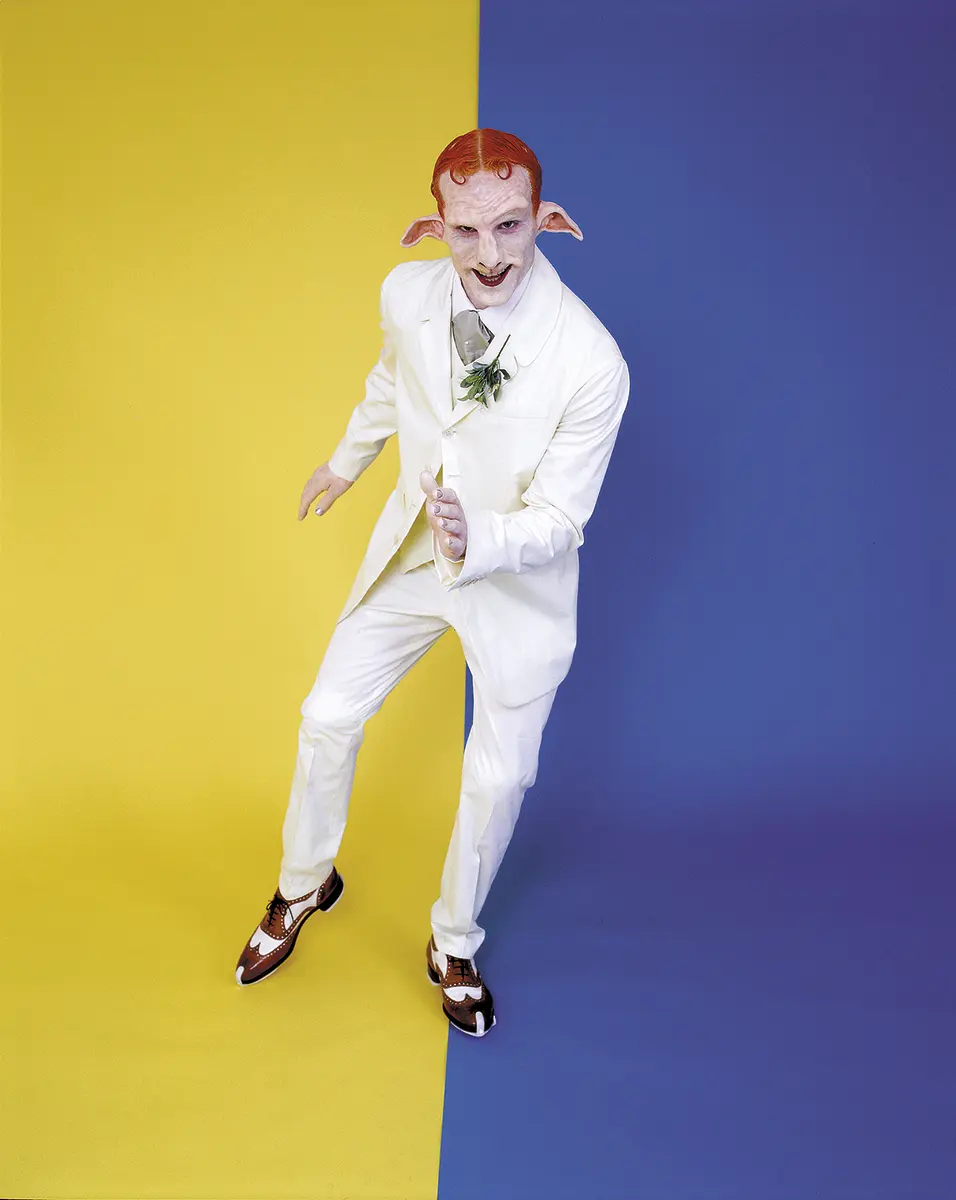
An undeniable mythology has also developed around Barney himself. With a history as a football player, pre-med student, Yale graduate, male fashion model, and now contemporary art star, it seems that Barney has the Midas touch. After graduating from Yale in 1989, the artist came to live in New York City where a studio visit by gallerist Barbara Gladstone set his career in motion. His first New York solo exhibition took place in October 1991, and from that point on he became an art world darling receiving a solo show at the San Francisco MoMA in December of 1991; participating in Documenta IX in 1992; exhibiting in both the Whitney Biennial and the Venice Biennale in 1993; and winning the prestigious Hugo Boss award in 1996. During the past eight years, Barney produced five major films that form his epic Cremaster cycle, all of which have been exhibited in major museums and screened throughout the world to critical acclaim. This year a major exhibition of Barney’s work, organized by the Solomon R. Guggenheim Museum, traveled first to the Museum Ludwig in Cologne, and then to the Musée d’Art Moderne de la Ville de Paris before its final installation at the Guggenheim in New York. By the age of thirty-six and within the span of twelve years, Barney has achieved many of the most highly coveted and important art world successes that most artists his age only dream about.
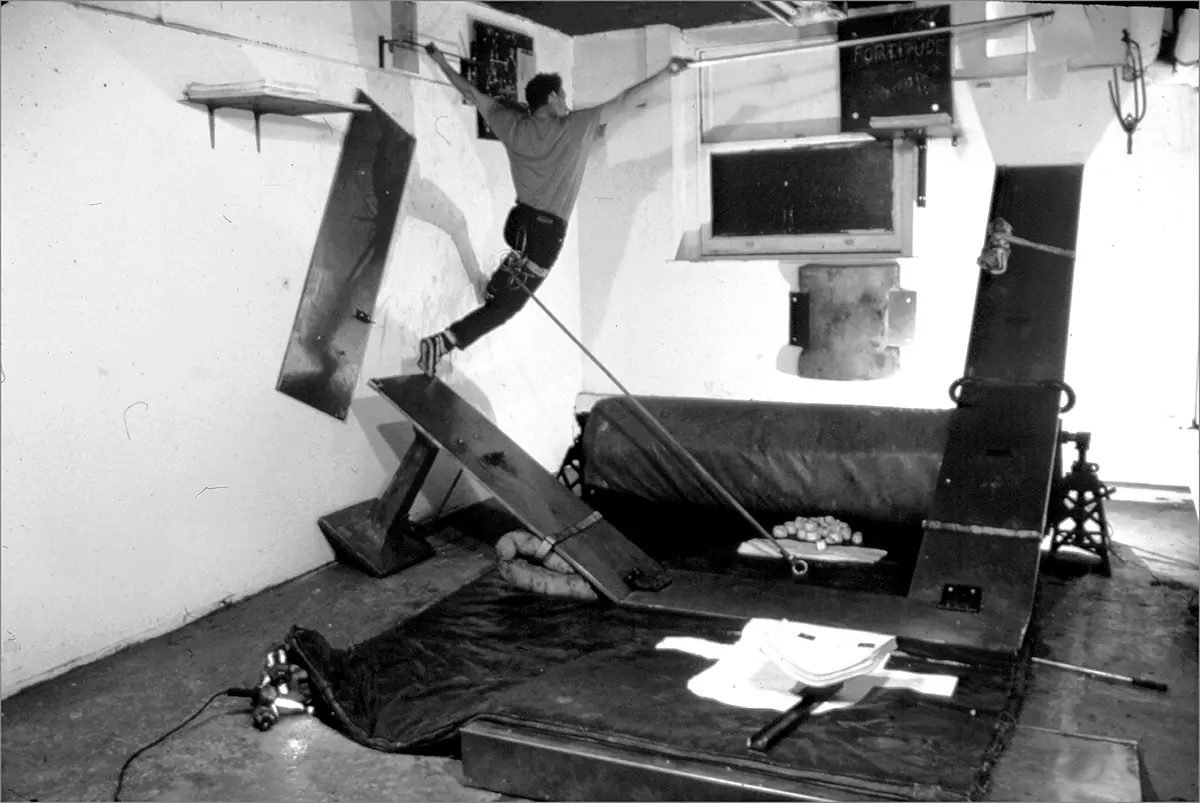
His earliest series of works called Drawing Restraint (1988-1993), applies the strenuous physical exertion of athletic training to the creative process of artmaking. Barney’s own experience as a football player and his interest in how forms —like muscles— can take shape under repetitive resistance, concentration, and endurance led him to make an analogy to the Promethean struggle and inherent will to create. This notion is one of the central and critical meta-narratives of Barney’s artistic oeuvre. Initially created while he was still a student, the performance-based work involved overcoming a physical obstacle in order to produce a material drawing. Using a ramp that extended up two sides of the room with drawing utensils stationed at the top, Barney strapped a cord around his thighs so that the higher he climbed the more resistance he experienced. Similar scenarios involved jumping on a trampoline to produce a self-portrait on the ceiling and pushing a so-called blocking sled used in football practice with drawing implements attached beneath, with the intention of rendering a graphic mark.
The process —involving pure drive and the discipline needed to transform energy into something useful— is the most interesting aspect of production for Barney; the tension between desire and discipline excites the artist far more in fact than the actual work of art itself. To explain this idea, Barney developed a physiological three-stage model whereby Situation is equated with desire, Condition with a disciplinary process, and Production becomes the generation of form manifest through anal and oral channels.1 Barney sees this model as a type of “sexually driven digestive system” that is most stimulating when the cycle oscillates between Situation and Condition —staying at the level of infinite potential and unresolved proposals.2
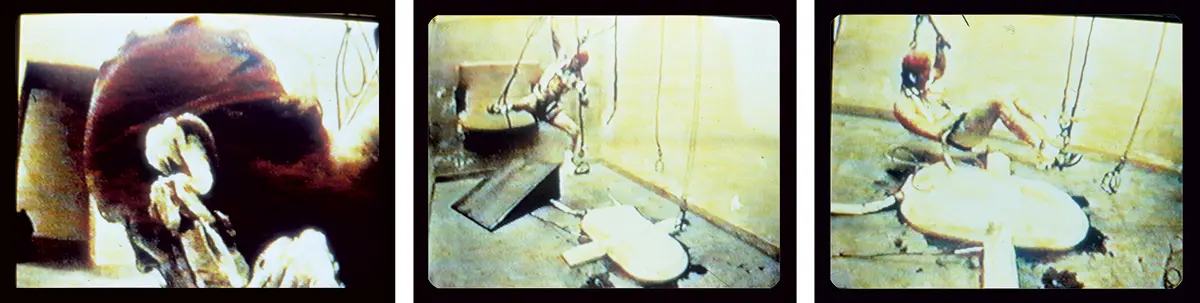
A psychosexual vein clearly runs through all of Barney’s work where the body —a self-enclosed organism— becomes the site of unlimited possibility spurred on by a combination of libidinal desire and physical restraint. In his “video-action” Field Dressing (orifill) of 1989, Barney metaphorically produced this threshold condition by climbing up, and sliding down a metal pole inserted into Barney’s signature “field emblem,” and repeatedly filling all of his bodily orifices with frozen petroleum jelly. By blocking off all external passages, Barney was ensuring the self-contained state of the organism operating between Situation and Condition, and given this logic, his performance suggests that desire —like the process of building a muscle or creating a form— can increase when subjected to physical discipline and resistance. According to Barney, this conceptual framework is represented in his “field emblem,” an iconic motif that is ubiquitous in his work and has come to function like a personal brand logo. The emblem, a capsule shape bisected by a horizontal rod, was developed by the artist as a symbol of an organism and its self-imposed closure.
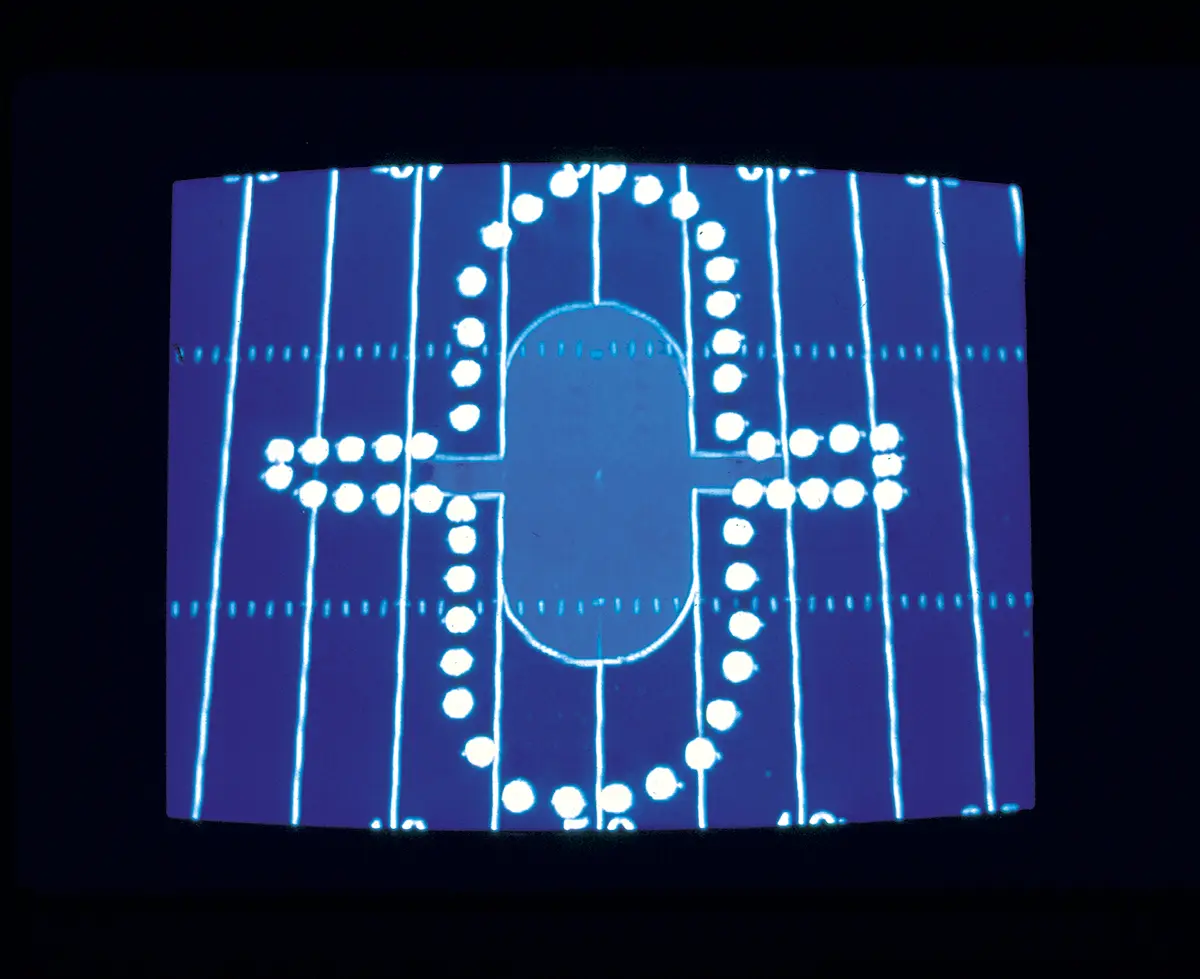
The idea of conflict within the organism or enclosed system is at the core of Barney’s elaborate narratives. Characters such as Jim Otto, an offensive lineman for the Oakland Raiders from 1960-1975, and Harry Houdini, an escape artist able to free himself from handcuffs, padlocks, and other harrowing forms of confinement, have come to represent opposing psychological and biological states. Otto is the symbol of raw and undisciplined desire and the excessive expenditure of energy, “a body susceptible to mutation, penetration, and differentiation."3 While Houdini is the personification of positive restraint who through discipline is able to escape from self-imposed controls and transcend physical limitations. These figures, or “character zones” as Barney refers to them, appear in a variety of guises in nearly all of Barney’s projects and represent the internal conflict to preserve a state of equilibrium and to avoid differentiation, a struggle which in the end will never fully be resolved. The internal struggle incarnated through the figures of Houdini and Otto made appearances in several of Barney’s early works such as his Jim Otto Suite (1991), [facility of incline] (1991), [facility of decline] (1991), RADIAL DRILL (1991), the Transexualis project (1991), and OTTOshaft (1992), and would again play a part in his Cremaster cycle operating as vessels that represent complex ideas and psychological states.
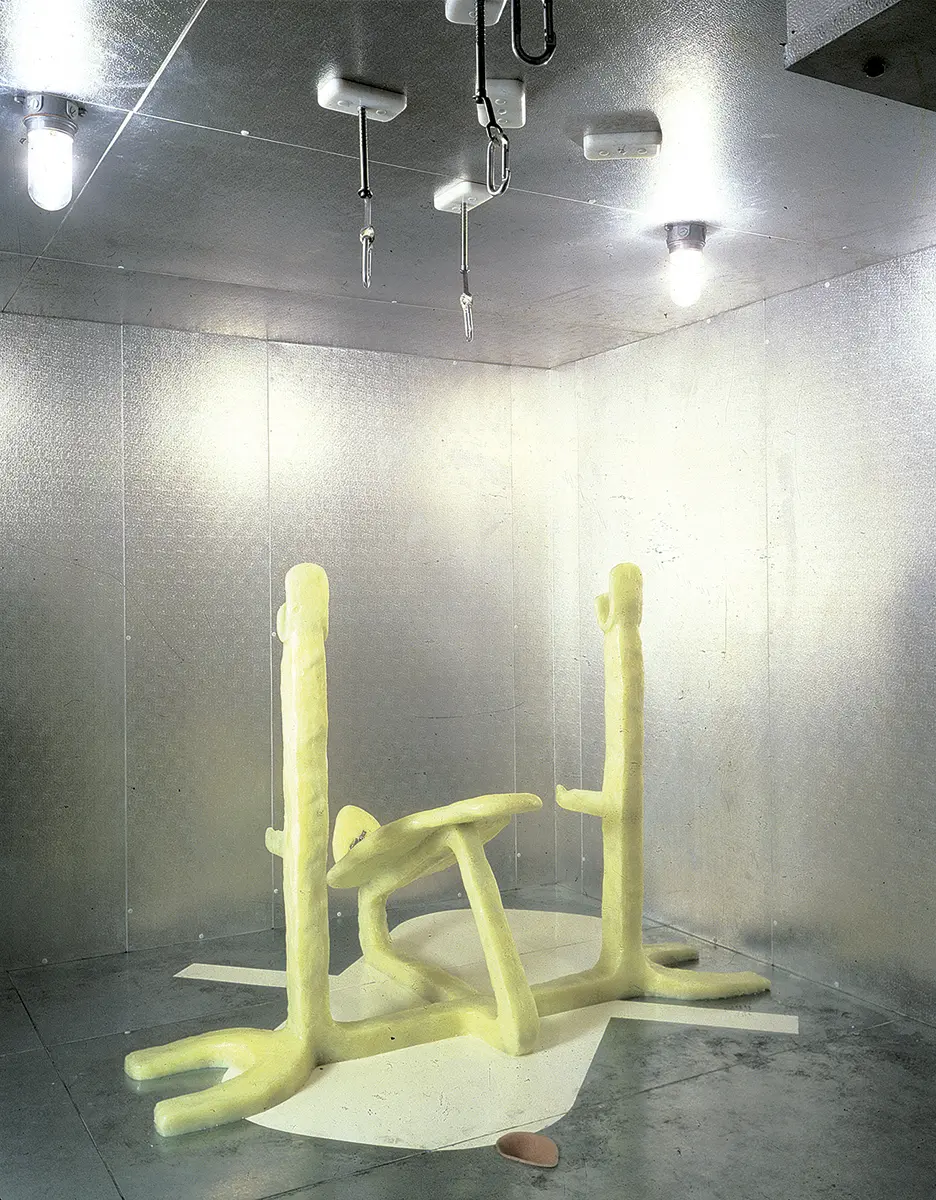
As always with Matthew Barney, there are multiple layers of meaning and numerous conceptual approaches invested in each of his projects. His theory of the threshold or the liminal zone of potential is also represented in works through references to the process of embryonic development and sexual differentiation. On one level it represents the idea of gender mutability, but more importantly, it is a manifestation of Barney’s obsessive interest in exploring an infinite space of potential and the energized process that takes place before an actual transformation occurs. The theme of sexual differentiation can be found in his performance videos and throughout the Cremaster series and can be seen as the principal leitmotif that structures his entire body of work.
During the early stages of fetal development, the internal gonads either ascend to become ovaries or descend to become testicles. Immediately before this biological transition takes place the embryo is essentially gender-neutral, and this state of undifferentiation represents for Barney a place of indeterminacy and ever-present potential. The idea of ascension and descension is directly related to the process of sexual differentiation, and this vertical movement is played out through objects, performances, characters, geographic landscapes, and architecture, and functions as a narrative vehicle to articulate Barney’s rather cryptic conceptual framework. Changes in temperature are also tangentially related to Barney’s idea of the undifferentiated state, as a movement of the testicles in the male body responds to outside temperature and emotional conditions. Regulated by the cremaster muscle, this upward and downward movement ensures the potency of sperm and protects the male reproductive system. The video-action, Field Dressing, conveys this structural framework as the character moves from the warm field of the ceiling and descends to the frozen field of petroleum jelly below, and after closing off each orifice with the viscous substance, he ascends once again to begin the cyclic process anew without ever resolving the conflict.
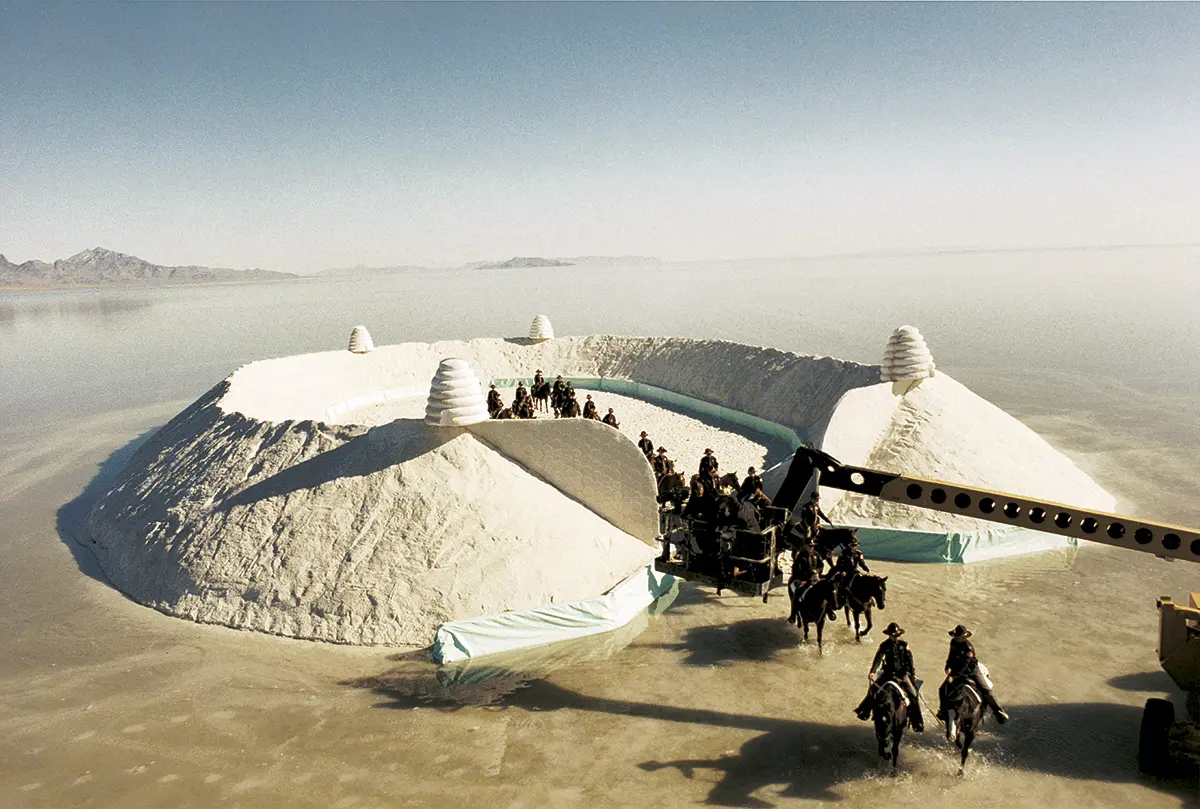
Barney’s oblique and less-than-straightforward logic often makes his work seem impenetrable and difficult. If his artwork was merely dense, no one might bother to decipher its many mysteries, however, the films are often strikingly beautiful, both in their formal presentation and in their conceptual logic. His five-part Cremaster cycle, begun in 1994, incorporates autobiographical material and personal fantasies together with mythological, historical, and popular characters, cosmetic prosthetics, and symbolic locations all within seven and a half hours of opulent and often disturbing visual imagery.4 Shot out of sequence, Barney began his film series with Cremaster 4 followed by 1, 5, 2, and ending with Cremaster 3 in 2002.5
Each film in the cycle exploits a distinctive recognizable film genre: the Hollywood Musical Extravaganza [#1], the Gothic Western [#2], the Gangster film [#3], the Car Chase/Road movie [#4], and an Opera set in five acts [#5]. While Barney inhabits these genres for his own purposes, they are superficial resemblances and are marked by his own visually indulgent sensibility. Appealing to the pleasure principle, Barney’s films are reminiscent of the decadence and baroque subversion found in Peter Greenaway’s works, as well as in the graphic and visceral imagery of David Cronenberg. His movies are essentially visual, with less than ten lines of spoken word in all five films; the narrative is advanced through an eccentric system of symbols ranging from geography and architecture to characters, objects, and sculptural elements.6 Protagonists in these dramas remain undeveloped and, according to the artist, they “quiver between something understood as a character with agency and something that operates more as a state of some sort, a zone."7 Interestingly, his figures seem to be playing out biological processes whose movements are unknowingly and unwittingly dependent on ritualistic motions and actions, and although they are given names and faces, it often appears as if we are watching a series of biological functions from a privileged Archimedean vantage-point.
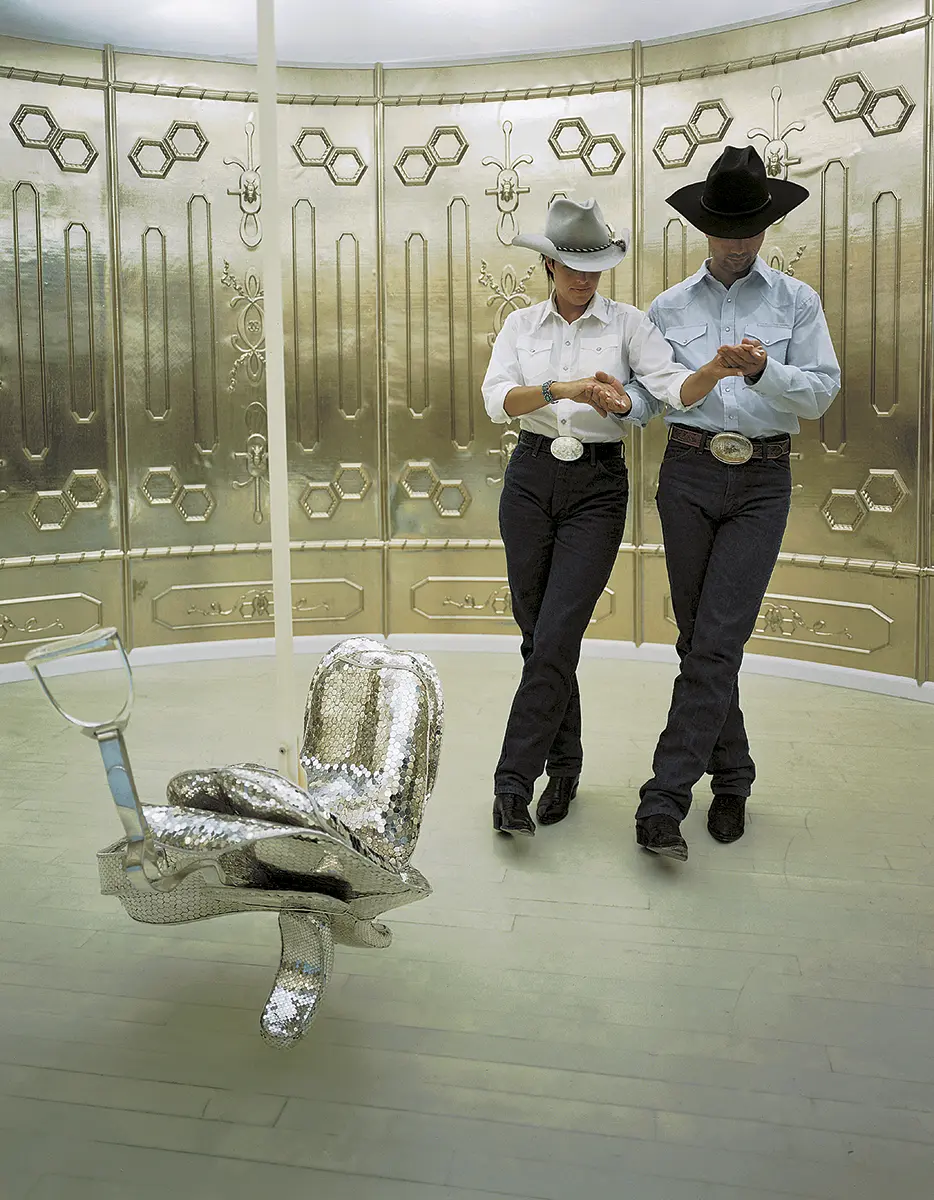
The cycle follows a biological model of embryonic sexual differentiation as conceptually envisioned by Barney, whereby Cremaster 1 represents the most ascended state of undifferentiated gonads and gender-neutrality, and continues through the process of gender definition to Cremaster 5, which represents the final descension and the fully realized male state. Although the Cremaster muscle itself is not the actual subject of the films, its role in the process of regulating the height of the testicles makes it a useful metaphor for the overall structure of the narrative. To the extent that gender differentiation is a central issue within the films, it also acts as a metaphor for the process of creativity as derived through internal struggle— a theme that has undergone many incarnations in the trajectory of Barney’s video, performance, and film work. As is typical within Barney’s eccentric and fantastical world, concepts are explained through bodily metaphors and physiological experiences.
Cremaster 1 takes place on an American football field in Barney’s hometown of Boise, Idaho. The main character, Miss Goodyear, simultaneously inhabits two Goodyear blimps that float above the blue Astroturf playing field. From this aerial perspective, she directs a large chorus of dancing girls by moving formations of grapes into distinctive patterns from above. The diagrams reproduced by the dancers reflect many of Barney’s signature symbols beginning with the outline of a barbell, to various forms of cellular divisions, through the “field emblem” and finally representing an undifferentiated reproductive system. If Cremaster 1 represents a state of equilibrium with no sense of internal conflict, then moving through the cycle the idea of conflict is introduced into the narrative in Cremaster 2, desire and self-imposed resistance are merged with hubris in Cremaster 3, differentiation metaphorically begins despite resistance in Cremaster 4, and male differentiation is finally realized in Cremaster 5.
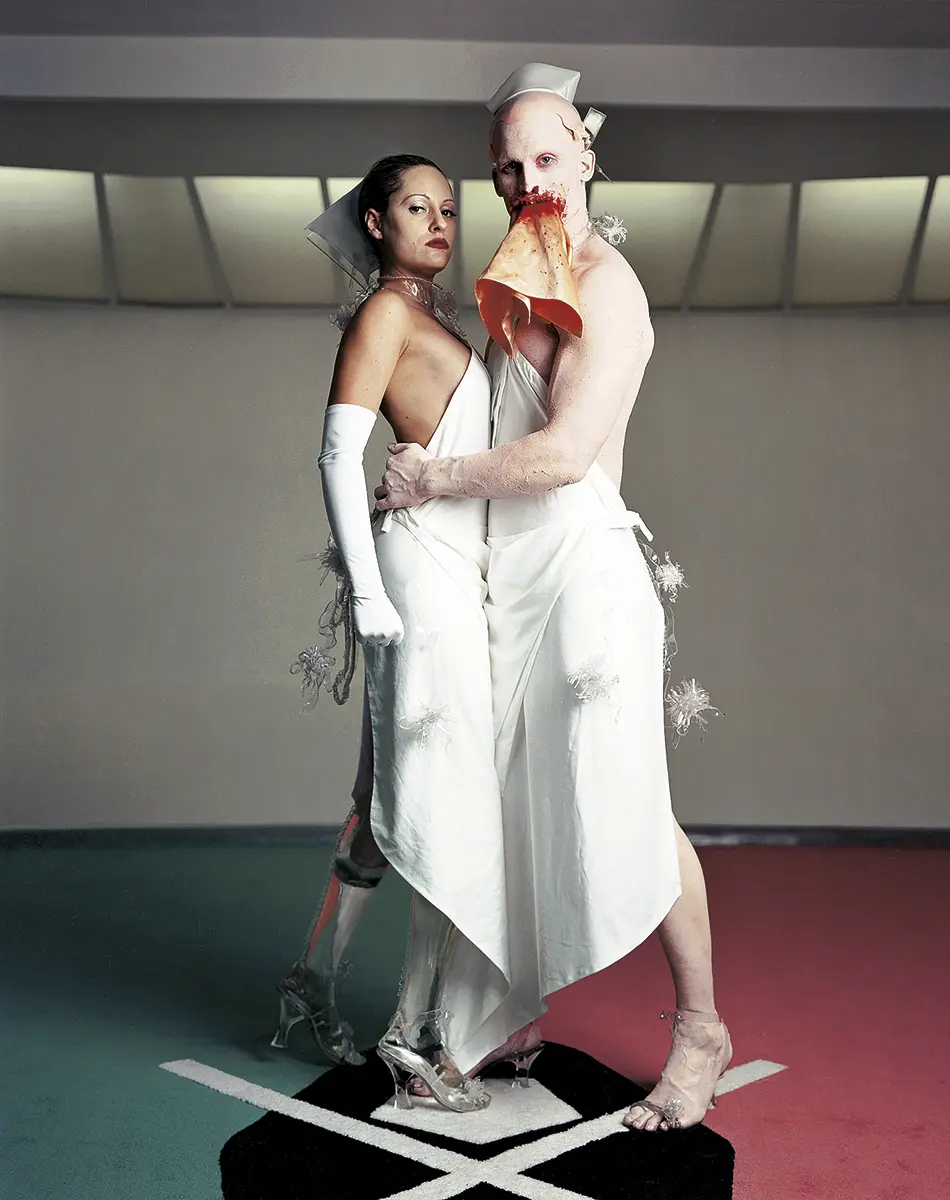
While the first three chronologically produced films —Cremaster 4, Cremaster 1, and Cremaster 5— seem to adhere more closely to the conceptual idea of gender differentiation, the last two films created in this series, Cremaster 2 and 3, have more elaborate and complicated narratives and are far longer, making these films more difficult to decode. Cremaster 2, incorporates historical figures such as Gary Gilmore, Harry Houdini (played by author Norman Mailer), and Johnny Cash in a complex story weaving together Mormonism, murder, and the life of bees within the geographies of the Canadian Rocky Mountains, the Bonneville Salt Flats in Utah, and the Columbian World’s Fair in Chicago in 1893. It would be far too complicated to describe each film in the detail it deserves, but suffice it to say that all of the characters played by Barney such as Gary Gilmore [2], The Entered Apprentice [3], The Loughton Candidate [4], and the Diva/Magician/Giant [5] must overcome physical and emotional constraints moving inexorably toward the final denouement in the Gellért Thermal Baths in Cremaster 5. In fact, Barney’s ending is ambiguous, and although male differentiation ultimately does take place, there are signs that this process may not be final, thus pointing toward irresolution of the conflict and the return to the first phase of the cycle.
Spatial mapping is an important component of Barney’s work and appears at both the micro-level and macro-level through his aerial views of choreographed dancers, patterns of mounted state troopers, a ring of bison, the circular configurations made by the Chrysler Imperials, and of course the ambiguous finale which loops back around to the beginning of the series in a circular movement. On a much larger scale, Barney has mapped the entire geographic space of the cycle moving in an easterly direction with five points of entry beginning in Idaho through the Rocky Mountain range, to New York and the Isle of Man, and ending in Budapest at the Gellért Thermal Baths. Barney’s conceptualization of space allows these patterns and locations to become enclosed systems and permits him to think of these spaces as formally constructed objects. Accordingly, all materials produced by Barney for his Cremaster cycle —the films, photographs, drawings, books, and installations— form part of what he deems a sculptural practice. In other words, Barney views the entire universe of forms within the constellation of the cycle as one multidimensional artwork.
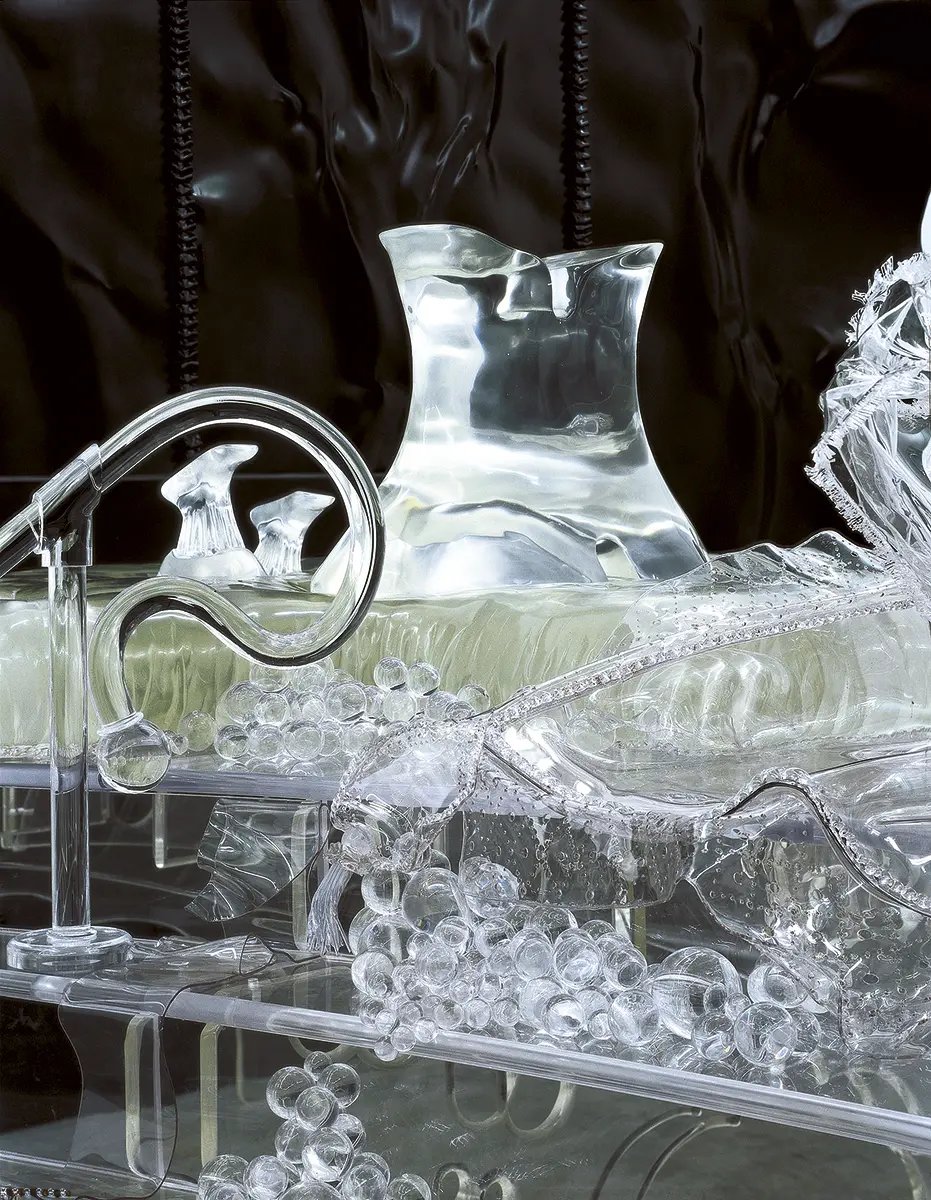
Given the very esoteric nature of Barney’s artistic proposal and the difficulty of the overall narrative, it seems curious to find such widespread interest in his work both among the general population and in the art world at large. So why are Barney’s visual narratives so popular and why have they received almost universal critical acclaim from the moment he appeared on the radar screen? One theory is that Barney became popular at a time when the art world had wearied of identity politics, and while it is true that his production touches on important social issues —such as critiquing constructs of masculinity— his work is not aggressively political. His approach, in contrast, is autobiographical and uses oblique narratives and internal logic to create extravagant and contemporary mythologies. It might also be said that his artwork fills a void in our information-driven culture —it offers the viewer a chance to decipher complex stories and to freely explore private dreams and fantasies. Mass media tends to spoon-feed its audiences using laugh tracks, emotion-laden music, and simple plots to tell a story. Barney’s work alternatively provides an opportunity to slowly and thoroughly analyze intricate visual narratives and to lose oneself in a mythological world where desire, randomness, and eccentricity are paradoxically converted into order.
*All images illustrating this article are a courtesy of Barbara Gladstone Gallery.
NOTES
1. Thyrza Nichols Goodeve, “Travels in Hypertrophia,” Artforum 33, no. 9 (May 1995), p.117.
2. A short but interesting interview with Matthew Barney can be found on the following Public Broadcasting System website: http://www.pbs.org/art21/artists/barney/clip1.html.
3. Nancy Spector, “Only the Perverse Fantasy Can Still Save Us,” Matthew Barney: The CREMASTER Cycle, (New York: The Solomon R. Guggenheim Foundation, 2002), p.12.
4. The five films in the Cremaster cycle were originally shot on video and were later transferred to film.
5. The Cremaster cycle was filmed according to the following sequence: Cremaster 4 (1994), Cremaster 1 (1995), Cremaster 5 (1997), Cremaster 2 (1999), and Cremaster 3 (2002).
6. Spector, p.82.
7. Jérôme Sans, “Matthew Barney: Héros modernes/Modern Heroes,” Art Press, no. 204 (July–August 1995), p.7.
CHARMAINE PICARD
Art Critic and Doctoral Candidate in Art History at the University of Chicago.