
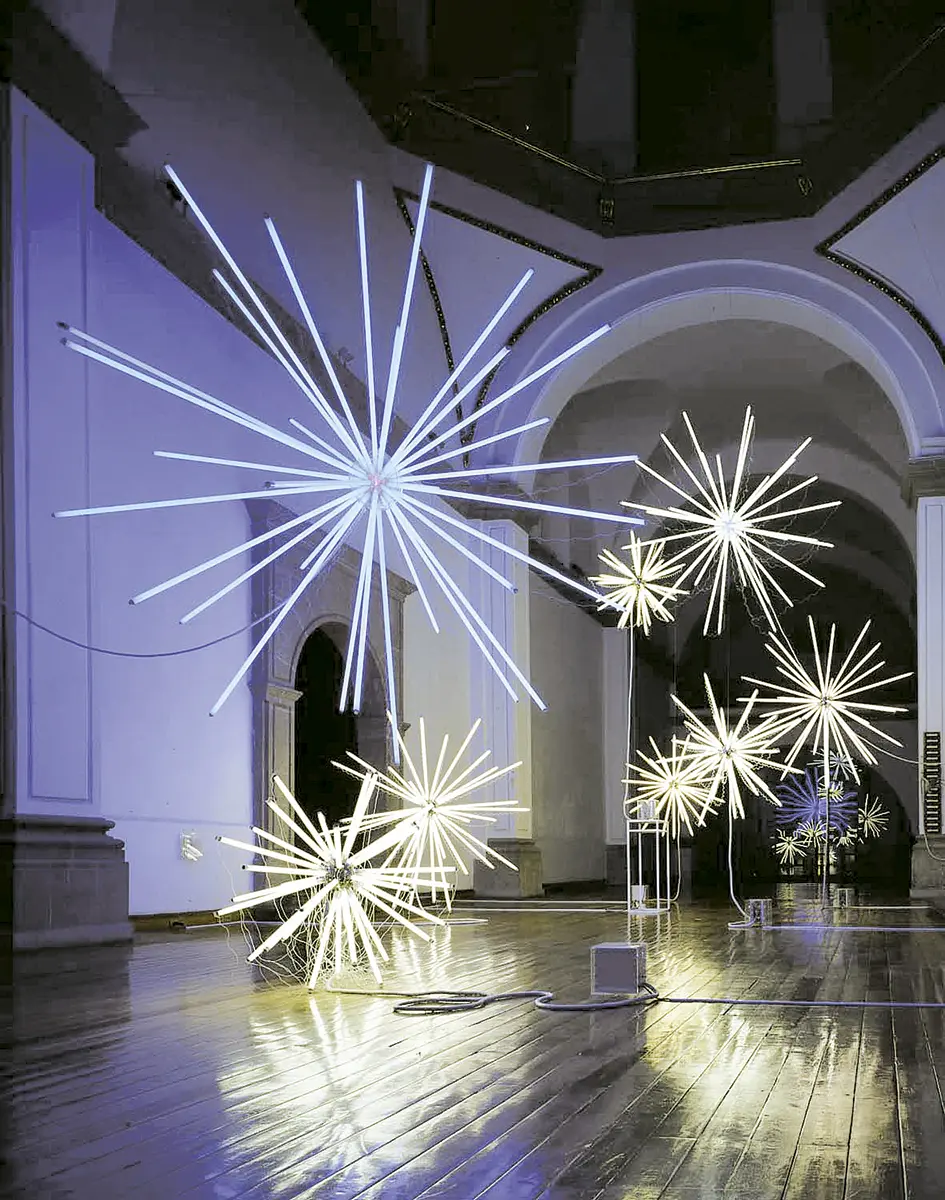
Thomas Glassford (Laredo, Texas, 1963) presented Event Horizon at the Laboratorio de Arte Alameda in Mexico City, between February and May of 2003. It was specifically conceived for the central aisle of the building, formed by eight stars of the Asters series, each one of a different dimension and of subtle detail that makes them unique. Each star is basically made out of a core of chrome or clear acrylic (in the case of the larger stars) from which industrial fluorescent light tubes, of various dimensions and colors in some cases, emerge. From the end of the luminous tube to the core, a spiral cable connects the end with the core. The electric current is fed to the stars through a white “hose” that comes out of an electric transformer situated right underneath each structure and placed on the ground, inside of a clear acrylic box. Each one of these electric transformers is at the same time connected to a current box, also visible from the central aisle of the museum, and it neatly allows the view of what usually would be hidden for being part of the technical operation, in this case, an essential part of the piece. Each one of the details that form part of Event Horizon is taken care of and ordered, adding to the shocking beauty of the piece and conquering this space of great dimensions and complex characteristics with this large-scale installation.
The artist's statement explains in the following way the reference to the title of the piece: “Event Horizon refers to the membrane of a single sense or to the field that surrounds the black holes, one of the characteristics that define these astrophysical objects preconceived by Einstein’s theory of relativity. This concept places Glassford’s recent large-scale installation within the sphere of astronomy, and more specifically, it links it with the stars and their relation to the black holes. When a star starts to be attracted to a black hole, the rays of light are slightly affected by gravity. As the attraction continues and the density increases, an Event Horizon forms. The Event Horizon is a special surface traced by the rays of light that won’t ever escape towards infinity, far from the star, and neither will they fall into [the star] again. However, in a dynamic system such as a collapsing star, the Event Horizon is generally expanding, although eventually it will stop doing it, once all the matter has fallen inside.”
Because of the specific nature of fluorescent light, which slightly flickers, the stars seemed to slightly vibrate in space. The biggest star, with tubes of blue light and a translucent red core in the center, is, due to its size and color, the most distinctive of them all; it stands out from the rest and achieves a perfect balance in the composition. The reflection of the light on the floor of the aisle, as on the enormous glass that separates the entrance from the room, augments the spectacular nature of the piece, multiplying the light.
Two of the key characteristics in Glassford’s pieces are the use of common materials, industrial and domestic, and the construction of pieces that transgress languages by oscillating between drawing, sculpture, installation, and objects. These ever-present characteristics in the work of Glassford have reached a constant sophistication. Asters, a series that is still evolving —in this case and jointly taking the aisle of the temple in San Diego to give life to Event Horizon— can trace its influences back to minimalist works like those of Dan Flavin, whose typical work materials were the tubes of light that Glassford also uses here. Further than any art historical reference, of which we could trace many, they would not be enough to argue in which sense this installation stands apart from any tradition modifying the space in a live and passable analogy of sidereal space.
Event Horizon demonstrates the technical, aesthetic, and conceptual mastery of the artist. The transformation of the aisle into a piece of cosmic space, the level of detail that endows each structure with unique characteristics and a feeling of greatness, and closeness at the same time, is indescribable in words and glorious in sensations. The surprise of recognizing the materials that we see daily transformed into these beautiful luminous structures and the power of the whole allows it to be appreciated for its simplicity, genius, and of course, greatness.
FRANCISCA RIVERO LAKE