
In accordance with its institutional mission of promoting the arts of design and printing in their multiple manifestations, the Carlos Cruz-Diez Museum of Printing and Design presents an exhibition of works by sculptor William Barbosa, titled Puertas (Doors). The montage, comprised of small models and photographs of doors created for different construction projects throughout the country, attests to the vitality and current value of that old project, the integration of the arts.
The useful does not exclude the beautiful but benefits from it. In Barbosa’s case, industrial appropriation is only a tool that makes explicit the primacy of the aesthetic. As a craftsman, Barbosa built pieces for other sculptors, achieving in the process a mastery of metal, and as a metallurgy salesman he got to know the secrets and the demands of the trade. The old Bauhaus dream of incorporating art into the city, making functional use of an aesthetic object, is apparent in these works created by Barbosa as a sculptor and as a craftsman. Art, architecture, and industry come together in harmony to achieve a balanced visual and spatial communication.
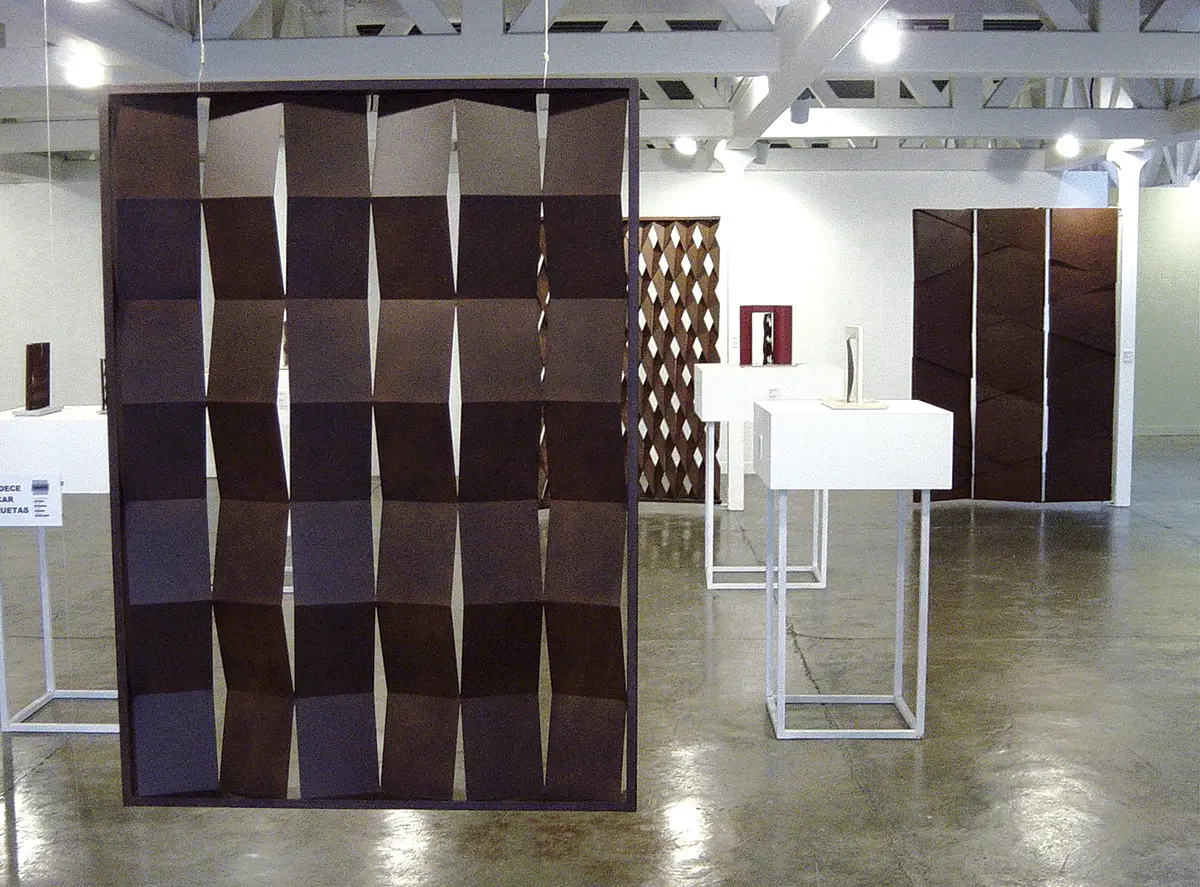
A constructive sense guides Barbosa’s work. In the 1980s, the artist found the motif for the creation of his first sculptures in geometric shapes. Later, these shapes morphed one into the next to create a kind of weaving where space and form, line, and matter gave the piece dynamism and flexibility. As a result of these two cuts, Barbosa achieved a modular geometry that seduced the viewer with the malleability of its shapes. “With its high constructive purity, its simplicity, and the plasticity of its resolution,” says Félix Hernández, the show’s curator, “this modular geometry brings up the idea of expansion in the surrounding space-time, and it keeps, in its execution, a visual secret. In this sense, the tensions and stimulating planes achieved do not fall back into stability but increase the piece’s spatial complexity through a combination of folds, angles, sinuosities, curves, and cut-offs, resulting in shapes that shift according to the viewer's point of view...”
The composition of Barbosa’s sculptures tends to be asymmetrical. These works’ playful character propitiates a dynamic interplay of light, movement, and rotation, creating a gravitational set between space and matter whose vitality and organic nature contrast sharply with the metal’s heaviness and inertia. Given the characteristics of his art, Barbosa’s declares himself a follower of the tenets of the Madí group, with which he developed a close affinity in the mid-1990s.
The formal relationship between Barbosa’s Puertas and his work in sculpture gives the former a unique, unrepeatable character; thus, the exclusivity of his designs for residences in the capital city becomes a privilege, both visual and practical, for the residents’ inhabitants. The originality of these doors is a prelude, a reminder of those majestic entryways to the palaces, temples, and citadels that signaled the prestige and power of ancient sultans, kings, or emperors, who often safeguarded their private domains from the rest of the world by means of beautiful architectural enclosures. In this sense, the symbolic and aesthetic connotation of Barbosa’s portals for shopping malls, commercial establishments, and private homes, created for the consumer’s pleasure and enjoyment and to safeguard their inhabitant’s privacy, reaffirm the sense of beauty that should characterize a society for which artistic creation is among the major priorities, since the refinement of our sensibility, conducive to aesthetic enjoyment, is achieved through the perception of form.
GLADYS YUNES