Why this obsession with fruits, fish, and women in cozy settings taken from the artist’s own surroundings? I believe that Amelia, consciously and unconsciously, was utilizing the obvious symbols of femininity and fertility as metaphors.
GIULIO V. BLANC
While a fair amount has been written on Amelia Peláez, the artist, (1896-1968) little has really been said about the woman. She is usually portrayed as a modest, self-effacing person devoted to her home and garden and with a deep appreciation of the natural and man-made beauty of Cuba. It is not the role of the art historian to seek out intimate details of an artist’s private life, but when these details shed light on their work, they cannot be ignored. The biographical approach has served us well in the case of such artists, to take but two examples, as Pablo Picasso and Frida Kahlo. A knowledge of the lives of these complex individuals is basic to reach a complete understanding of their paintings. It is possible to look at art on the superficial level that is form and color and on the deeper levels to which the intellect and emotions respond, but it is much more useful to have at hand certain “keys” that allow us to penetrate into the artist’s psyche.
In the work of Amelia Peláez, we can limit ourselves -if we wish- to the masterful prism created by the artist through an assimilation of Cubism and other modernistic innovations. Her interpretations of the forms and colors of Cuban architecture and flora are dazzling in their kaleidoscopic variety, a pleasure to the eye and mind and, in their apparent coziness and domesticity, also to the heart. But there is a subterranean level of nostalgia, eroticism, and fantasy which the perceptive viewer can often glimpse through the intricate surface of stained glass, grillwork and foliage. The artist herself admitted this when she noted that her art was a subjective response to the outside world1. However, her legendary reticence, the result of a Cuban Victorian upbringing and a natural discretion, prevented her from elaborating on this and caused her to create a self-protective facade of quiet spinsterhood.
One key to understanding the underlying psychology of Amelia Peláez is her uncle, poet Julián del Casal (1863-1893), who despite having died three years before her birth, his memory was kept alive in the family and Amelia developed a special attachment to him. Del Casal belonged to the species of dandy-aesthete. The last decades of the nineteenth century and the early twentieth were the golden age of the dandy-aesthete, producing such artists and writers as Marcel Proust, Oscar Wilde, Gabriele D’Annunzio, Gustave Moreau, Aubrey Beardsley and Ronald Firbank. The passions of these and a host of other, less well-known figures, revolved around the cult of beauty and the artistic and literary currents of Orientalism, Symbolism, and Art Nouveau. Like Dorian Gray or the Vampire of legend, their witty and graceful exteriors often concealed dark, destructive impulses involving opium and other forbidden pleasures. But what finally destroyed them was World War I. With the bombardment of the cathedral of Rheims and the death of Rupert Brooke, golden boy of English poetry, and thousands upon thousands of other youths, it represented a victory for Caliban and philistinism over Ariel and aestheticism. While there were survivors, this physical and spiritual carnage and the succeeding decades of ever-increasing vulgarization of culture killed their bright and brittle spirit.
Julián del Casal, as is abundantly clear from his writings, identified fully with the great dandy-aesthetes of his time in Europe2.Courageously, he was their representative in Havana, which had never seen his like in terms of eccentricity and non-conformism. His room with its Japanese decor, his satirical attacks on pompous Cuban grandees, and the platonic romance with Juana Borrero, consumptive girl-poet, are further evidences of Julián del Casal’s dandyism. Unfortunately, he died young in true dandy fashion after a brilliant remark at a dinner party caused him to strain his tuberculosis-weakened lungs in a fit of laughter. The romantic, cult-like veneration given to his poetry and exterior personality has, as in the case of his niece Amelia, obscured the true nature of the man. But the decadent, sensual, melancholy quality of his writings reveals a sense of alienation, a hidden personality that the world would never understand or accept. In sum, if Julián del Casal shared the virtues of the European dandies, he must have also shared their vices, at the very least in a repressed fashion. His work, especially the essay My Last Illusion, with its longings for the “abnormal” Paris of Huysmans and Jean Lorrain, allow us to make this assumption3.
Amelia, who was to illustrate her uncle’s most decadent poem, The Agony of Petronius in 1935, understood him well4. Her own life reflected his, but on a different scale. She was never flamboyant, sarcastic, or camp. She was, however, an independent spirit, unto herself, disdainful of philistinism, living a secret, interior life. If Amelia admired the detachment from everyday life, the uniqueness, the quest for an ideal dream existence of her uncle, she rejected the more negative manifestations of dandyism. Internalizing her fantasies as well as her realities, she re-expressed them through her art.
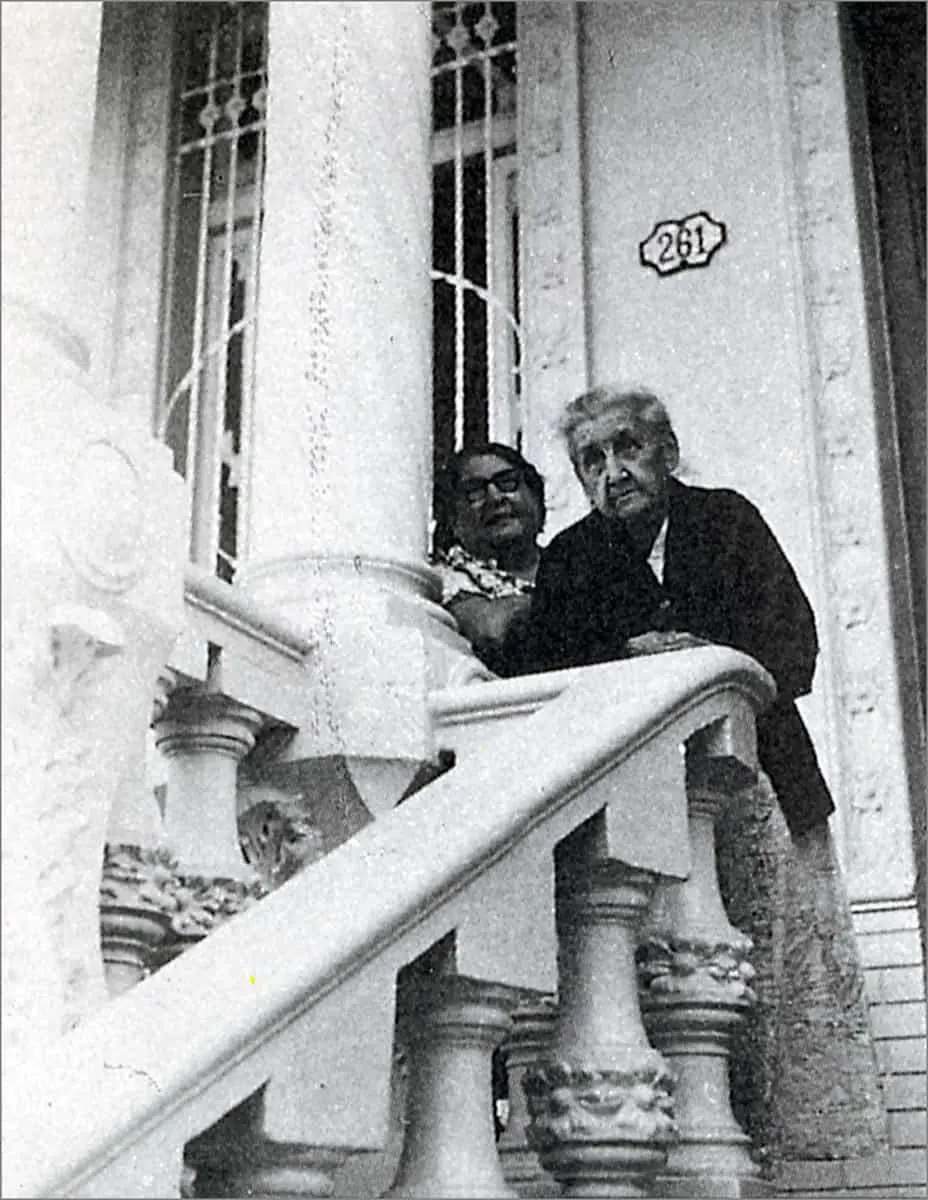
Amelia’s invented world was a feminine one. Her home, the Villa Carmela, was named for and presided over by her formidable mother, the widowed Doña Carmen del Casal de Peláez. In later years it would be shared with the artist’s unmarried sisters Irene and Carmen. The Villa Carmela was a typical old-fashioned Cuban house with high ceilings, tile floors, and delicate knick-knacks. The back patio-garden, songbirds, and creating desserts were Amelia’s principal sources of relaxation. Order, timelessness and separation from the twentieth century characterized Amelia’s existence here, where she spent most of her life. Curiously, to this day, in the midst of the traumas of family separation and revolution, the last member of the Peláez family remaining in Cuba, Amelia’s sister Carmen, maintains the old house in the Vibora suburb of Havana as it was in the early decades of the century.
On the one occasion that the artist left Havana for an extended period of time, she did so only to find two other powerful female influences. It was Lydia Cabrera, the Cuban writer reminiscent in her beauty, intellect, and freedom of the American expatriate Natalie Barney (the “Amazon” of Remy de Gourmont), who obtained a scholarship for Amelia to study in Paris. She also shared a living and working space in that city with Amelia and arranged for her first major exhibition (at the Galerie Zak, in 1933). In the early 1930’s Lydia Cabrera was involved with painting, a field she would soon abandon in favor of literature and folkloric investigations. Both women had the good fortune to study with the Russian emigré Constructivist Alexandra Exter. "Madame Exter” as she was always referred to by both Amelia and Lydia, became a teacher as well as a close friend and her influence was enormous. But this triangle of work and friendship was interrupted in 1934. Amelia, despite her teacher’s warnings that it was an unwise thing to do in terms of her career, returned to Cuba.
She was not to see Mme. Exter again until after World War II, when she returned to Europe on a short trip. As for Lydia Cabrera, her own interests and other friendships, mainly those with the Venezuelan writer Teresa de la Parra and later María Teresa Rojas (who became her companion of almost half a century) were to occupy her time. She never developed as great an interest in Amelia as a painter as she did in the early 1940’s for Wifredo Lam. Lydia maintains still that Amelia was a fine colorist but left something to be desired in terms of composition5. One suspects certain existing “sibling rivalry” between the two young women for the approval of their demanding teacher and older friend.
There is a certain poignancy at the thought of a thirty-eight year old woman who had lived an independent life in the Paris of the Jazz Age returning to the virginal existence of her girlhood bedroom. Implicit in this was the abandonment of a prestigious European career as well as the renunciation of a “grown-up” life: one with a spouse, lover, children, an own home and possessions. We shall never know what prompted Amelia to choose the route she did. Was it some great disappointment in love, her fundamental aloofness from the things of the world, or the simple reality of an unattached woman who could not support herself either in Paris or Havana in the midst of the Depression? But if from 1934 to her death in 1968 Amelia’s life was that of the genteel, cloistered lady of colonial times, her art went beyond this and reveals a spirit filled with fantasy, longing, and both ecstasy and sadness.
Amelia devoted herself almost exclusively to two types of painting and drawing after 1934: still-lifes and depictions of women alone or in pairs. Already in Europe she had been drawn to these subjects. Various works may be used as examples which clearly reveal, when analysed on a level beyond that of style and form and color for their own sake, something of the underlying psychology of the artist.
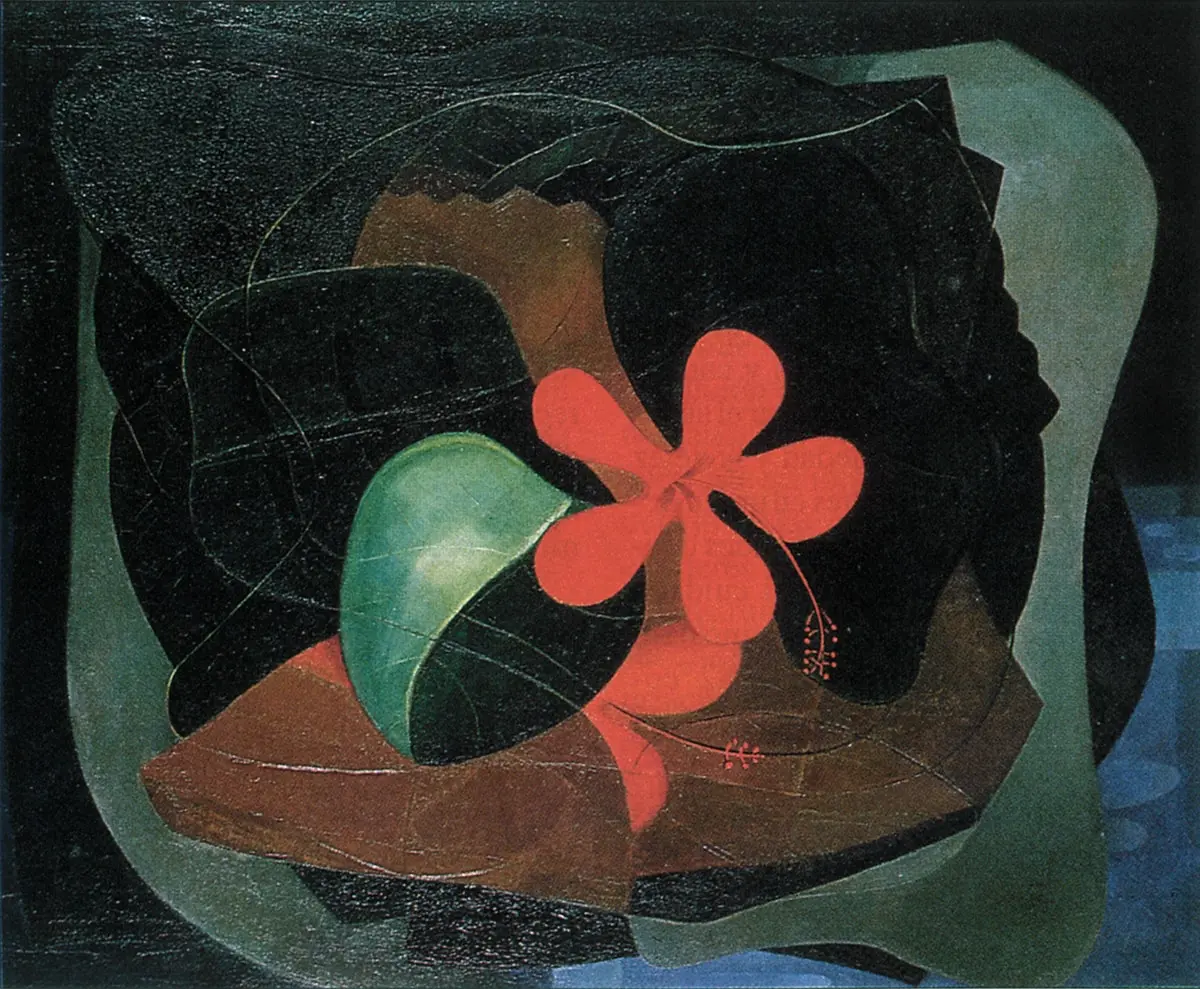
Hibiscus, from 1936 is full of the seductive mystery of a tropical garden in the moonlight. Many different tones of dark blue predomínate and there are layers of abstract, organic forms. But it is the red hibiscuses in the center, protected by voluptuous green leaves, that draw our attention. These flowers are subliminally erotic, recalling the female sexual organ; they are fragile and inviting.
Numerous other paintings from the 1930’s could be cited in which the artist utilizes circular forms, the eternal symbol of femininity, with one or more exotic flowers and fruits. Besides femininity, these circular compositions recall mandalas, those archetypal symbols seen by Carl Jung as representing wholeness and unity on both a personal and cosmic level6. Amelia’s centrally placed still-life motifs thus connote something beyond what they represent.
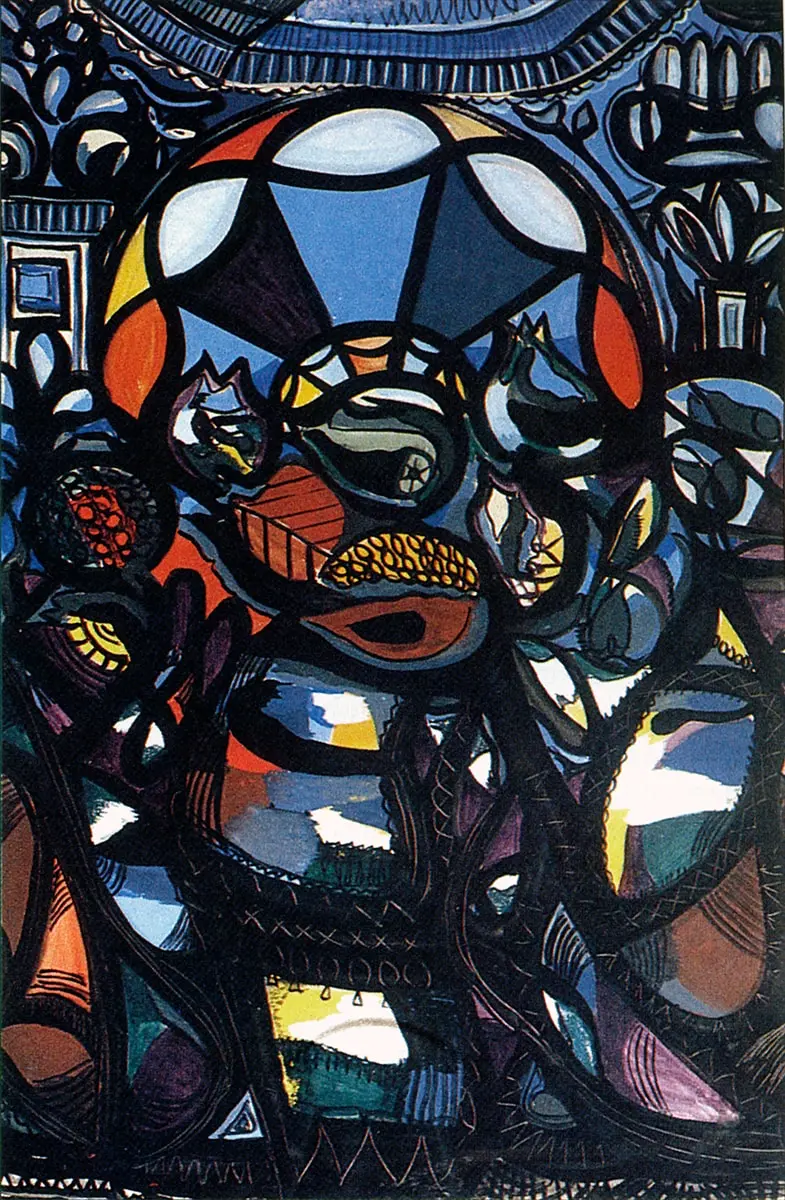
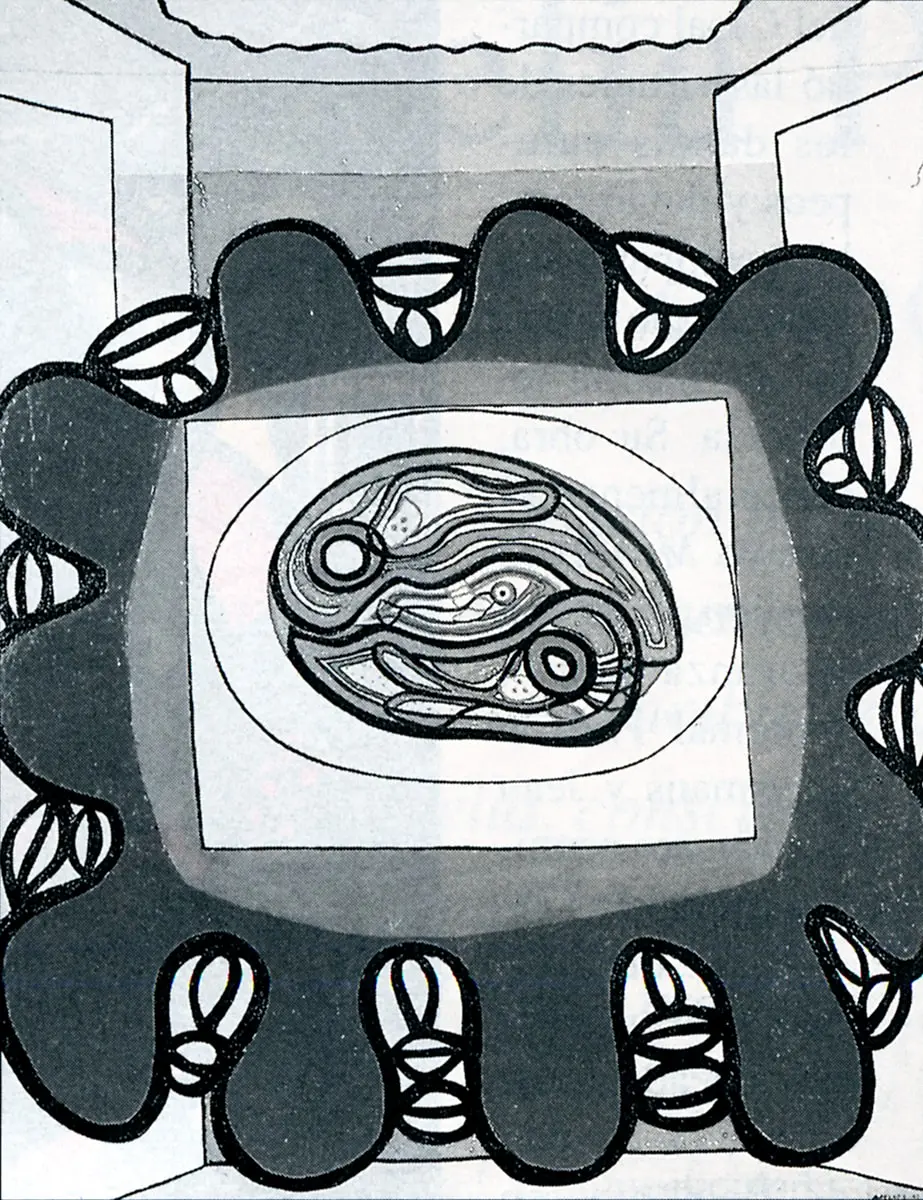
After 1940, Amelia arrived at her “baroque” style in which forms and colors inspired by Cuban colonial architecture, stained glass fanlights, iron grillwork balconies and window guards and columns with Corinthian capitals serve as settings for the previously isolated still-lifes. Now the latter are like hot-house fruits and flowers, even more precious and fragile than before and still exuding a strange exoticism. Pomegranates reveal ruby seeds; there are wedges of rich oranges or red melons; pieces of pineapple, mamey, papaya abound. The artist takes a special delight in depicting the fruits at their most luscious and appealing. Another, if somewhat less common, still-life subject for the artist were fish. Depicted like fruit and flora in an architectural/domestic “frame” of stained glass, columns, wicker, usually in pairs, the fish are set on a dish. Curves and roundness are emphasized and we are sometimes reminded of creatures in an embryonic or fetal State, lying in the womb or in an egg.
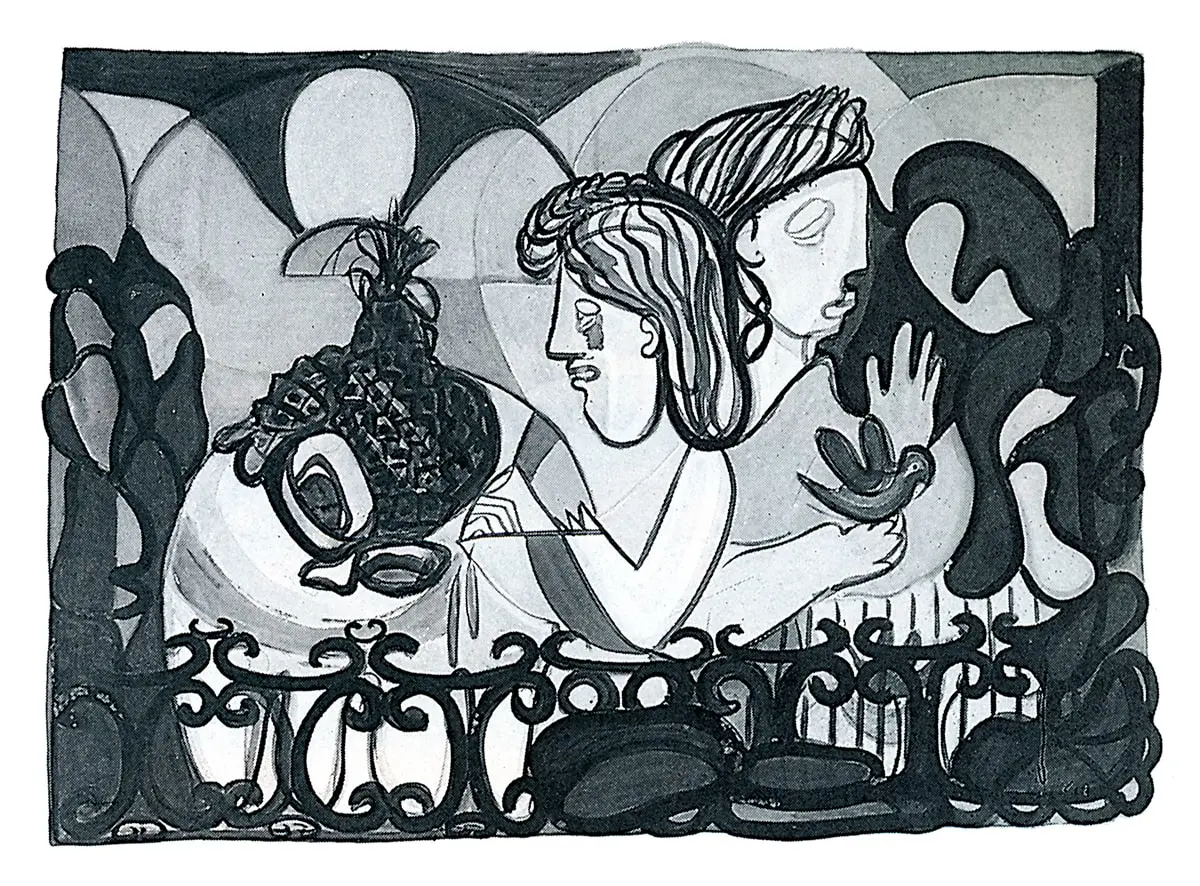
When Amelia does not place a still life at the heart of her composition, she puts one or more women or a woman and a girl there. Sometimes they are shown in conjunction with a still-life motif, although the latter assumes a secondary role. During the 1930’s, the artist created a series of drawings with voluptuous nudes asleep or reclining under a tree or in an interior. During the 1950’s she did various studies of Manet’s Olympia, that much analysed temptress and embodiment of female sexuality. But Amelia’s numerous depictions of two women playing the piano, sitting at a balcony, or reading are especially telling. In The Balcony, a gouache from 1942, we have a double-headed woman who is in actuality two women. One seems more introspective than the other. Next to the women is a still life of pineapple and another, unidentifiable, fruit sliced to reveal its egg-like seed. The two-headed woman and variations on this type continued to interest Amelia throughout her career.
Why this obsession with fruits, fish, and women in cozy settings taken from the artist’s own surroundings? I believe that Amelia, consciously and unconsciously, was utilizing the obvious symbols of femininity and fertility as metaphors. Unable or unwilling to lead the life of most women with a husband or lover and perhaps children, she turned her unfulfilled desires, her repressed eroticism, into symbols that are more than still-lifes, they are self-portraits. Her depictions of women hint at a double personality, an alter ego. In the pairing of stronger with more passive ones, they also bring to mind the artist’s relationships with her mother and sisters and also her friendships with Lydia Cabrera and Alexandra Exter.
For Amelia, the enclosure was the following: a nostalgic, fantastic re-creation of the colonial past of her girlhood, which survived in the family home. What this secret garden or fantasy palace contained was the artist, not as she seemed to be, a plain, self-effacing spinster, but as she existed in the realm of her imagination. Amelia as a fecund, voluptuous woman. Amelia as a free, independent spirit. Finally, Amelia with the ideal friend.
When reading two of Julián del Casal’s poems, Rainy Afternoons and Sad Virgin, one is struck by the parallels with Amelia and her art7. In Rainy Afternoons, del Casal speaks of the melancholy rain seen from the balcony of a colonial house and dreamily evokes distant voices and eyes hidden in the mists, conjuring up forbidden passions. In Sad Virgin, the poet’s heroine dreams of the flowers of other meadows, born under unknown skies... which, bringing to life the fiantes of your senses, engender in your soul new chimeras. He speaks of the disillusionment of this chaste figure at her balcony who flees the materialism of her century in pursuit of ideáis that appear before her in the shadows of deep lethargy.
Amelia Peláez, the woman, is a paradox. She was a modernist who bravely abandoned the conservatism of the Havana academy and became a major figure in Cuban, and Latin American, art in her lifetime. She was a “liberated” woman who lived with the artists and writers of 1920’s Paris. But Amelia was also the shy Cuban maiden of the nineteenth century, protected from the world by the iron grills of her house and the devotion of her mother and sisters. She was nun-like in appearance and liked looking after her plants and parakeets. But somehow these two personalities came together through the medium of her art, reconciling opposites and transforming the realities of a placid existence into a baroque fantasy. In her painting, the artist came to terms with inner conflicts, desires, lost hopes. Beyond the levels that are a unique and masterful style and a homage to the beauty of her island, lies the most profound level of Amelia’s work. It is comparable in its hermeticism (for, ultimately, nothing is ever completely revealed) to José Lezama Lima’s Paradiso, a metaphysical autobiography in which Cuba is more than the reality of what it was and becomes what the artist wished it to be, a lost, romantic Eden. In this Eden of exotic plants and shuttered rooms is the artist, waiting for an imaginary friend, both as she was and as she could never be in “real” life.
NOTES
The biographical data on the artist as well as references to paintings in this article are taken from the catalogue prepared by the author for the exhibition Amelia Peláez: A Retrospective held at the Cuban Museum of Arts and Culture in Miami in July and August of 1988 and the Museum of Modern Art of Latin America of the O.A.S. in Washington, D.C. in September and October of 1988.
1. Consejo Nacional de Cultura, Amelia Peláez, 1968, p. 7, catalogue of the exhibition at the Museo Nacional, Havana.
2, Julián del Casal, Prosas, Biblioteca Básica de autores cubanos, Consejo Nacional de Cultura, 1963, passim.
3. Julián del Casal, op. cit., pp. 226-229.
4. This unpublished illustrated manuscript (the calligraphy was done by the artist’s brother Manuel) is in the Peláez home in Havana.
5. Conversations with Lydia Cabrera, Miami, 1984-1987.
6. For a recent discussion of the mandala in art see The Spiritual in Art: Abstract Painting 1890-1985, New York: Abbeville Press, 1986, passim.
7. Vicente Báez (ed.), La Enciclopedia de Cuba, Vol. 1, pp. 467-468.