
Agnosticism and tribalism sui generis populate Abraham Cruzvillegas’s first solo show in the United States. The show comprises a variety of objects installed on the gallery floors and walls. Cruzvillegas was born in Mexico in 1968 —a key year in world history— and works in two terrains: the literary and the visual. Initially involved in painting, now the plurality of his materials takes us toward an art created ex nihilo, in a spirit of salvage and reconstruction. Cruzvillegas’s work seems to refer to indigenous peoples, but with these indigenous ascendants, the artist creates a visual philosophy that leads the viewer into various traps. He appears to proffer indigenous rituals, but in fact, these are aleatory feasts and unfamiliar ceremonies.
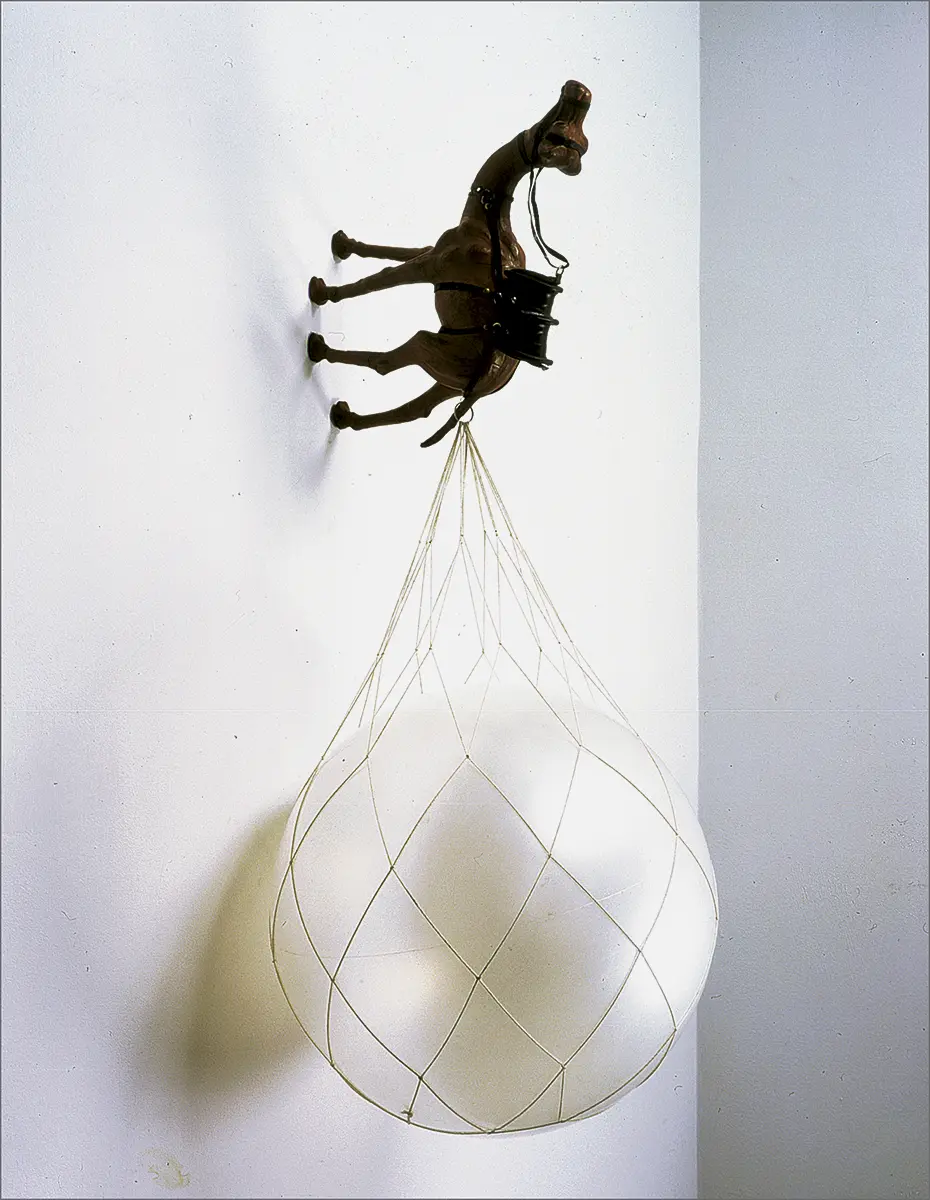
The New York gallery is inhabited by twelve pieces titled in Spanish; other elements in the show similarly reference the language of Latin America: cacao seeds, feathers, cotton, palm trees, maguey, and banana leaves. It should be noted that these allude to Latin America’s native languages and the many dialects of Spanish found on the continent. The reader must realize by now that in this show we find ourselves in an expression of a past and present Latin American-ness. The archetypal materials— mong them potatoes, maize, and yerba mate —signal recognition of the past that Cruzvillegas ascribes to our current civilization. He integrates these with technical and industrially-developed materials —copper tubes, wire threads, metal-sheet reflectors, acrylic, cement, galvanized steel, screws, and nylon wire, among others— to reach a synthesis. There is a tendency toward exoticism fueled by the aforementioned local elements —what has become known as “Mexican curios,” such as those objects that caught the eye of North American visitors to Mexico in the 1950s and 1960s, or even earlier. Feathers themselves are almost excessively beautiful symbols when part of the rituals of various tribes past and present, and beyond that, as part of the insufficiently appreciated animal world. The accumulation of materials, like categories that succeed each other in different historical moments, has been a primitive as well as a baroque revelation. This accumulation and the vision of salvaging materials —even without using them— has been taken up by many artists in the twentieth century. And is what Abraham Cruzvillegas emphasizes: the use of that which is unpolluted, the presentation of segments of a society free of social, political, and environmental corrosion. Some of his work brings to mind parts of sets for old romantic films. His works are anchored in that visual contradiction.
La tarasca, Las guerras floridas, El desnivel, and La gloria: these are some of the titles of the pieces installed on the walls —although not necessarily related to the notion of two-dimensionality. On the floor we find La concordia, El triunfo, La montañesa, La monumental and La fuente de la Colonia. If the sea shells contribute to the previously noted exoticism, they also refer to the veneer of touristic development with which many of Mexico’s marvelous sites are exploited without regard for natural species and materials. La gloria, of cacao and nylon thread, an allusion to religious thread counters and to indigenous accounting specialists, is a beautiful piece reflecting the counting of fruits or sacrifices. Cruzvillegas’s titles coincide with his conceptualization of the historical elements cited earlier. It is not by chance that the artist, as noted, was born in 1968, a year of great socio-political turmoil, including the tragic killings at Tlatelolco, and the riots in Paris and the United States.
GRACIELA KARTOFEL