
When Ángel Ricardo Ricardo Ríos (in what follows, ARRR) confronts his canvas or his paper, he takes off on a kind of light-baggage expedition. After his many adventures, we see him return with several containers filled with shapes, colors, shadows, and drippings that, although linked thematically to other objects he has produced at different times, live a parallel and autonomous existence, an existence that is not subject to other avenues of exploration in his artistic production.
¿Is it a two-dimensionalized sculptural object? ¿Is it a case of painted canvases and papers with drawings being transferred to the three-dimensional realm? In lieu of an acceptable answer, let us say that ARRR’s artistic work has developed fluidly in both directions. Simultaneously in time and completely connected in their development, these directions are nonetheless autonomous in their expressivity. Both ARRR’s objects and his paintings offer a new reading of subjects that not too long ago would have seemed exhausted or in any case the exclusive territory of architects and designers.
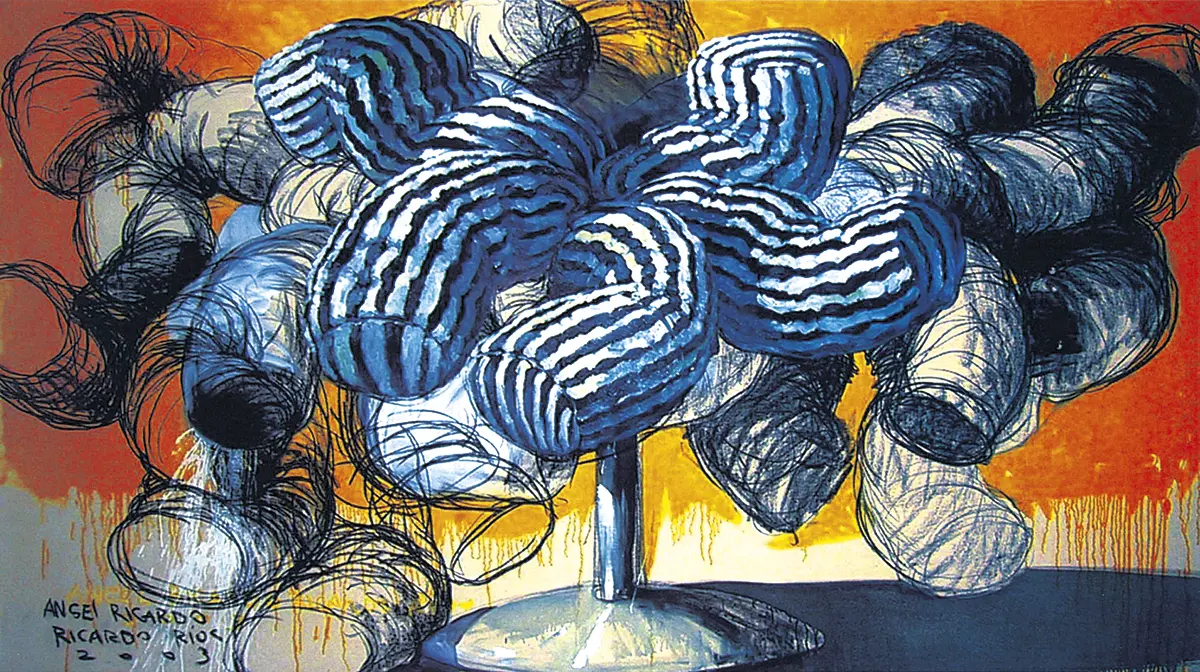
In order to go in search of an original gaze, ARRR takes as his starting point the de-contextualization of objects by means of a displacement of their utilitarian qualities. Besides de-contextualizing objects (be it in drawings, be it in sculptures), he confers on them a peculiar character that makes them appear before our eyes as in between the objectual-sculptural and the diagram- or a sketch-like pictorial, without in them being “just” one of those things.
ARRR’s three-dimensional pieces are perfectly defined objects with a noticeable sculptural vocation (sometimes a utilitarian one) in the same way in which his two-dimensional works are, beyond that which they represent, (disciplinarily) autonomous in relation to the subject of representation.
Perhaps because of this, the misleading asepsis of ARRR’s objects becomes, in his canvases, a quick and seemingly unfinished brushstroke. It is known that much of his painting has evident ties with sculptural objects (and these with his painting); however, this intimate connection between what possesses volume and what is on a canvas goes beyond a mere painting of the bodied and the two-dimensional.
Such an apparently simple disciplinary relationship develops in a parallel fashion. Complementing each other, they coexist. Negating each other, they offer each other support. An ARRR painting in which possible objects are represented is, indeed, a representation, not the objects themselves. On the other hand, objects that have been made and now occupy a three-dimensional space inside a gallery, a museum, or a home, are not something that has been drawn but something with a body and, for even greater enjoyment, something that occasionally carries the generous potential to provide utility for its owner.
In relation to the objects, the viewer is a potential user. In relation to the drawings, the viewer is a desiring being who also carries out the intimate, personal game of competing with his or her gaze the seemingly missing sections in the piece. ARRR’s careful carelessness in giving his pieces the texture of the unfinished is the result of a long meditation on his painting, a meditation where, moreover, he has obsessively placed a blotch here, a shadow there, revealing an author with a minutely detailed gaze and a rigorous process. Witnesses to that are, if any are needed, his evocations of pillows traced in charcoal, announced as outstanding examples of drawing by their volume, depth, location within the plane, and shadows.
Invariably we find that the object of drawing has turned on itself. While our gaze is on the canvas or on the paper, it is also true that our memory is on the object itself. Therein resides one of the work’s strongest appeals: pillows on floating funnels, a mass of pillows lighted on a table or overflowing through the mouth of a cone, undoubtedly the evocation of that which is represented and now made poetry.
I must admit, some of the pieces in this exhibition suggest scenes of lust. Encounters, involvements, flight attempts, these are some of ARRR’s achievements; when a lounge chair (or something like it) surrounds an enormous roll of pillows, or when two very big shapes meet, sensually fusing and making absurd the existence of two bases that at any other time would separate them.
These large groups of pillows seem restless. The feeling comes perhaps from inside them, or perhaps from the language of comics —where drawing is the main feature and expressivity its most distinctive characteristic. This is why a beam of light is an enormous triangle and the soft shapes represented take our eyes comfortably from one curve to another, from one fold to another; from encounter to encounter.
ARRR’s work contains the singular energy of the creation that evokes not only other disciplines but other ways of seeing. His approach to things, to things within his canvases; to his canvases, which are in his study surrounded by things-all of this denotes a creator capable of manifestly translating different expressive languages. A pillow here, and there a table, striped canvases it's all the same. Painting continues to represent. The participants appropriate all the passions told therein.
SANTIAGO ESPINOSA DE LOS MONTEROS