
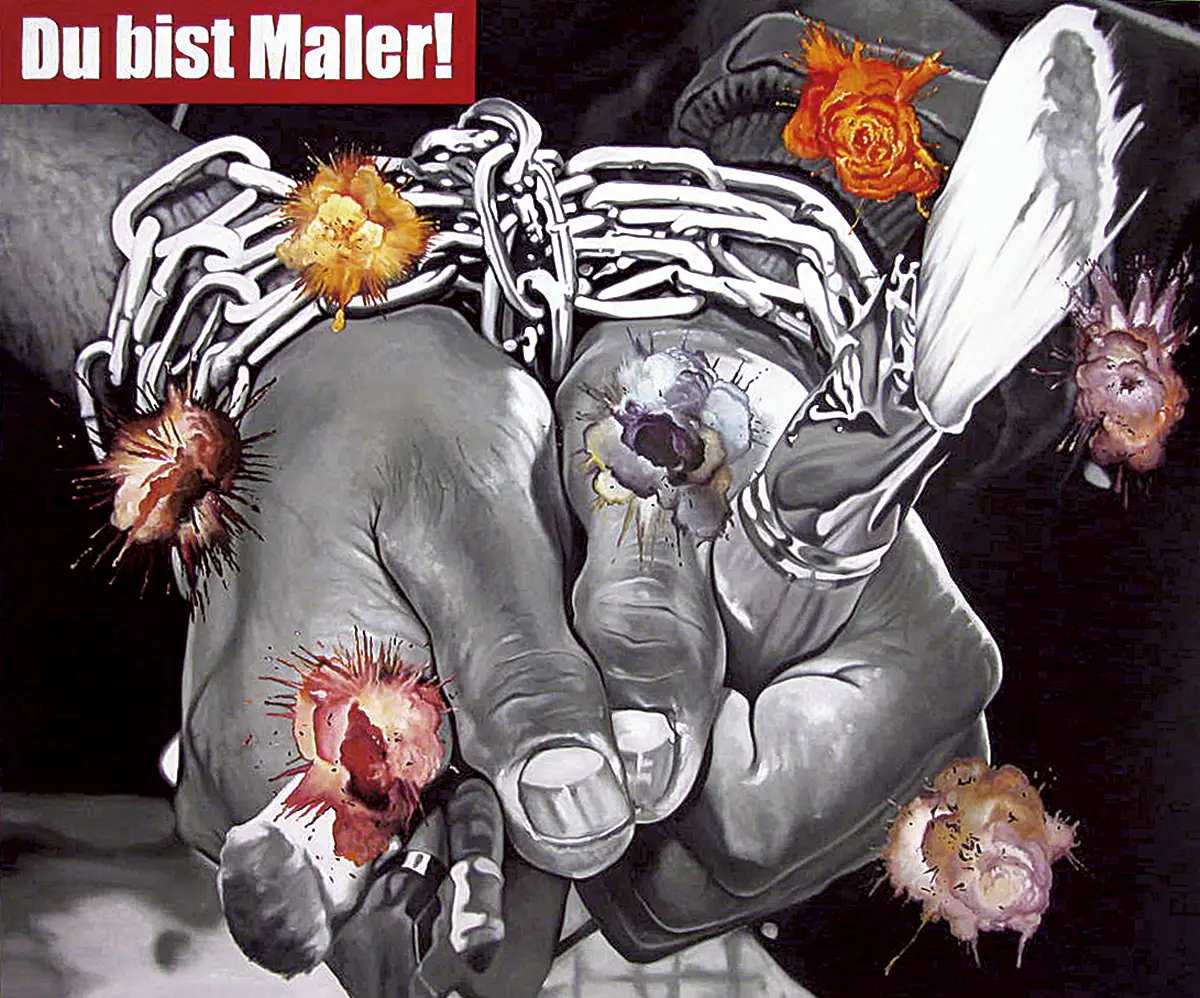
Sometimes in the world of art, we find revealing coincidences between distant and distinct events, whose sudden simultaneity sheds unexpected light on issues that would otherwise remain hidden or forgotten. One such coincidence happened last October in Europe, with the inauguration in Frankfurt and in Madrid of two very distant exhibitions that nevertheless were joined in their exploration of the disquieting relationship between pop art and socialist realism. The Frankfurt show was held at the Schirn Art Hall under the title Communism: The Dream Factory. Visual Culture in Stalin’s Times, attempted to recount that singular visual culture through a vast selection of paintings, posters, leaflets, and films of the period. The Madrid show, on the other hand, was small and had for its title Armando Mariño, the name of the Cuban painter whose works —five large-format paintings— occupied the walls at the Fernando Pradilla gallery. It had seemingly little to do with Stalinist culture, none of whose characteristic figures and motifs were to be found in the huge, forceful canvases, which dealt instead with images and topics common in American society and visual culture.
Why then, given their many differences, group these two exhibitions together? I repeat: because both bring to the fore the relationship between pop art and socialist realism, which as is perhaps remembered the movements similarities —and precisely in the New York scene of the 1980s— by Komar & Melamid first and later, with greater clarity and decisiveness, by Eric Bulatov. These artists, ironists rather than critics, post-soviet rather than post-modern, carried out a brilliant re-elaboration of socialist realism, bringing to light what that movement had quietly in common with American realism a la Rockwell —the most popular painter in the United States, as Robert Hughes pointed out— and even more notoriously with pop art. But the connections so revealed were not limited to the merely aesthetic plane but extended to those that existed between the US and the USSR, as societies whose image of themselves was dominated by propaganda. It is surprising in any case that a liberal society, dedicated to the defense of markets, and a state-centered society, devoted to planning and a mortal enemy of that same market, had to coincide in their systematic and large-scale use of propaganda to capture the minds of their citizens or to galvanize their militants.
With his exhibition in Madrid, Mariño situates himself at the same crossroads. His paintings, although about American topics as we have said, and with rotund slogans in English superimposed on the images, are a variation on the kind of Soz Art practiced by Komar & Melamid or Bulatov. This is not surprising, since ultimately Mariño is a post-Soviet artist, and not only because his work started in Cuba after the fall of the Berlin Wall and the dissolution of the Soviet Union, but for more than three decades the main international support of Castro regime. No, the reason in his case is the same as with the Russians: he comes from a society dominated by political propaganda, and he uses that information and that life experience to manipulate in his way and with utter freedom the visual codes of American capitalism. Capitalism of the advertising image if there ever was one. This is why his paintings, besides having been executed in the manner of posters, share with advertising the format, composition, and colors that allow them to hit the viewer straight in the eye. In end by noting that with this exhibition in Madrid Mariño has added the title of a post-Soviet artist to the one he already had as a post-colonial painter, gained in previous years by creating paintings and installations where an emblematic black color interrupted with its unexpected, wild, and unencumbered presence the demarcations, myths, and rituals of Art History (the one with the capital “H”) and of Western culture.
CARLOS JIMÉNEZ