
Assume Vivid Astro Focus (Eli Sudbrack) represents a new breed of artist working today that does not seek individual stardom or name recognition. Instead, AVAF uses a pseudonym rather than his given name and collaborates with different types of artists for each of his shows to deny the stereotypical egocentric mentality that Western society expects, and sometimes even demands, of artists. For his first show at Deitch Projects, AVAF worked with Matthew Brannon, Joseph Ari Aloi (JK5), Gerard Maynard, Slava Mogutin, Michael Wetzel, Los Super Elegantes, Action Daddy, and Honeygun Labs to realize a number of works that, in general, focus on the theme of the garden. Inspired by a multitude of different cultural references that include Tibetan tanka paintings, Hieronymus Bosch’s Garden of Earthly Delights, and unicorn tapestries, as well as Victor Vasarely’s Op art paintings, Pink Floyd album covers, Francis Picabia, and Peter Max, the artist, and his team create hybrid art forms that transform the gallery space into a psychedelic sensory overload of imagery.
In Deitch’s main gallery, AVAF’s brightly colored computer-generated designs cover the walls and spread across the floor and ceiling, decorating nearly all the areas of the darkly lit space. On the far wall, a video projection made in collaboration with Honeygun Labs features AVAF’s art persona Carla lip, synching a version of Yoko Ono’s Walking on Thin Ice from 1981. He was inspired by the song because it was the last one that Ono and John Lennon made together, but more importantly, the song also reflected a disco spirit at a time when, according to AVAF, disco officially had been declared dead. The video’s imagery and stop-motion special effects pay homage to early music videos from the 1980s, in particular Peter Gabriel’s Sledgehammer and Duran Duran’s Girls on Film.
A particularly personal reference is evident as well: gay culture. The adorned figure of Carla, wearing glittery makeup, feathers, and sequins, was inspired by the elaborate costuming of the Cockettes, a San Francisco-based performance group made up mostly of gay men who lived and loved together in that city’s Haight-Ashbury district in the late 1960s and 1970s. The group featured Hibiscus, well-known for his incredible outfits and makeup, and Sylvester, who later became a prominent disco star; Divine and John Waters also were loosely affiliated with the group. It was after seeing a documentary about the Cockettes in 2002, that AVAF made a conscious decision to address gay issues in his work. On the wall opposite the video projection is a portrait of Slava Mogutin, who was persecuted in Russia for his homosexuality and eventually was granted asylum in the United States.
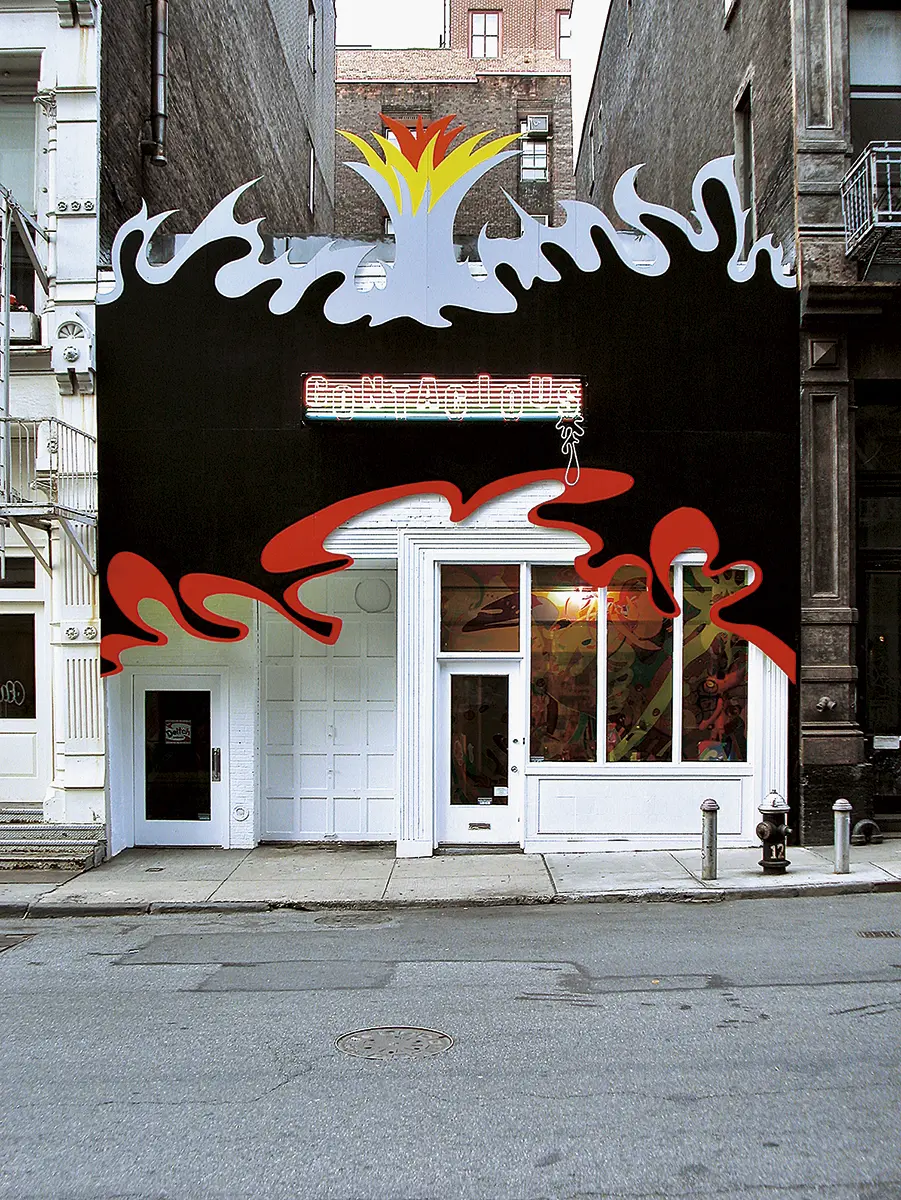
On the exterior of the building that houses Deitch Projects, AVAF mounted a large neon sign featuring the word “contagious,” which the artist says refers to AIDS and the resulting devastation the gay community faced less than a decade ago. In creating such a piece, AVAF does not attempt to speak about a specific health concern or assume the role of a political activist. He merely wants to recall the disease and the politics that were ubiquitous in the gay community several years ago.
AVAF says that his work is about awareness, about being aware of all that surrounds us both past and present. His work serves as a record of everything that has been or is now part of his life, and by extension, everything that has been or is now part of the lives of his collaborators. The sources for his imagery, which he explicitly records in his hilarious to-do lists, reveal an active mind that is never at rest. AVAF is willing to revive anything that engages his curiosity, even that which may not follow the current fashion. By referring to these sources and collapsing the distinctions between high art and wallpaper design, comic books, tattoo art, floor stickers, soft-core porn, ornate makeup, computer graphics, outlandish costumes, outdated popular music, or —you name it, much of his work reflects a camp sensibility. Yet his artistry, with its clarity of design and overall composition, unifies the disparate elements in his work and prevents it from becoming completely vulgar, banal, or merely humorous, which are often seen as the definite characteristics of camp.
In examining his work, it is important to understand the role AVAF plays in the realization of his exhibitions. Although he refuses to use his own name in order to eradicate egocentrism and describes himself as the “connector” among his collaborators, we must consider the fact that he is the one who conceives the overall concept for the show and selects the artists with whom he works. As a result, he, therefore, serves as a quasi-director, a role often associated with egotism. But AVAF avoids this problem by allowing his collaborators to bring their own voices to the exhibition; he acknowledges them and their contributions in the press release, not usually the case when artists work with other people. For this exhibition, AVAF worked with the tattoo artist JK5 to produce Untitled (Garden #6). AVAF also invited JK5 to set up shop in Deitch’s front gallery where JK5 conducted his own business throughout the show, creating tattoos based on his own designs, as well as others in the spirit of AVAF.
AVAF also uses a pseudonym in an effort to abolish the current policy on copyright, which he sees as an infringement on artistic expression. In fact, he would like to see AVAF work made not only by himself and his collaborators but also by others who would work independently of him and without his knowledge. He hopes that AVAF's art production will spread far and wide, even outside the art world, in such a way that all people will be able to enjoy it in their own way. To that end, Sudbrack intends to change his pseudonym again in the near future to prevent the AVAF name from gaining in popularity or from being associated with an individual signature style.
In the end, AVAF reminds us that by its nature the self is both individual and collective. In celebrating the latter expression of identity, AVAF is creating a body of work that is inspired by numerous collaborative interactions and myriad random cultural influences that challenge stereotypes of artistic creation.
CRAIG HOUSER