Taking as its starting point the specific case of the city of Caracas, the German Cultural Foundation and the Caracas Urban Think Tank have chosen the study of informal urban culture as the main subject for their exploration. The principal goal of this group exhibition is to deal with the different impressions produced by the social, political, and cultural reality of this capital city on Latin American artists and on fellowship recipients from the developing world. It is Caracas as a case study, its implications perfectly applicable to the current situation and reality of any Latin American metropolitan center where improvisation, the dynamics of chaos, the mutability of urban cartographies, and the economic crisis have hastened informal practices.
The starting point in the development of this project, then, emanates from the informality present throughout the city at both ends of the social scale (and everywhere in between) as a dynamic that formalizes and informalizes Caracas and its perimeter in fascinatingly complex ways. This phenomenon, perhaps ignored in the past, has grown and multiplied like an organism, with multifarious, inapprehensible vehemence. The lack of projection, planning, and structuring that characterizes informality within and around the formal ways of many large Latin American cities has been the subject of numerous conjectures, observations, and explanations. As a latent reality, informality has been susceptible to contemplation and appreciation by an artistic sensibility that expresses itself through a vast array of vehicles and touches on a multiplicity of disciplines, such as sociology, biology, mathematics, physics, psychology, geography, and architecture.
The Caracas Urban Think Tank is a group that includes Alfredo Brillembourg, Hubert Klumpner, Matías Pinto, and Mateo Pintó. In deciding to carry this project forward, they submitted Caracascase to the German cultural foundation, Kulturstiftung des bundes, which has supported more than fifty artistic projects in Germany and abroad. The foundation developed and presented a series of programs, including Art and the City, of which Caracascase cultura urbana informal is a part. The challenge of Caracascase was assumed by the Caracas Urban Think Tank, along with ten teams of professionals from several countries, in addition to local teams, institutions, universities, and private citizens.
Caracas is a model of the city as a receptacle of contemporary artistic expressions; it is a city that, like its counterparts in Latin America and Asia, has been subjected to explosive growth. Informality in Caracas must be understood as a global condition, a mixture of improvisation, anonymity, and provisionality. Caracascase provides an opportunity for artists as well as scientists, Latin American or otherwise, to offer their version and unveil their poetics on this matter, to become involved in the phenomenon, and offer solutions and approaches for its comprehension through interdisciplinary fieldwork.
A large number of interested artists find their way to the project, be it through the foundation, through the website, or through personal contacts. Each participant submits a proposal on which the committee votes. Once the team is formed, work on-site begins; the development and the results are exhibited at the Sala Mendoza in Caracas.
The characteristic phenomenon of informality that has interested the participating artists the most is the large poverty belt as translated into structures that house the city’s humblest inhabitants; these are Caracas’s marginal neighborhoods. The topic has given rise to heated debates since the process of informal appropriation, as well as the mobilization and settlement of those structures, respond to the inhabitant’s own initiative in the urban space and constitutes a grave problem for the city. Caracas, hecho en Venezuela (Caracas, Made in Venezuela) is a proposal by Austrian designers Sabine Bitter and Helmut Weber, who have studied the appropriation of space as a transformation and a social phenomenon that transcends urban metamorphosis. The outline of a construction emblematic of informal appropriation in Caracas, such as the housing group 23 de enero, is represented as a calligram, with typography taken from Venezuela’s National Constitution (a source of contemporary struggle and conflict in the country as a whole).
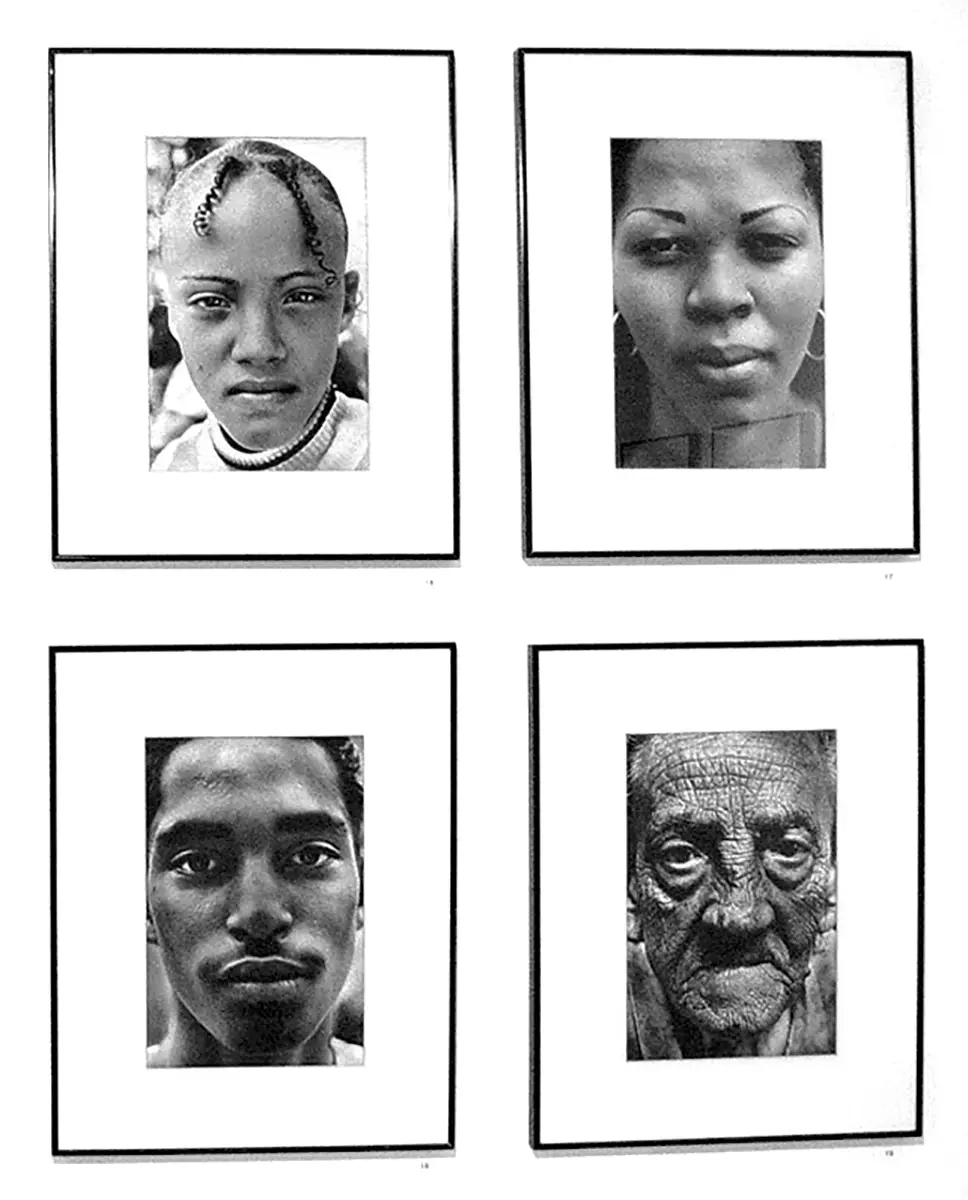
Brazilian artist André Cipriano goes to the city’s most critical areas and records, through the humble faces of its inhabitants, the living history of informal Caracas. His photography is a document of large urban slums and the people that live in them, a black-and-white ethical questioning that demands to be taken into account by all Venezuelans and by the government in order to confront the misery and violence present there.
The proposal put forth by Japanese architects Shuhei Endo and Keisuke Fukuma develops a Phenomenological map of Caracas. In an interesting photographic register, they approach different topics related to social reality “inside the neighborhood.” A cluster of facts and conditions that has captured the team’s attention, scenes of everyday life, and the simplest informality, which, given its frequency, has already become “formal.” Salient examples of improvisation, contraband, and fleetingness are registered to create an online catalog, the representative imaginary of Caracas’s informality.
Economic confusion hastens overcrowding in the city, and the informal behavior of urban dwellers forces them to adapt to the environment and to the physical space, appropriating it beyond any planning. Streets, avenues, boulevards, and squares have, in a short time, seen their original function redefined in order to meet informality’s immediate needs. One practice that is close to becoming institutionalized amidst the reigning anarchy has turned public spaces into minefields of small-scale street merchants who conduct their business on a daily basis completely alienated from the irritating social and administrative infrastructure of legality and formality.
The proliferation of housing is already a formalized practice, something that falls within the borders of the commonplace. Unfinished structures are in a permanent state of improvisation, expansion, change, and construction, according to the needs of their inhabitants. To ease coexistence, these settlements generate their own criteria and their own laws, codes, and spontaneous norms. Several proposals in Caracascase explore this subject.
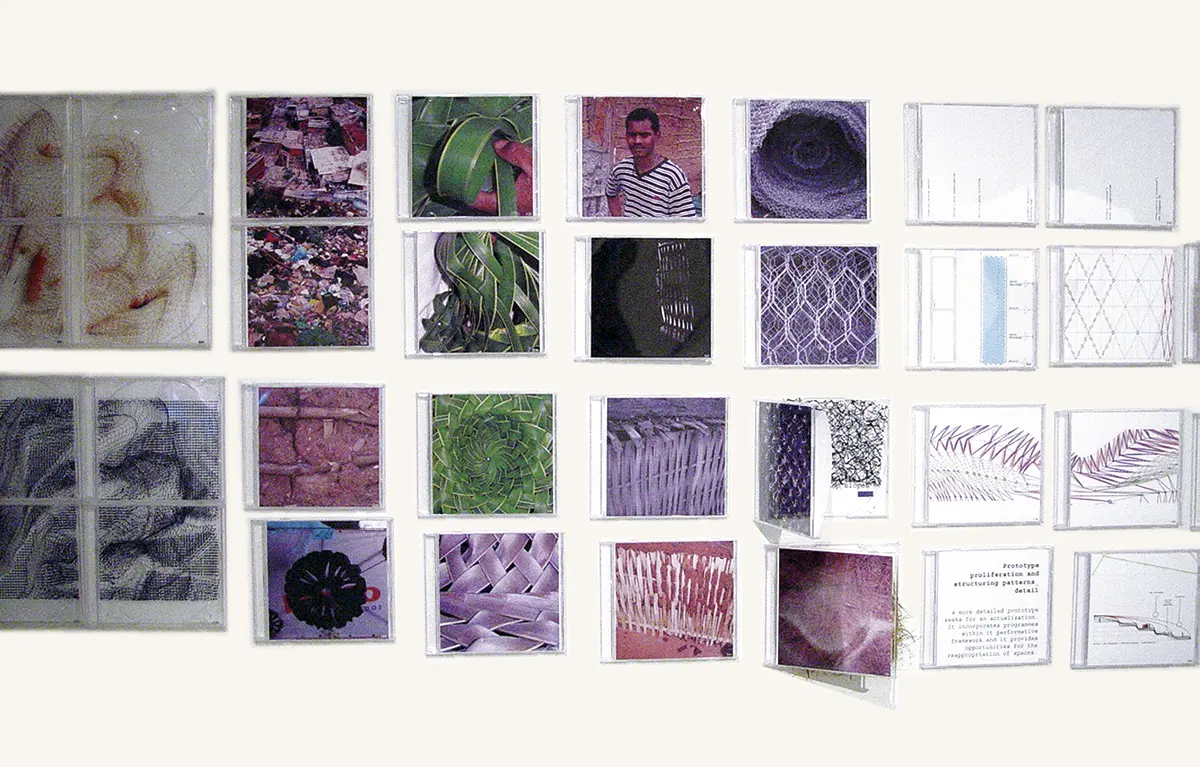
Canadian engineer Guy Lafayette, along with Italian engineers and architects Marco Poletto and Claudia Pasquero, developed Regímenes de lentitud, paisajes operacionales (Regimens of Slowness, Operational Landscapes). For this team, informal culture is a model of proliferating slowness. The unplanned nature of its origins nevertheless demands a set of norms. Armed with this hypothesis they set out to prove that behind what seems merely chaotic we can find a universe of forces, strategies, and movements that allow the system to function as a concise structure. The plastic proposition of Regímenes de lentitud consisted of establishing analogies between the simplest constitutive systems, such as the weaving of a traditional hat and technological assemblages, breaking the norms in each case and thus corroborating that order and working rules must exist at any scale, since both systems proved to be sensitive to slight disturbances.
In the same vein, the project Prácticas urbanas, especializaciones tácticas (Urban Practices, Tactical Specializations), by German architects Sabine Müller and Andreas Quednau, studies informal systems and informal mobility. In their analysis of practices like those of street peddlers who situate themselves in a specific location and then move to another, and to another, Müller and Quednau find a harmony in the system’s mobility that cannot be understood as a stand-alone function but must be seen within the general framework in which it operates. Their plastic proposal is an abstract design, almost of a molecular nature, where examples of these movements are graphically synthesized into dots and lines.
Mexican architect Felix Madrazo, his Israeli colleague Lyat Esakov, and Ukrainian architecture student Elena Chevtchenko will develop Disponibles (Available). This creative team will demonstrate with special interest the notion that to recover spaces useful for a locality, it is not necessary to make use of architectural intervention; it is possible instead to execute strategies that allow the communities themselves to effect their recuperation and optimization. This same team, along with photographer André Cipriano, has proposed a Museo de los barrios 23 (Neighborhood Museum 23), a marvelous utopia designed to confront the serious situation of Caracas’s formal museums. The other two proposals generated by this team are Arquitectura directa (Direct Architecture), where neighbors will build their own housing units, and Regulaciones urbanas formales (Formal Urban Regulations), which registers and transcribes conversations about the rules of interplay and occupation within informal structures at the time of their establishment in a locality.
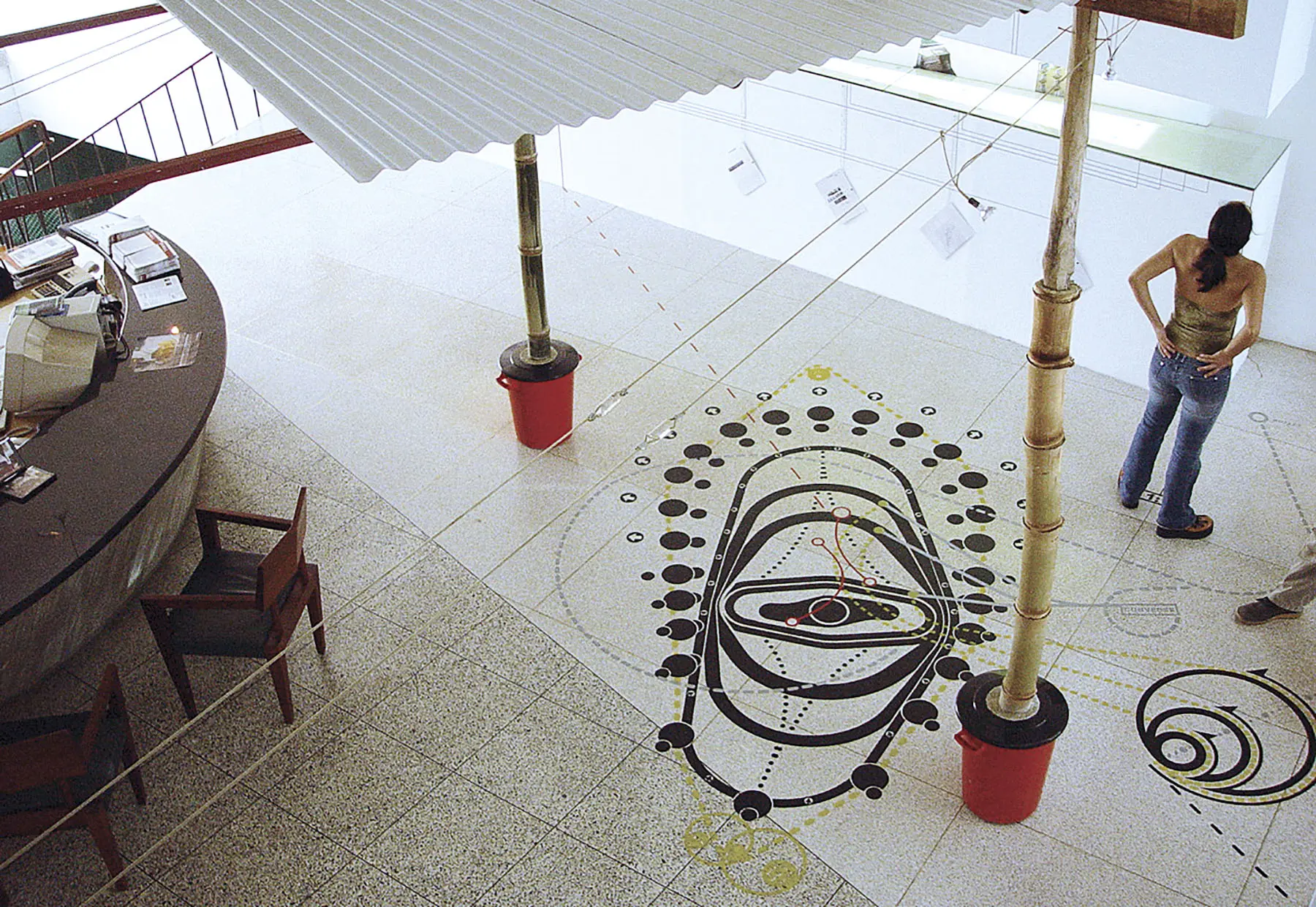
The very serious problem of the lack of clean water in marginal neighborhoods and areas surrounding the city has inspired Marjetica Potrc, a Slovenian artist, and Liyat Esakov, an Israeli architect, to present Casa en crecimiento, ciudad en crecimiento (Growing House, Growing City). This project offers self-sustainable solutions that can be built and executed by the communities themselves. Among their ideas is an ecological dry bathroom. A pilot project for this was built in La Vega, a marginal Caracas neighborhood, to test its feasibility. The gallery exhibit is complemented by a schematized construction sequence; a number of quickly done drawings; a systematic video explaining how to assemble the bathroom; and a large illustrative photograph. Similarly, an initiative emerged from this creative team to solve the problem posed by direct sunlight shining on people who work informally on the streets. It is a roof-like structure in rough materials that was assembled and improvised in Sala Mendoza’s gallery space.
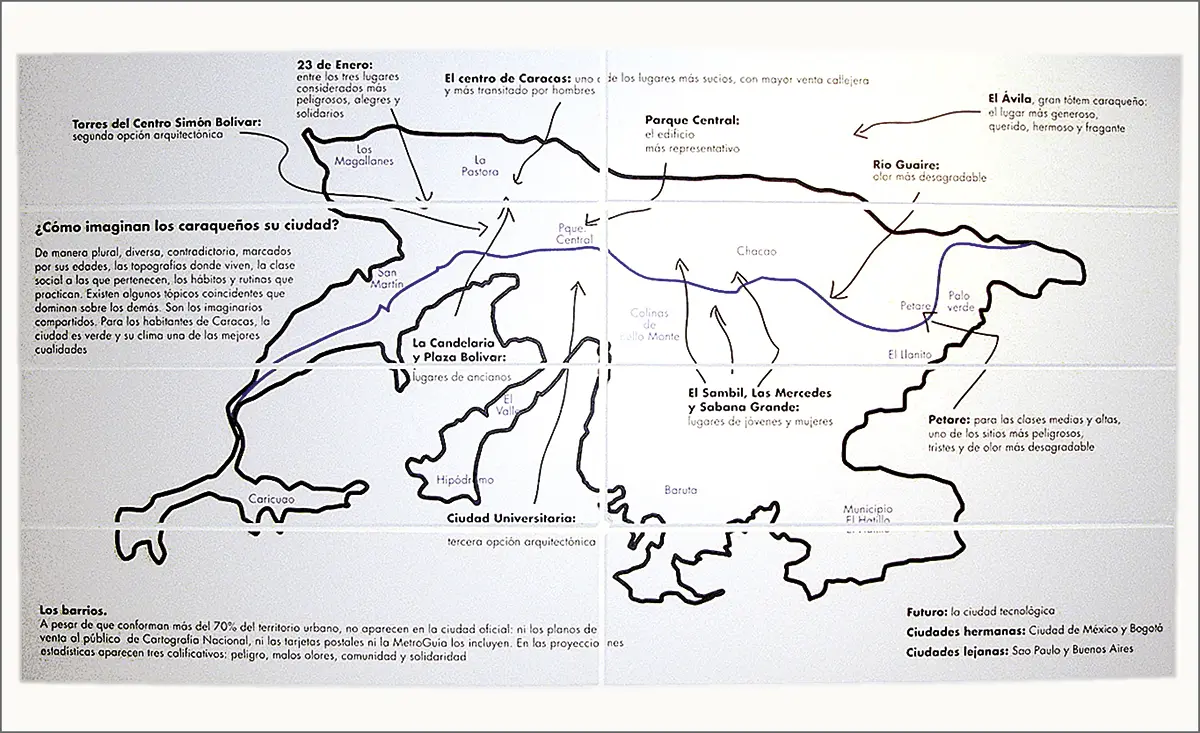
Caracas imaginada (Caracas Imagined) is the project of Colombian philosopher Armando Silva and a team that comprises sociologist and journalist Tulio Hernández, social communicator Ana María Carrano, visual communicator Amanda Castiblanco, and anthropologist Guillermo Santos, all from Venezuela. Immersed in Caracas’s informal dynamic, they have developed seven imaginaries expressing the collective as a socio-cultural construction by the citizens. These are projected on a map of the city, accompanied by a brief description of each of the areas, and use surveys to capture the participant’s opinions. Photographic representations and projections illustrating and condensing urban experiences, narratives, or ceremonies related to informal social practices complete the project.
In his project La invisibilidad no es casual (Invisibility Is Not Accidental), German writer Raúl Zelik reflects on Caracas’s fragmentation into highly contrasting social classes and segments. From an activist position, Zelik investigates informal groupings in order to find alternative means of organizing. In developing Caracas es (Caracas Is), Pablo Souto, an architect and photographer from Argentina, photographs different locations in Caracas juxtaposing them with a map of the city.
Scientists play a central role when it comes to projecting their vision and their poetics regarding the phenomenon of informality in Caracas. Mathematician Ignacia Arcaya and biologist Diego Rojas, both from Venezuela, are developing Caracas, ciudad fractal (Caracas, Fractal City). Both analyze patterns of reproduction, multiplication, grouping, and disposition in relation to the chaotic phenomenon, not in terms of disorder or arbitrariness but with fractals or a deterministic sort of chaos. These scientists have explored the map of Caracas to analyze it as a geometric structure and observe the fractal properties that apply to the city’s marginal areas.
Caracas invisible (Invisible Caracas) is the proposal presented by French filmmaker Nicolás Bencilhon and Venezuelan filmmaker and anthropologist Maria Alejandra Padrón. Located in a dark room (arranged within the exhibition’s design) it projects an intriguing series of documentary films that record a story centered on the horse races. Their characters are the inhabitants of the Las Mayas neighborhood next to the race tracks, who watch the competition from a distance and have a parallel horse race in their own community. The film registers the expressions of each family member as they ceremoniously take part in the entertainment. Venezuelan artist Alexander Gerdel is responsible for the video Cine Atlántida (Cinema Atlas). Each one of the compositional elements of its narrative discourse is inspired by informality: improvisation, fragmentariness, the permanently unfinished, instability.
Following the well-attended opening, Caracascase has been the object of more than a few polemics, given the critical, social, political, and moral nature of its proposition. Among the participants we find many positions regarding the capital city’s crisis; the exhibition provokes a wide range of interpretations—the debates, strong clashes, and tendentious opinions have even prompted the resignation of one of its participants. Nevertheless, the careful selection of the works on exhibit as well as the museological criteria in evidence attest to the painstaking labor involved in realizing a project such as this, which is without precedent in Caracas. Caracascase will be documented and published by Next Text, in a book that will present each proposal emerging from the project, along with other Venezuelan works on the subject.
ELISA RODRÍGUEZ CAMPO