
Édouard Duval Carrié has created a unique art form from his confrontation with the truly bizarre aspects of Haitian history, politics, culture, and religion. With his inventive and distinct style of painting and sculpture or the combination of both within ritually organized installations, he imbues the remarkable personalities and deities of Haiti with new power. No one is safe from his acerbic wit, not generals, dictators, or the Voudou spirits (loas) that permeate every facet of life. His realm is one of fantasy where everyone is present: loas, ancestors, heroes, soldiers, enemies, the Duvaliers and their Tonton Macoutes, and the artist himself. It is a splendid landscape of savage gardens and beautiful creatures that can be humorous, full of terror, or as alluring as the call of a siren, in Haiti, the loa of love, Erzulie.
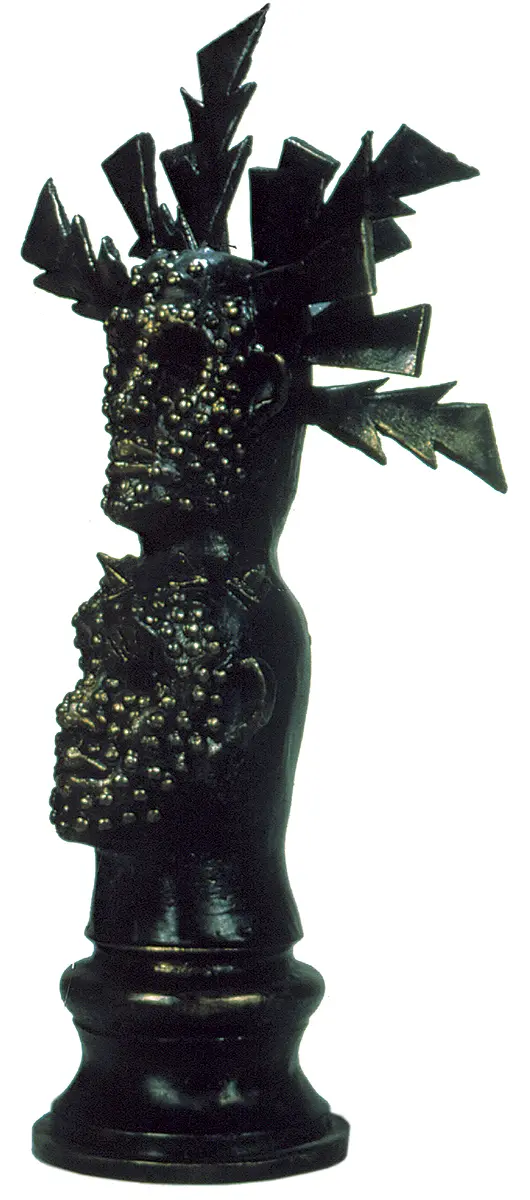
This fascinating exhibition of paintings, sculptures, and installations originated at the Phoenix Art Museum before traveling to the Lowe Art Museum in Miami, where the artist resides. Duval-Carrié has introduced additional images and recent work to enhance the survey of familiar paintings and objects and complement the original exhibition. Always creative and full of surprises, he continues to look at the world around him with imagination and humor and explore new technical approaches to give his characters their extraordinary settings. The colorful personalities invented by Édouard Duval-Carrié cavort in his strange landscapes and beckon seductively from plastic frames inset with toys and other objects. Intrigued by the lore of Haiti, especially the stories brought from Africa that have commingled with the reality of the island’s existence to create a quasi-real —if not altogether surreal— explanation for the past and present life, he creates perplexing images that offer little explanation about the historical fact or fiction that originally inspired them. Actually, since it is difficult to distinguish between the mythical and the historical in Haiti at every level, the truth may be stranger than fiction in his works. This is what makes them so provocative. If a title or image serves as a clue to the meaning within, he manages to distract from its source in the most imaginative way. In complex canvases that combine African fables, classical mythology, and Haitian and world history with contemporary events, Duval-Carrié presents a personal vision of the spiritual and artistic traditions of Haiti that is unlike any other.
Endless Passages refers to passages of various descriptions that assume relevance on numerous levels. The passage may be that of immigrants from many lands who cross the seas to reach freedom in the United States, but it is especially significant for the Haitian and Cuban immigrants to Florida. The passage may also refer to ritual crossings and the ceremonies and superstitions associated with the cycles of life and death that are guarded by the spirits. In the Americas, the passage that brought the Conquest will forever linger in the minds and hearts of its people. The African Diaspora in the post-Colonial Americas still echoes today. Duval-Carrié’s work can be appreciated from all of these perspectives as he chronicles the Haitian experience via a unique and colorful style of imagery that is very much his own.
The beautiful giant blue sculpture of Erzulie Dantor, the loa of love who appears frequently in Duval-Carrié’s work, sets the mood for the exhibition at its entrance as she greets her adoring public and invites the viewer to enter her world of fantasy. It is a world of complex, evocative images where politics, religion, and art mix in a colorful mélange that may be seen as a reflection of the turbulent history and reality of Haiti. The characters in Migration des Espirits, 1996 have been arranged in a Baroque-scaled polyptych in which each of the panels recounts an aspect of Haitian history from colonial times to the present. The extraordinary array of colorful nudes, representing different tribes of African slaves and the spirits who guide them, are depicted as they depart from their homeland, traverse the sea, encounter the dance of death with the gods’ companion, Baron Samedi, and finally reach the world of the present, where Erzulie intercepts the motley crew and offers hope for the future.
In Vox Populi, 1998, a large mixed-media work with the artist’s hand-made frame, the loas assume ritual guise as a triumphant trinity of spirits that are as perplexing as the syncretic definitions that inspired them. Overtones of ecological and mythical ceremonials emerge out of his harmonious interconnections, and we welcome the promise of more to come from this extraordinarily imaginative artist.
CAROL DAMIAN