Gunther Gerzso’s extensive international retrospective at the Santa Barbara Museum of Art in California artfully played upon the spatial qualities inherent in the artist’s best works. Dividing and subdividing the sprawling north wing of the museum’s ground floor into a labyrinth of innumerable intimate alcoves, the installation offered viewers secluded spaces for considering the works of one of Mexico’s earliest abstract modernists.
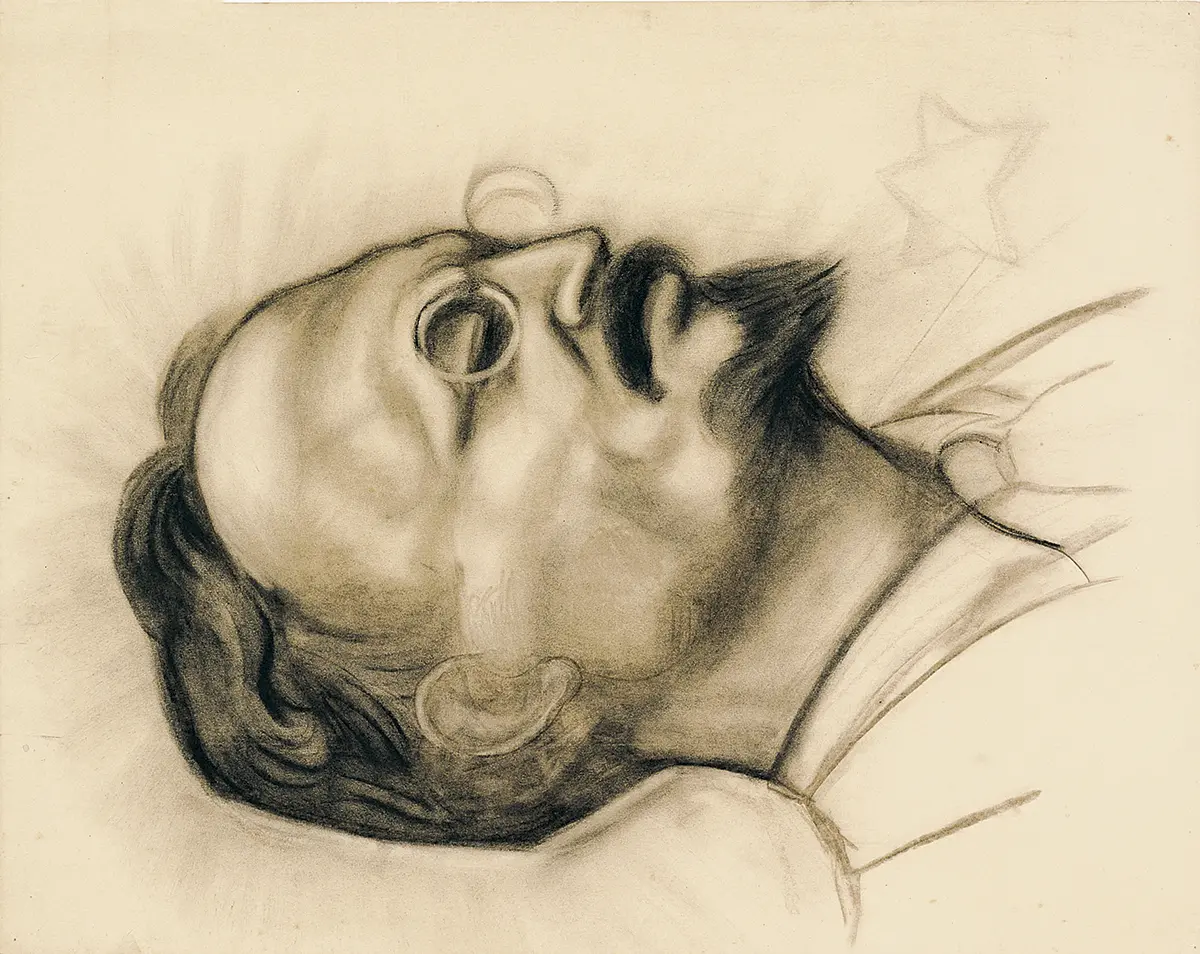
Arranged chronologically, the show opens with a small room that profiles some of the artist’s early drawings. These include works in the style of Mexican muralism, which reveal Gerzso’s initial admiration for the Mexican Muralists. These pieces reveal an artist exploring not just the relationship between art and historical consciousness, but also the versatility of artistic materials and their powerful propensity to convey innuendo. His Untitled (Postmortem Portrait of Leon Trotsky), rendered with soft, charcoal strokes contrasts remarkably with a nearby drawing, Untitled (Head and Fist), which features a worker drawn with rudimentary angular forms and thick, dark charcoal lines. While the political polemic of these early works would in time give way to more encrypted ruminations on the relationship between painting and historical context, Gerzso’s early interests in the expressive potential of charcoal serve as a harbinger of his subsequent study of the ancient European techniques of oil painting.
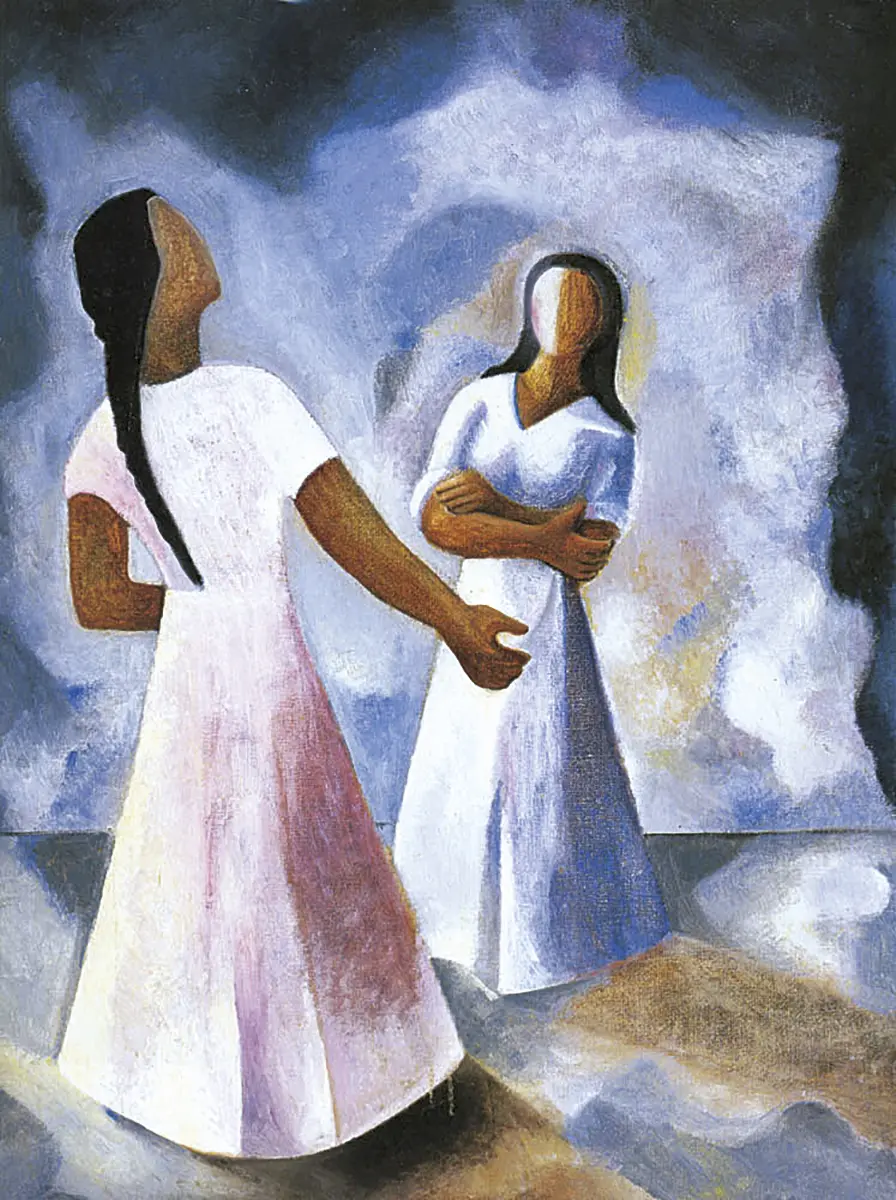
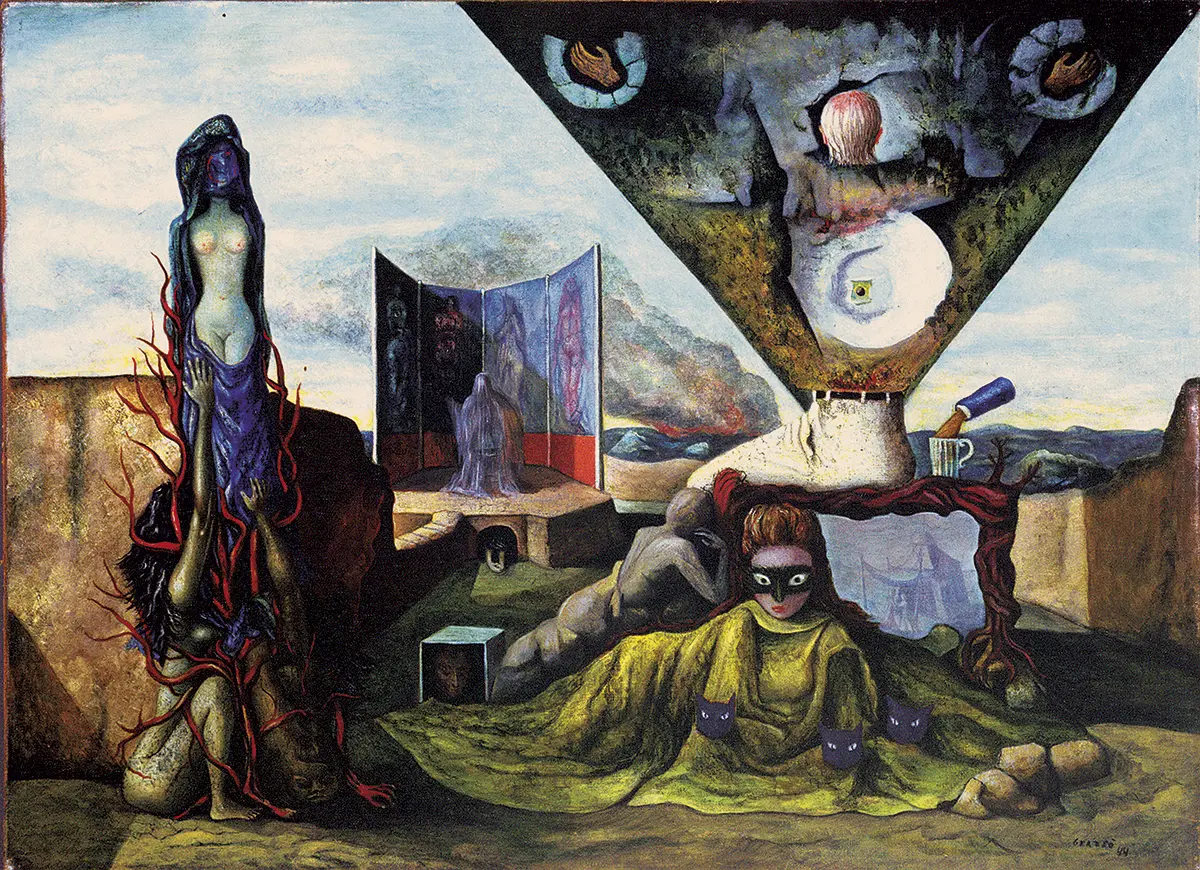
Entering the next room, one encounters a suite of figurative works that mingle rational and irrational imagery and evoke the illusionist style of Surrealism. There are poetic works such as Performer with Chair, 1935–40, and Dos Mujeres (Two Women), 1940, in which melodic pastel colors of lilac, pink, blue, and white play against edgy and precariously balanced compositions. Also profiled is Los días de la calle Gabino Barreda (The Days of Gabino Barreda Street) of 1944, which provides a glimpse of Gerzso’s artistic circle at a time when it included painters such as Benjamín Peret, Remedios Varo, Leonora Carrington, and Esteban Frances. Gerzso paints their portraits and comments on their individual proclivities by translating their signature styles and leitmotifs into sign symbols of the artists themselves. Thus, Varo appears disguised in a mask surrounded by three cats, while Peret hovers above the other artists as an orchestrating mastermind. Other, more difficult images also appear during this period, including the abstract figurative piece, El Descuartizado (The Quartered) of 1944, which one suspects may have given the rise in part to Octavia Paz’s identification of sadist themes in Gerzso’s works.1
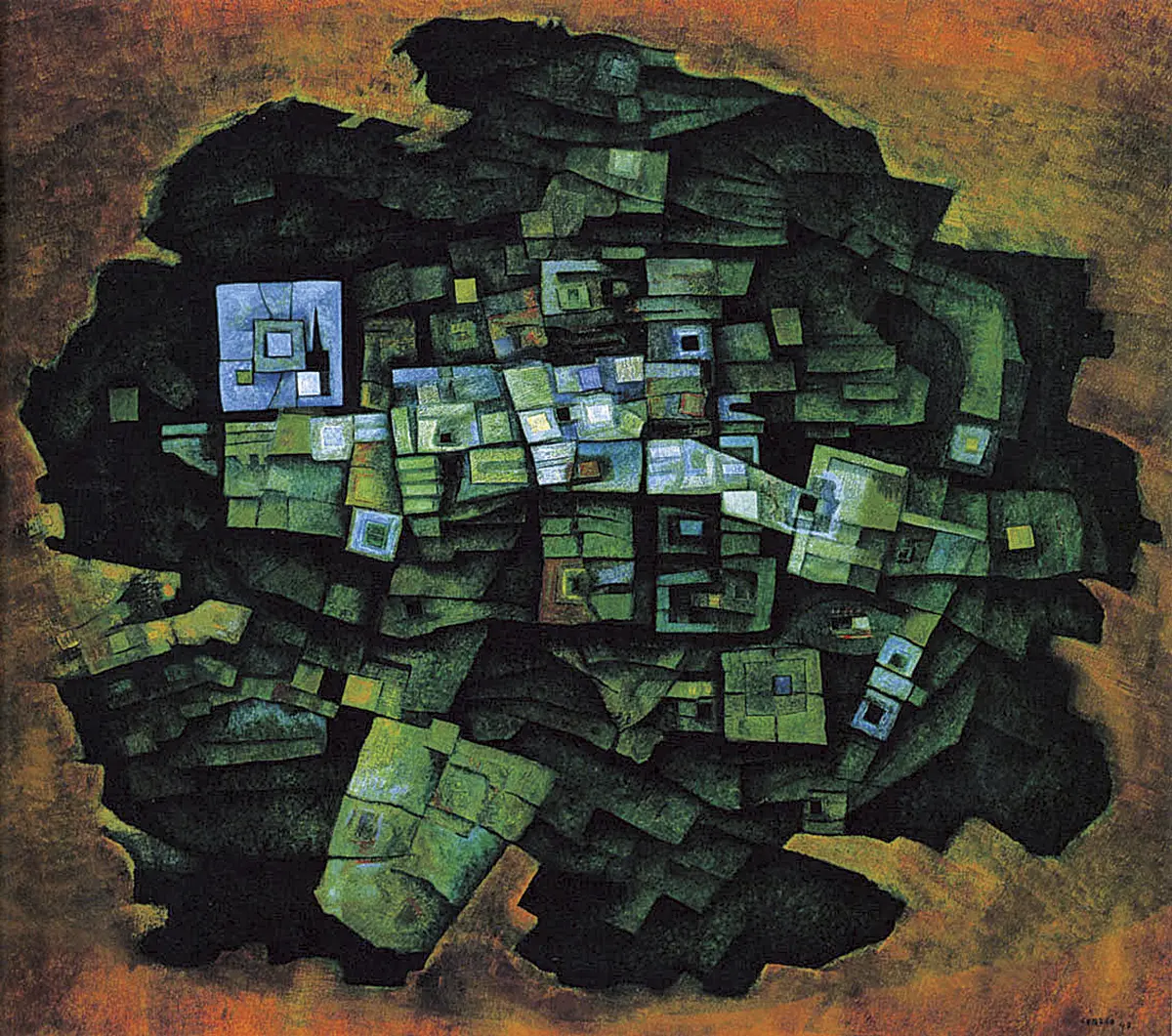
One then turns unexpectedly into an alcove profiling Gerzso’s stunning breakthrough works, including Cenote (Natural Sinkhole) of 1947, and La Ciudadela (The Citadel) of 1949. These mesmerizing early abstractions that foreshadow his subsequent developments have a mystery and power that time has not diminished. The canvases feature small jostling squares and rectangles clustered together in irregular shapes that congeal into the oval or square-type forms that emerge in the center of rectangular canvases. Certainly, as exhibition curator Diana du Pont points out, Gerzso is rethinking Cubism here, revisiting the analytical phase of Picasso’s and Braque’s explorations while stepping beyond these early modernist interests. As both du Pont and Cuauhtémoc Medina suggest, Gerzso crosses such formal, early-modernist European artistic investigations with interests in historicity, specifically endowing form with indigenous, Pre-Columbian cultural associations. Born in Mexico of European lineage, Gerzso invents works in which these worlds meet and even collide. As Medina suggests, “Gerzso saw very clearly that this intercultural friction was the essential element in Latin American art and in his own art."2
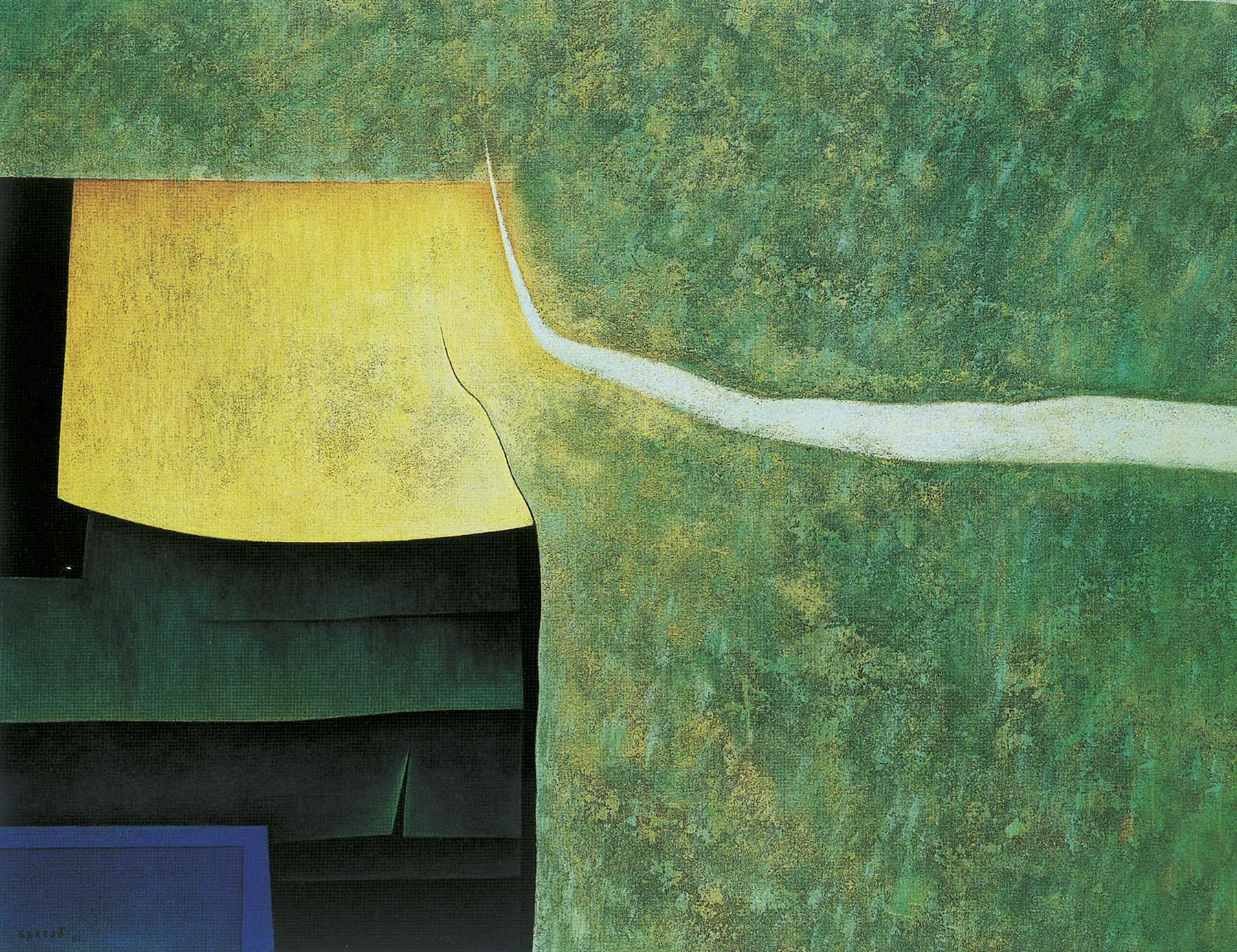
Du Pont argues that Gerzso’s mature works, which include such paintings as Aparición (Apparition) of 1960, Muro Verde—Paisaje de Yucatan (Green Wall—Yucatán Landscape) of 1961, and the exhibition’s signature image Personaje—Paisaje (Figure—Landscape) of 1972, are formally structured on the square. It was a form that Gerzso apparently used deliberately because of its dual reference to the ancient Pythagorean ideal of the Golden Section, and the ancient Pre-Columbian symbolism of the talud-tablero evident in the ruins of Teotihuacán.3 In Gerzso’s paintings luminous overlapping forms can be read as archeological strata that allude to territories under excavation or in the process of being rediscovered. If du Pont’s and Medina’s postmodern interpretations are as cogent as they sound, then these hermetic works can be regarded as ultimately linked to the artist’s highly personal visual explorations of socio-cultural identity.
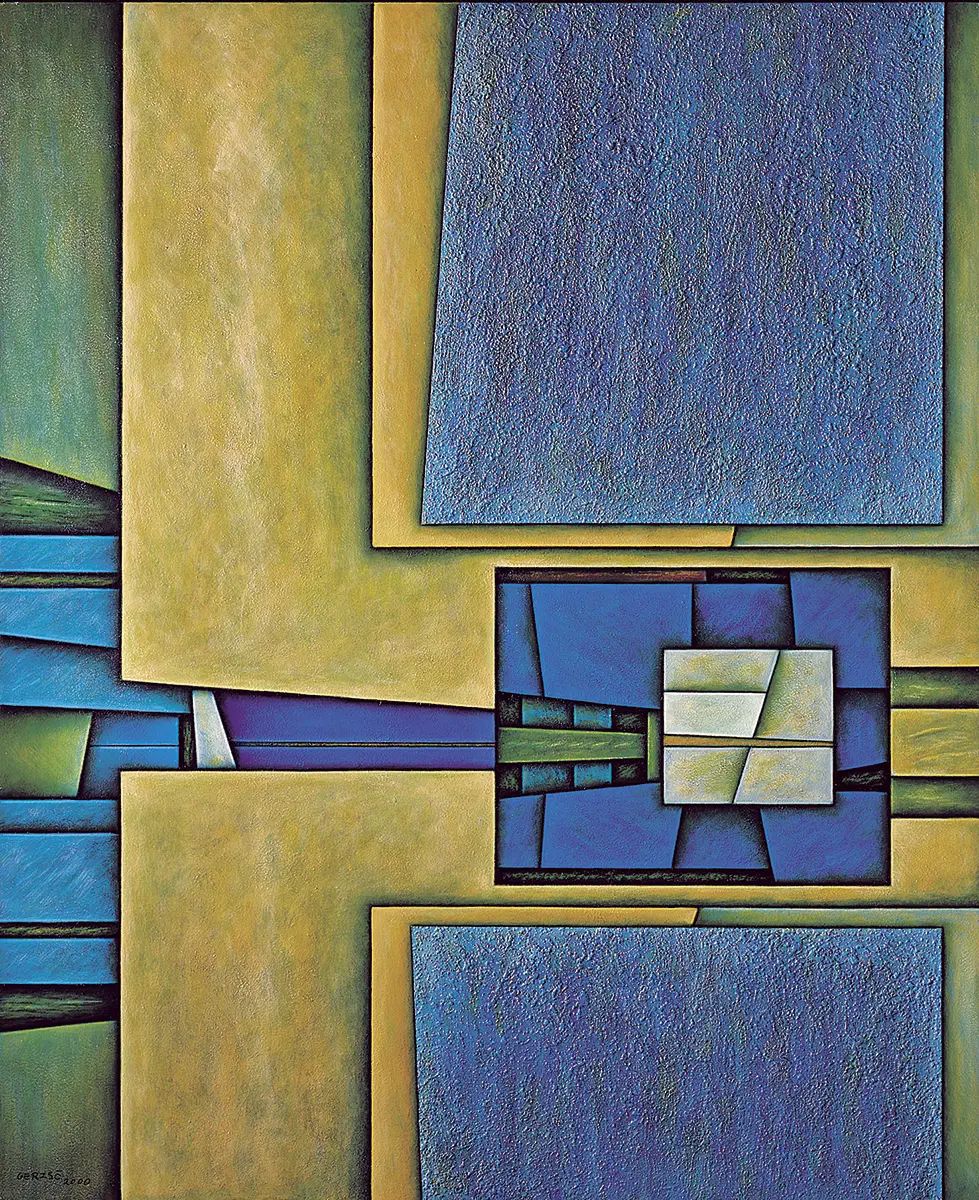
As a Mexican of European heritage, Gerzso’s sense of “outsider” identity within Mexican culture thus becomes manifest in the tension he builds between the color-saturated surfaces of his images and his interest in the illusion of depth. Gerzso is as interested in the artistic oil glaze techniques of Flemish and German Renaissance painters as in exploring the historically truncated and obscured Aztec civilization, and his paintings speak in general of the indeterminacy of knowledge, and in particular address the complexities inherent in epistemological concepts of historical and cultural identity. Anticipating the skeptical nature of postmodern discourse, his works metaphorically mimic the quest for truth within the historical and cultural labyrinths of time and space. Definitive yet indeterminate, material yet ethereal, linked to history yet irrevocably lost, Gerzso’s abstractions hauntingly promise the revelation that tantalizingly and eternally remains just one step away.
Exhibition itinerary: Risking the Abstract: Mexican Modernism and the Art of Gunther Gerzso runs from July 12–October 19, 2003, at the Santa Barbara Museum of Art, Santa Barbara, California. Telephone: 805.963.4364. The show appears at the Museo de Arte Moderno, Mexico from November 12, 2003–February 22, 2004. Subsequently, it will be shown from March 10–June 27, 2004, at the Mexican Fine Arts Center Museum, Chicago.
NOTES
1. See Octavio Paz, “Gerzso: La Centella Glacial” (Gerzso: The Icy Spark),” in Octavio Paz and John Golding, Gerzso (Neuchâtel, Switzerland: Editions du Griffon, 1983).
2. See Cuauhtémoc Medina, “Gerzso and the Indo-American Gothic,” Risking the Abstract: Mexican Modernism and the Art of Gunther Gerzso (Santa Barbara: Santa Barbara Museum of Art, 2003), p. 211. As noted in the exhibition catalog, Medina’s essay “Gerzso and the Indo-American Gothic: From Eccentric Surrealism to Parallel Modernism” is a revision of an earlier essay prepared for a Gerzso colloquium held at the Museo de Arte Carrillo Gil in Mexico City on June 17, 2000. It was subsequently read at a conference entitled “Global and Local: The Condition of Art Practice Now,” held at the Tate Modern, London on February 3, 2001.
3. Diana C. DuPont, “Gerzso: Pioneering the Abstract in Mexico,” in Risking the Abstract: Mexican Modernism in the Art of Gunther Gerszo.
COLLETTE CHATTOPADHYAY
Historian and Lecturer based in Los Ángeles. Member of the International Association of Art Critics; frequent contributor for Artweek, ArtNexus, Art Asia Pacific, and Sculpture magazines.