Heriberto Nieves’ exhibition, conceived specifically for the spaces of Santo Domingo’s Museo de Arte Moderno, makes use of linguistic-visual elements belonging to neo-minimalism and neo-conceptualism in order to give shape and physical and visual concretion —following Klee’s injunction to make the invisible visible— to something that has been among the programmatic impulses of Western culture as a whole since Greek antiquity, and more specifically since Pythagoras and Plato: the investigation of Reality’s mathematical substratum.
The whole of the physico-mathematical sciences and their technological derivations, genetics, music, and statistics applied to the humanities, or the system of numerical proportions in architecture or in the canons of physical beauty, not only within the arts but also in the aesthetics of every day and of the body, have been regulated in the Western world by considerations of a mathematical nature. An exhibition like Círculos de difracción underlines and celebrates measurement as a mental habit and a constructive norm for consciousness and its conditions of operational possibility in the world, but also the generative character of numbers, their ontologically substantive quality, and an evocation of Renaissance cosmologies, where the circle was acknowledged, like the Eastern archetype of the mandala, as a symbol of divine perfection and totality, before this archetypal model was broken by Kepler’s ellipse, emblematic of the Baroque universe and of a weltanschauung that diverged, as Sarduy points out, from Copernicus’s.
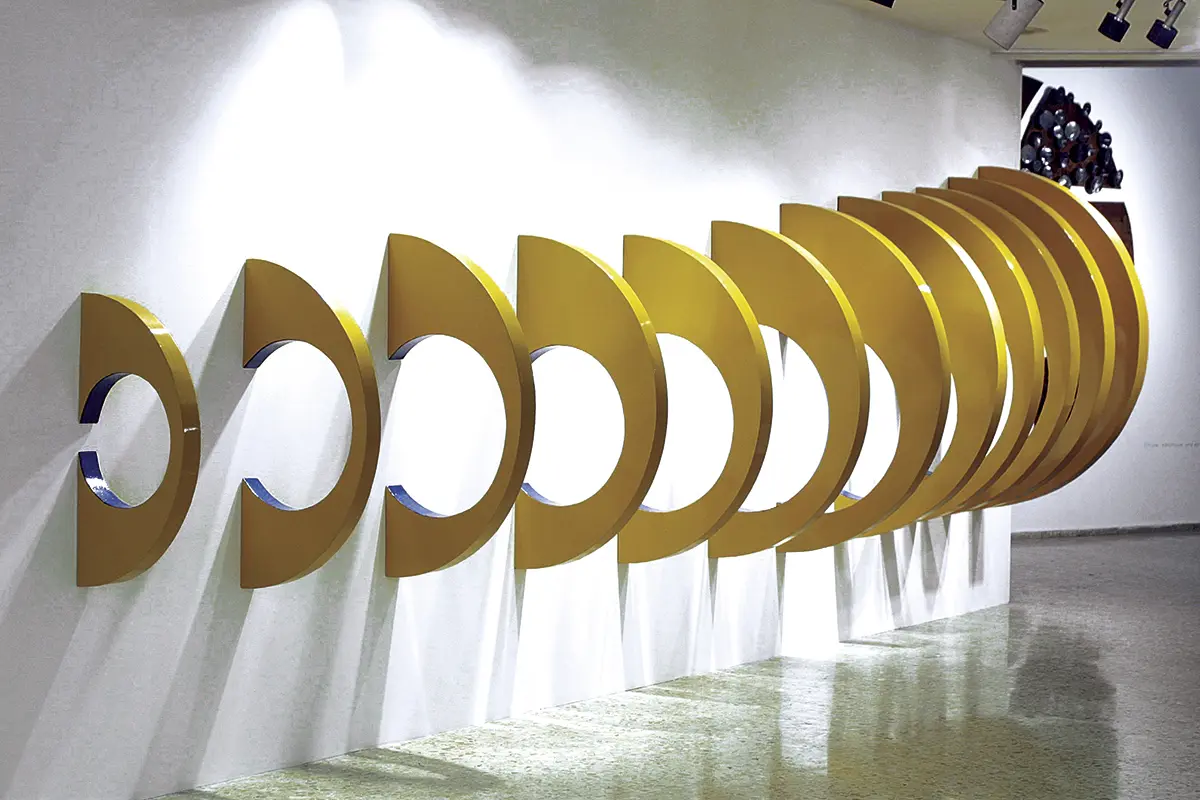
The circle appears here as a generator of space, and as a realm of harmony, of exquisitely balanced internal tensions, and while there are echoes of Negret and Pablo Rubio, the artist has carried out an exhaustive exploration of circular shapes, be it on the plane, on the emerging three dimensions of relief, on three-dimensional structures, or on the self-moving image of video, traversing the whole spectrum of perceptual and representational concepts that can be derived from a pure form, from an “eidos” carefully defined by the intellect, which generates, from the site of the intelligible, images and shapes more and more immersed in the realm of the senses and of change.
In a different sense, we can say that Nieves develops the complete cycle of a basic idea, turned into a primary structure from which a whole language of formal conceptualizations, and a specific combinatory of these, is derived. In this way, he applies the Renaissance compositional model of the tondo to a two-dimensional visual group where basically warm/neutral and ochre and earthen chromatics, as well as the simplicity of circular shapes, focuses our attention on textures, bestowing a warm and harmonious sensuality upon a series that would otherwise be excessively aseptic and cerebral. The yellow tones of the shapes emerging from the walls to integrate the vacuum with the sculptural fill and affirm in that way the mathematical continuity of its space and its different measurability, as well as the intense vermilion of the exempt circles, also support this reading: mathematics does not cancel sensuality or the pleasure of the tangible; they are their condition of possibility.
One of the most interesting points is the way in which the shape of the circle is prismatically decomposed in these structures in vermilion, a primary color inscribed also, like Mondrian’s chromatics, within the essentialist and rationalist sensibility that privileges what is primeval and uncontaminated, immediately intelligible, unmixed. In that sense, it incorporates a perceptual sensibility derived from Cézanne and the Cubists, translating movement, time, and our lived experience of the sequential into spatial terms. Similarly, the texture of pointed shapes breaks with the atemporal classicism of closed and featureless forms, enriching sensorial and mental experience with new modulations that, at no point destroy or hide the form’s structural integrity.
Through a spectacular and architectonic display, the artist has established a closed dialog, a completed circuit of visual and also acoustic tensions, with a certain flavor that reminds us of what we heard once from Dan Cameron: the space of the museum is, in today’s de-sacralized world, the only space that gives people access to the kind of ecstatic experience that was formerly provided by sacred sites, temples, and loci culturally defined as numinous, whose purpose it was to facilitate the experience of an essential dimension of our own selves, that which escapes to the spatiotemporal categorizations of the secular.
With that promiscuity of media that modern art has inherited from the techno-avant-garde, Nieves has developed the representational concept of the circle from the mental image to the drawn mural, to three-dimensional space, and finally to the moving image, in a sense that goes beyond illustration or didacticism, particularly with those expansive images he presents of the expansive circles rippling on water, where we find parallelism not only with cosmogonies and cosmologies from Antiquity and the Renaissance, but also with the expansion of his own creative process, similar to that of Nature, evolutive and expansive like Physys itself or, as Aristotle said, of an art that does not imitate Nature “but its processes,” which are none other than those of constant creation, the expansion of what exists, the well-ordered harmony of Being, in a Universe where it seems, death has not arrived yet, and where the principle of entropy remains ignored by the circle’s recurring perfection.
LAURA GIL