Expectation and seduction are the main themes in Brazilian Hildebrando de Castro’s exhibition at the Fay Gold Gallery, one of Atlanta’s top art galleries. All his works are in black and white and consist of painted portraits of a female model and photographs of pulsating hearts. The four portraits show the face of Numa Ciro, also a Brazilian and de Castro’s close friend, frequent model, and inspiring muse of many years. The artist builds visual tension with these works by organizing the paintings in a sequence that begins in Numa I, 2002 with the model looking down in quiet self-absorption, and ends in Numa IV, 2002 at the specific moment when the model lifts her gaze to meet the viewer’s. The four images of Numa correspond to four images of the heart titled Missing Person 1–4, 2002, and constitute a recurrent theme in de Castro’s art. According to the artist, the title of these photographs alludes to “the question behind every lonely heart: Where are you? Where is your love?” Each heart relates to one of the portraits and visually pulses with desire as Numa awakens from her introspection. In Big Heart, 2002, the heart swells in size and becomes three-dimensional under Numa’s direct gaze.
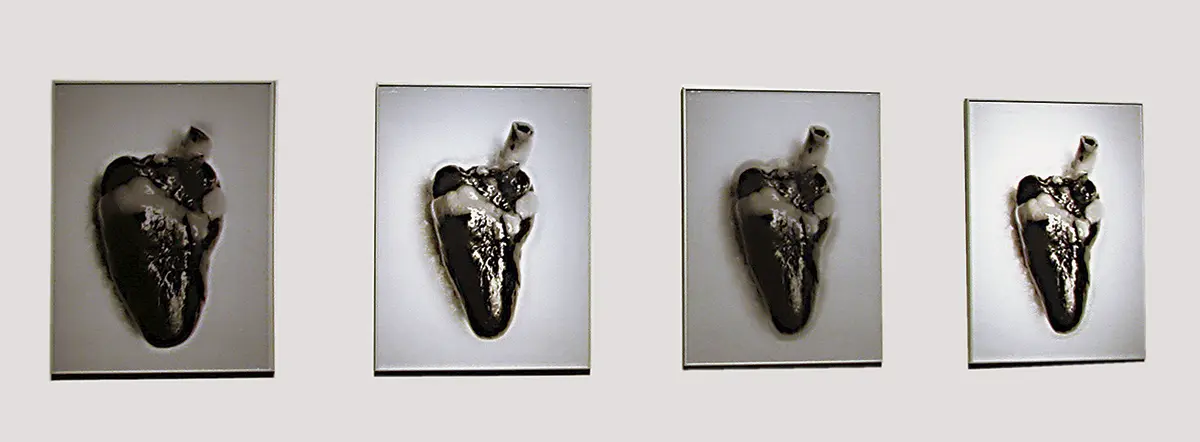
De Castro has become fascinated with exploring the concept of movement in his work. His aim is to achieve the effect of pulsation by combining a serial format with lenticular photography. This technique allows him to show two images simultaneously: one of a normal heart and the other of an expanded heart, both of which become visible as the viewer moves from one photo to the next. The artist used chicken hearts for his photographs and produced the expanded effect on a computer in Photoshop. Although the resulting images look more realistic than computer generated, de Castro’s work defies any simple notion of figuration. His present aesthetic is highly reductive. He eliminates superficial details and uses bare, empty backgrounds. This gives these works a cool, conceptual look that creates a paradox: while the heart is, for de Castro, a symbol of passion and emotion, his images are measured and detached. They are also distinctly out of focus. The artist explains that this stylistic choice is not related to the work of Gerhard Richter, whose art he was not familiar with previously, but rather to the blurriness memories sometimes seem to have when seen with the mind’s eye.
The exhibit also includes a blurry, black-and-white painting titled Natureza Morta, Deer (Still Life, Deer), 2002. Animals and landscapes are new subjects in de Castro’s art and are based on his photographs of the dioramas at the American Museum of Natural History in New York that feature animals and natural environments. He is fascinated with the “stuffed” animals displayed behind the windows. His title natureza morta (literally, ‘dead nature’ in Portuguese) does conceptual justice to what these museum animals are: quite dead but made to look as if they were still alive.
The visual sophistication of de Castro’s work seems at odds with the fact that this Brazilian artist is self-taught. Born in 1957, de Castro grew up in a poor family in Rio de Janeiro. He was interested in art as a child but attending art school was simply not a choice available to him. He dropped out of high school in order to earn a living but managed to acquire artistic training by working for fifteen years as a graphic designer for various record companies. De Castro produced his first professional drawings in the 1980s. At first, he favored color pencils, but after a few years, he abandoned them for color pastels, in order to work on a larger scale. However, his use of pastels did not emphasize the specific qualities of the medium but rather made his work resemble oil or acrylic painting, a medium he had not yet explored. His pastels were realistic, somber, and dramatic but he prevented the work from becoming baroque by minimizing movement and emotion. In fact, he chose to represent the nudes, erotic situations, and unusual human characters that often appeared in his works with a detached, clinical eye.
In the early 1990s, he began to photograph his models in black and white because some of them were elderly and found it difficult to hold a pose for long periods of time. But by the end of the decade, his use of black and white also extended to his drawings and paintings. At the same time, de Castro found that his use of pastels limited the direction of his art, so he decided to shift to painting. In fact, he considers this show at the Fay Gold Gallery not only his first solo show in Atlanta but also his first real exhibition of painted works. De Castro has lived in New York since 1996 and has exhibited extensively in Brazil, the United States, and Europe. He returns to Brazil often, where he is currently preparing two new exhibitions.
FLORENCIA BEZZANO-NELSON