As a “design for living,” a floor plan proposes an idealized version of a more complicated reality. Floor plans serve as a platform for intentions and unconscious projections. They also provide an indicator of normative forces that subtly (or not-so-subtly) shape human relationships.
In UN Real Estates, María Elena González uses this dreamy, disconnected quality of floor plans to mold symbolic forms from personal narrative. These seemingly dispassionate constructs are the raw material for the New York-based artist’s sculptural installations, which she variously stamps into life. Trans Parent Home I & II are cast rubber floor plans based on González’s childhood memory of homes left behind in Cuba.
These seductive objects are placed on the floor, encouraging a closer inspection of their pale green, faintly luminous details. Depicted in shallow relief, the empty rooms and bathroom fixtures are a model for a domestic story that has either ended or is waiting to occur. Yet, denuded of people and furnishings, the floor plans hover in an unreal state that, to the casual observer, is unfixed by time or place.
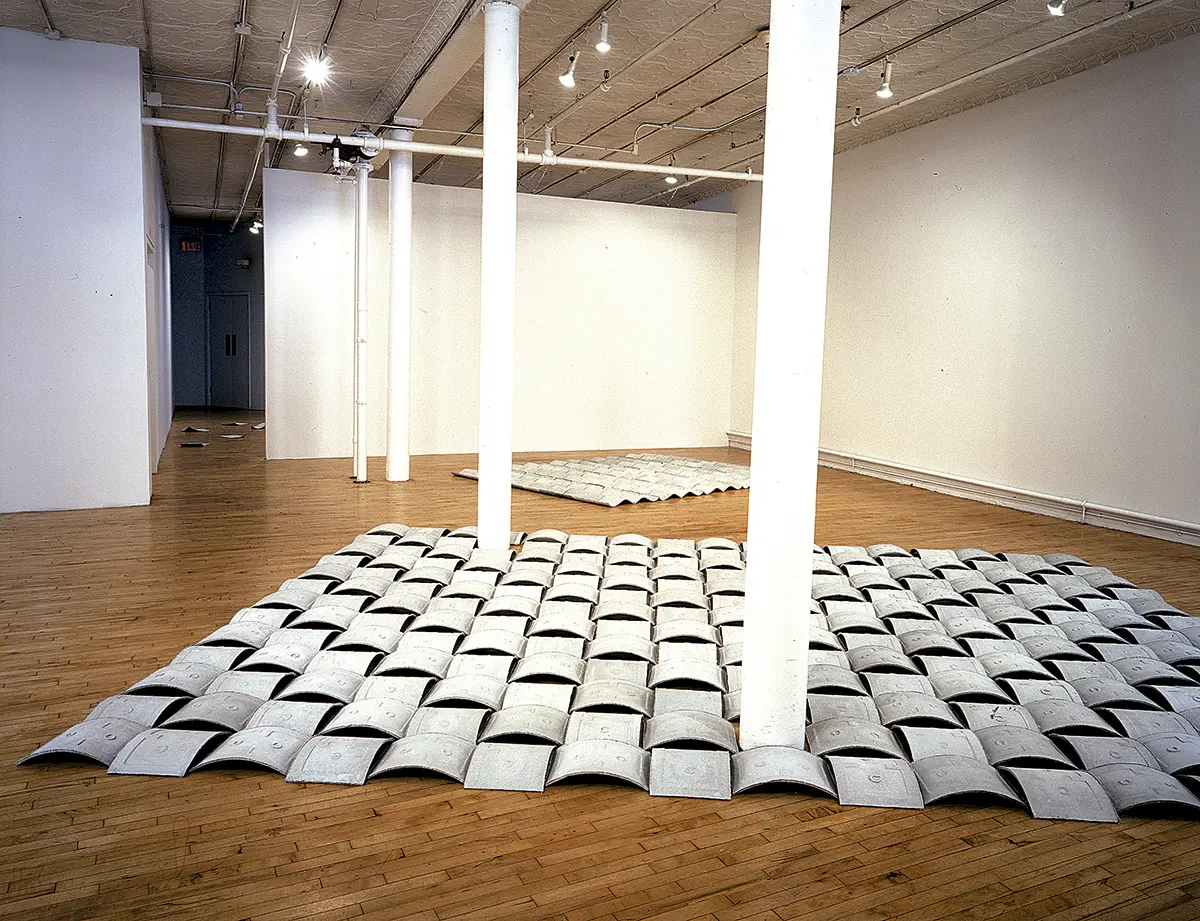
This lighter-than-air quality is echoed nearby in two hyper-patterned installations. Both are rectangular arrangements of gray objects that resemble roofing tiles, made perhaps from a fragile ceramic. In fact, the objects are floor plans cast in fiber-cement, a lightweight construction material that combines Portland cement and paper pulp. González adopted this form during a recent residency in Europe, where she learned to make the molded materials alongside workers in a Swiss plant.
The first installation, Weave, is composed of over two hundred of these tiles which have been barrel-molded and placed on the floor in rows, curve side up. Positioned in alternating directions, the rows form a gently-rolling lattice pocked with dark, concealed spaces. In Wave, equal numbers of the same tiles have been molded into S curves and placed on the floor side by side in uniform rows. This formation hugs the gallery floor in graceful arabesques that undulate across the overall design.
All of the tiles are embossed with the same, strangely-shaped floor plan and stamped with “C,” indicating “closet.” By singling out this neutralized, cast-off space, González may be referring to certain forms of social isolation which are either overcome or reinforced, at least visually, by the collective patterns organizing them. These elegant pure designs also suggest an architectural ethos at odds with messy social narrative, such as Modernism’s historic penchant for razing more heterogeneous floor plans.
In an adjacent room painted pale blue, González has created an antidote to the neat patterns above. Titled Flying Apartment Flotilla, this installation features numerous floor plans with personal significance to the artist. Scattered haphazardly around the room, these floor plans are also cast in fiber-cement and randomly shaped to appear as if stirred by imperceptible air currents.
The deception is simple but sufficient to lift the room into a quiet state of perpetual motion, an unreal state that is both imagined and sensed. Like wind-tossed autumn leaves, the installation is an apt reminder that plans are fine for houses but not so reliable for human lives. We understand the importance of plans but accept the reality that they will always be merely provisional. This careful modulation of ideas and sensations transforms the schematic elements in González’s work into distinctly wistful poetry.
JOHN ERWING