
Brightness, artifice, and something else in the works of Miguel Harte (Buenos Aires, 1961) gathered at the Museo Nacional de Bellas Artes for an anthology exhibition spanning the last 15 years of the artist’s production. The selection presents several moments in a trajectory, which at first captivate the viewer’s gaze with their tempting surfaces and unusual shapes. On a second approach, most of these pieces open up a space of uncertainty that forces us to slow down, and perhaps to reflect.
Artists don’t like to be pigeonholed. Although the show includes pieces dating from the 1980s, and although the artist had his first individual exhibition in 1985, Miguel Harte is considered a paradigmatic figure of the 1990s thanks to the character and essence of his shining and self-referential works, as well as for his artistic ties and the course followed by his subsequent shows. The 1990s were a time when, within a legitimating sector of the world of art, the artist’s subjectivity emerged as a prime value, and the decorative was posited as a distinguishing characteristic, while Argentinean society celebrated appearances (record numbers of plastic surgeries and of “hair-salon blondes”) and ostentation.
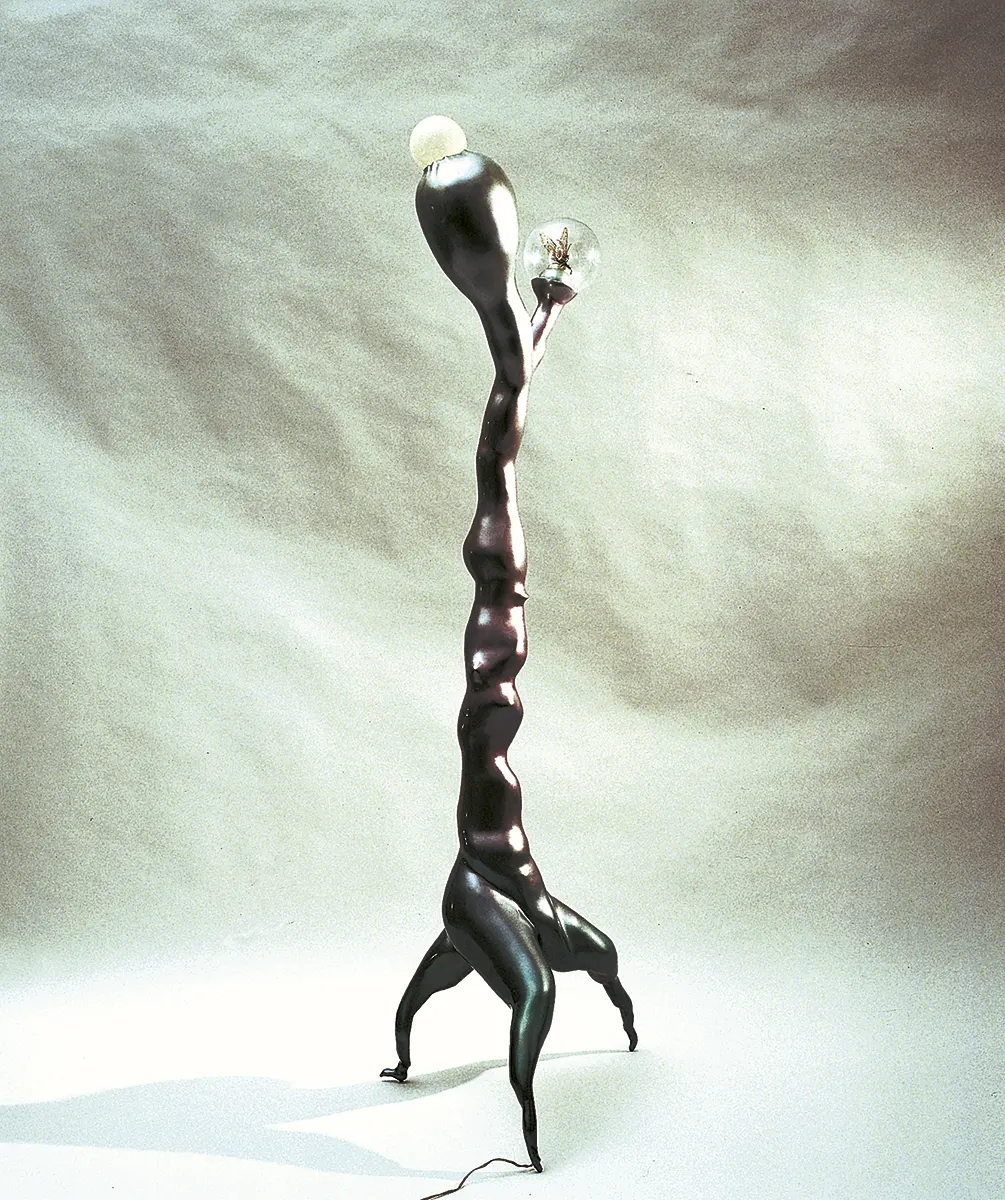
The pieces in this exhibition are objects on the plane —what else to call works in Formica with encrusted elements, dubbed “inclusions”?— and various constructions. Some resemble large toys, while others look like industrially produced items: a table, a lamp, or a hanger. While the most recent works have ends (limbs?) that, like exotic branches or sensual legs, step into space and make it their own. Alongside these works, there are artifacts that describe landscapes with urban overtones —buildings without openings, pathways without a destination— and organic ingredients that are unclassifiable.
Equally attractive in these misleadingly seductive works are the intriguing universes developed behind resin bubbles and inside soap-like glass bubbles growing in the extensions of some of Harte’s constructions.
Harte’s work alters the intention of the eye, the habit of the gaze, forcing the viewer to enter his almost microscopic versions of a cosmos of minerals and living forms, populated by hybrid beings that project a bewildering zoology where it is possible to find a crossing between a likeness of the artist himself and the body of an insect. Autobiographical elements abound in the work of an artist who, for instance, adds his own face and that of members of his nuclear family to little toy cars. In Rampa mortal, two of these toy cars (one of them a “self-portrait”) are ready to slide down a silky road with legs and no future. Will they jump into the void? On the adjoining wall, safely tucked away, is the third car. Could it be the family’s third member?
In truth, and thanks to the logic of its display, this anthology exhibition resembles at times a large toy room. Harte’s work on surfaces —initially Formica and contact, later industrial car paint— is fundamental in order to understanding the confusion that some of these pieces generate at first sight. These artworks demand time from their viewers since they are not a mere visual game: playfulness appears accompanied by an anxious density. Far from condensing a single idea, the exhibition multiplies stimuli so that the viewer can include his or her own perceptual experience.
Harte’s work represents nature under a different light, perhaps materializing glorious dreams or creating frightful and hallucinated scenes that trap or protect their inhabitants. The transparency of his “inclusions” lets us observe these strange little figures as they nest (or are they prisoners?) inside the bubbles, promising a closeness that is not truly such.
A long list of materials —iron, bronze, acrylic, epoxy, Formica, resin, silicon rubber, glass, and insects— helps the artist in the costly and careful process of manufacturing his complex works, which on occasion include light and movement.
Behind the art’s splendor, there is a sensitive artist and a complex system of relationships that move through the biographical, through his connections to art history, and through philosophy, announcing the absolute triumph of the image and of pure simulacrum.
VICTORIA VERLICHAK