This anthological exhibition of works by Roberto Elía (Buenos Aires, 1950), curated by Mercedes Casanegra and presented at the Centro Cultural Recoleta, spans over 30 years, between 1969 and 2003. The viewer is treated to many surprises by Elía’s splendid and very coherent body of work, which in its silent consistency invites us to feel our freedom and to revisit all preconceived categories.
Paintings, objects, installations, and works on paper all attest to the artist’s overarching interest in poetry. His entire work is a search for links between art and literature. Elía’s oeuvre is connected to writing in a refined and intimate way, and not only because of its tendency to modify the relationship between words and objects, or because Elía writes on long and personal white-page, non-ruled notebooks. The great figures of Argentinean literature —Jorge Luis Borges, Oliverio Girondo, Leopoldo Marechal, Macedonio Fernández, Julio Cortázar, Roberto Arlt— marked him in a defining way.
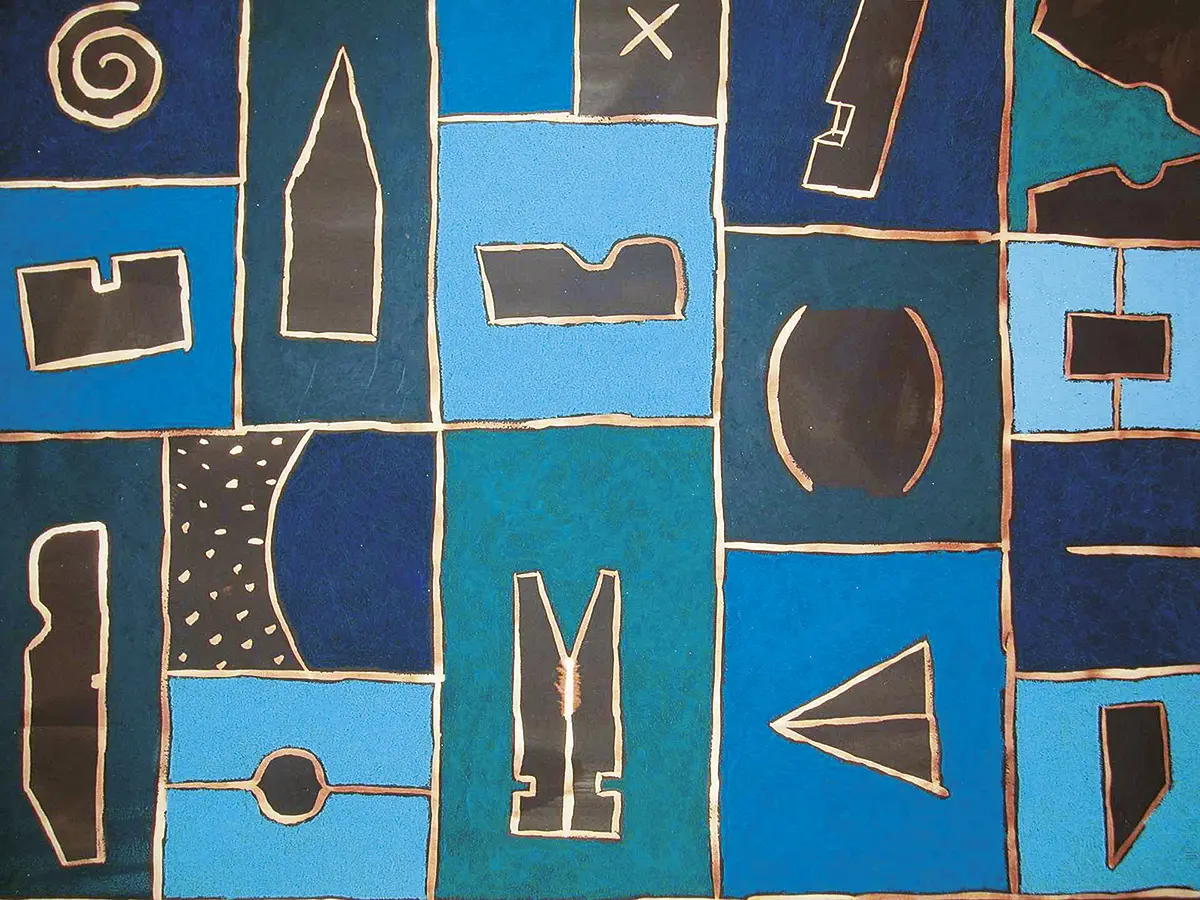
Always ready to elaborate what pre-exists, always on the verge of reconstructing the universe, the artist explores his tool beyond expectations and is capable of infusing a soul into the transformed (transforming?) objects, forceful sculptures, mysterious writings, despoiled paintings and delicate boxes that he makes. The profound mutation that shakes his clasps, matchsticks, pipes, parentheses, preserved fish eggs, canes, stones, pieces of chalk, wood, shale, buttons, threads, pencils, and big and small boxes, announce something hidden about to be explained.
The incorporation of clothes pins in Elía’s personal mythology came about early, in 1969. Emblematic elements, taken apart, reconverted, and re-signified, these clothing clasps are permanently bringing forward new representational content. The clasp tool is turned into a game or a toy, a reclining figure, a human effigy, a loving couple, a passenger of light, a parenthesis, a containment space, or an interrogation area, and ceases to be that object perceived by most as utilitarian. Elía uses clothes pins metaphors, as an analogy for other things, and they become the axis of a critical operation in a discourse about freedom, literature, life, and death.
Another one of Elía’s expressive tools is the parenthesis. There is something in those works created through the tracing of parentheses that at first evokes childhood, a memory of elementary school. Those two side-by-side lines, leaning inwardly to allow for insertion, appear initially as very elementary sticks. Simple custodians of an autonomous sentence, parentheses can also be the harbingers of interruption and suspension, or they can become two hands ready to receive or to contain.
The structure of the game of hopscotch was also incorporated in a symbolic fashion, and in a variety of ways, into Elía’s work. Do coincidences exist? Among the acknowledgments in his 1963 novel, Cortázar included Raymond Roussel, who 50 years earlier had published Impressions of Africa, a book that like Rayuela (Hopscotch) could be read starting on Chapter One, Chapter Ten, or any other. Elía’s first works were based on Roussel’s delirious novel, and some later pieces referred to the game of hopscotch.
The pieces themselves, an intriguing mixture of raw materials and paradoxical concepts, put ideas to work and generate unlimited variations. They force a penetrating gaze in order to apprehend the real and fictional clues the artist intertwines. In a double action, the work gives legitimacy to the every day and illuminates the rupture that gives it a revealing dimension, richly and unsuspectedly outside time and space.
Perceptive and corrosive, Elía works with a network of meanings, with literary, political, and social data, weaving a grid that appears as something delicate, neat, and free of brusqueness, all the while alluding to a complex subjectivity and a turbulent collective history.
VICTORIA VERLICHAK