
The images, difficult to read, show people holding portraits. Printed life-size on stainless steel using a technique that simulates the process of reticulation of the originals, taken from newspapers, they are part of the 2003 series Corpo da Alma (Body of the Soul). These images are emblematic of Rosângela Rennó’s investigation. Rennó (Belo Horizonte, 1962) has developed this line of work over the last 10 years; her research is based on photography’s documentary and archival character, and on the prominent role in society both in the public realm and the private sphere. The subject of her images uses the presence of photography to evoke vanished truths. The photographs are testimonies of disappeared or dead loved ones and of their tragic destinies. Taken from newspapers, blown up on steel, and exhibited in a museum, these images describe a course of the almost unequivocal condition of photography itself —between reality and artifice. Behind the seeming transparency of documentary photography, a series of choices and usages is revealed.
Curator Adriano Pedrosa defines the images in Corpo da Alma as re-photographs of re-photographs; these pieces were found in the first area of Arquivo Universal e Outros Arquivos (Universal Archive and Other Archives), a panoramic show surveying 13 years of work by Rennó organized around nine series and a group of objects from her early years. Conceived in 1992, Arquivo Universal is an infinite archive of journalistic texts containing narratives about the presence or existence of photographic images shown printed, or mounted in different ways. Continuing with the show’s pre-established path (it occupied almost a full floor at the Centro Cultural Banco do Brasil, in Rio de Janeiro), the next group of works is her series Vermelha (Red, of 2000-2003) recently exhibited at the Venice Biennale’s Brazil Pavilion. The series includes 16 portraits of men and boys at work wearing military uniforms. These portraits have been blown up in several shades of red, thus relating militarism and the color of blood in an interplay between the formal effects of the monochrome and the political context of the images gathered. The Vermelha series was exhibited interspersed with Violência y Vaidade (2000), yet another stratum of Arquivo Universal, which worked with fragments of texts referring to the presence of photography in conflict situations. The texts have been printed on typographic plaques and “framed” by black and red fuzzy pillows, once again creating an ambivalent dissonance between form and discourse.
Another photographic series that is also shown in its entirety is Vulgo (1998). This series was based on the negative archives of the São Paulo Penitentiary Museum. It is in Vulgo that Rennó explores the notion of the individual by focusing on its representation in the context of a public archive. Used for the creation of inventories of prisoners’ behaviors, as well as for their study and ultimately their control, this archive and these images are incorporated into the artist’s own work, revealing only some details of the subject’s bodies. Rennó’s appropriation of these images shows the almost phantasmagoric character that such photographic archives acquire over time and their final obsolescence. Revisiting private and dispersed archives, the series Cerimônia de Adeus (Good-Bye Ceremony, 1997-2003) uses wedding photographs taken at the moment when the couple say their good-byes and take off for their honeymoon, which has been compiled in collaboration with Cuban photographers.
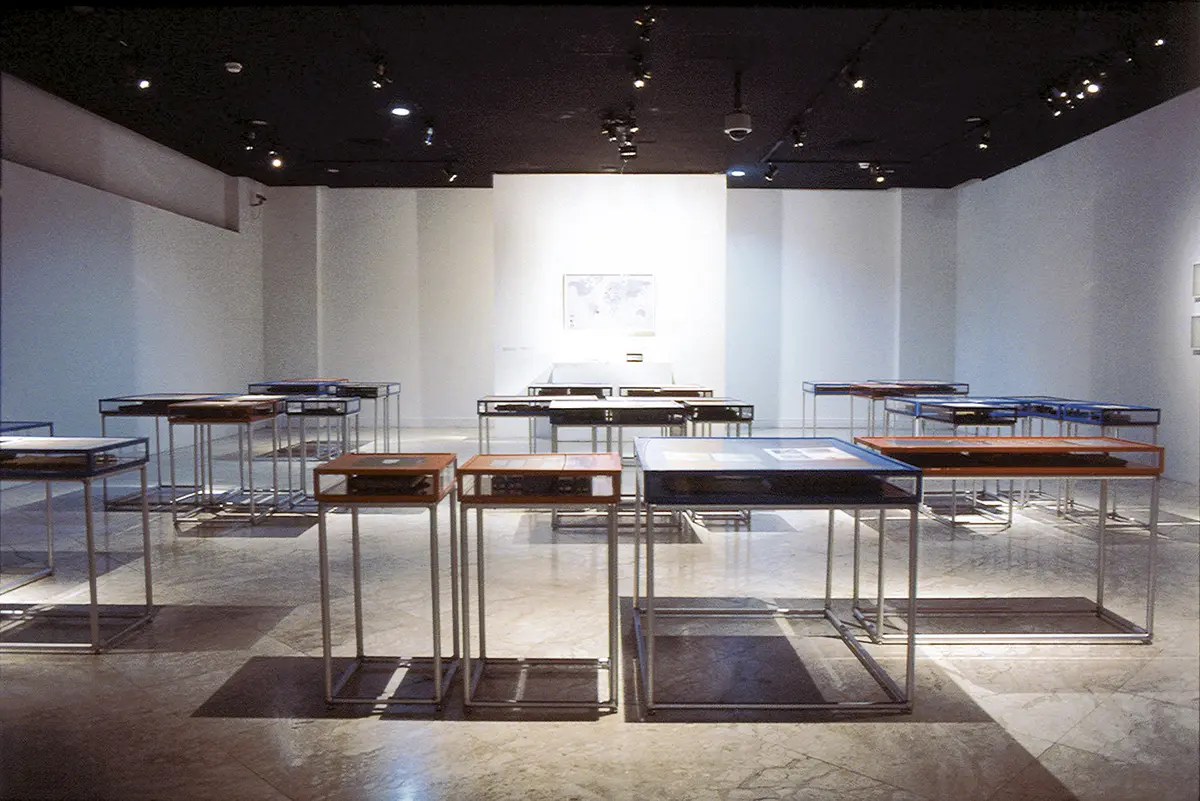
Collecting as appropriation is one of Rosângela Rennó’s favorite practices. Her series Bibliotheca (2002) commissioned last year for her individual show at the Pampulha Museum of Art, is in that sense an ambitious synthesis. Starting in 1992, when the artist purchased an album of portraits at a flea market in Brussels, this work ended up growing into a collection of more than 100 volumes. Rennó patiently examined these albums, creating catalog cards that minutely describe their contents: dates included photographs, inscriptions found, place of purchase, and other references. After this scrutiny, the album’s pages were glued and placed inside display cases, which are in turn wrapped in life-size photographs of their content.
The work explores notions related to the desire for totalization implicit in the concept of a library, but the access to information is circumscribed to the small metallic cabinet that holds the album’s cards. Viewers are removed from contact with the photographic objects themselves, as the whole experience is mediated by texts written by Rennó and signed by the librarian.
In the context of contemporary art, where photography is an ever more central practice, the work of Rosângela Rennó reminds us of its self-contradictory, but always political, nature.
RODRIGO MOURA