This visit to Barcelona, the first chance we have had to talk leisurely and at length, has allowed me to find in Jusidman, alongside the excellent painter and the prestigious art critic, an enormously curious and learned man who is passionate about everything related to the art of painting.
He talks enthusiastically about the Gainsborough show in London: about Tate’s good criteria for selection and about that most supple of painters whose portraits, even today, emanate a close, gentle presence as if they were still trying to find ways to please the viewer.
“To many, Gainsborough’s seductive power may appear frivolous, since we frown upon art that is created in order to please —we are told, instead, that the artist must confound, even attack, his public. Come on. The relationship between artists and viewers can be understood as a long-distance conversation, but that doesn’t mean that we need to shout at each other.”
I bring up the topic of those “anthology” shows invented by exhibition commissioners, such as Comer o no comer, mounted in Salamanca. Protocol forces us to bring up Marcel Duchamp in this connection; even if he was never interested in the topic of food, we cannot ignore his famous bottle carrier. Jusidman tells me that many of those commissioners are primarily engaged in anthropology and that he is not interested in contemporary art as an anthropological index, because, if it is a matter of eating, we can affect more interesting anthropology in a supermarket than in a contemporary art museum.
“Perhaps this is why Biennials try more and more to look like supermarkets. Yes, they tell us that such an extraordinary phenomenon is a result of the critical spirit that underpins the artistic avant-garde. I wonder why it is that the same critical spirit is not applied to the regrettable system of cronyism —between the star artist, the star curator, and the institution— that has inflated the bubble of art-as-spectacle over the last fifteen or twenty years. Think of the clever artists of the moment, think of how well they have learned to package these 'critical values' that curators and institutions promote, and think of the talent required to provoke an ad-hoc public reaction. Lately, it is not even a matter of articulating ideas: a mere flashy prank will suffice. What worries me is that so many young artists volunteer for this game without questioning it even for an instant and that a public accustomed to premature pranks will continue to demand more and more clever stars, whose careers will be as flashy as they are fleeting. The confusion of immaturity with innovation is, I think, an absurd and self-destructive by-product of contemporary art presented as an anthropological spectacle. Evidently, for the time being, the 'big league' remains out of painting’s reach, since the environment being created does not favor those intimately personal contacts—complex and subtle—that articulate good work in this genre.”
Yishai Jusidman tells me that he was one of those children for whom drawing comes easily. His family was not artistic, but, as any good bourgeois Jewish family, it valued cultural achievement and so he was enrolled in painting classes from an early age. His drawing teacher took him with her to the classes given by Carlos Orozco Romero, a well-known contemporary of Tamayo in Mexico, who situated himself between muralism and a more “Frenchified” line of surrealism and metaphysics.
“I learned the basics of oil painting with Orozco, between the ages of ten and fifteen if memory serves. Later I was admitted to the Pasadena Art Center College of Design, and I went there with the idea of learning about video art, performance, and all those things that back then were seen in Mexico as the absolute avant-garde. I created my videos and my installations, and after all that I realized that the reason art interests me is painting. The desire to practice painting to my heart’s content is what drove me to Cal Arts, the fashionable liberal school. But I wasn’t aware of their anti-painting pedagogical philosophy (which, paradoxically, produced painters like David Salle, Ross Bleckner, and Lari Pitman). The need to find my own place in a context in which theory and ideological demands dictated a priori what kind of art was to be made, made me realize that, as an aspiring painter, I had to find the appropriate intellectual support for my work. I left that school after one year, in 1985. I went to the New York School for Painting, Drawing, and Sculpture. At that time, several artists who were the apparent heirs of abstract expressionism taught and worked there. A number of months later, I realized I’d changed a pictorially sterile dogma for one that was past its expiration date.”
Jusidman finally decided to pursue a Master’s degree at New York University. He took philosophy, art history, and comparative literature classes, and he found a bibliography that differed from what was in use in art schools: an alternative founded on authors from Panofsky and Gombrich to Wolheim and Goodman.
I ask him which painters interested him then, and which ones interest him now, and he tells me that he is attracted to painting that has an inescapable visual impact, painting that not only illustrates an idea but articulates it. In school, he was interested primarily in De Kooning, then Goya and Rembrandt, and even Tàpies. In 1984, the year of his first exhibition, still in Los Angeles, neo-expressionism was in fashion and the dealer thought that young Jusidman would sell well. In truth his painting had little to do with Schnabel and Kiefer, being instead a kind of expressionism coming way too late.
“I was an immature 'DeKooning-ian,' without the critical and ironic distance of the neo-expressionists. At the age of twenty-two, I did not possess those attributes. Today, Velázquez and Vermeer are the supreme models for me, not surprisingly. My interests depend also on what it is that I am painting at any given moment; when I painted landscapes, for instance, I continuously returned to Constable and Monet. Lately, it seems, there has been a change in my preferences, and it turns out that the twentieth-century painter I am most passionate about is Morandi, even above Pollock, Mondrian, and Reinhardt. I knew little of Morandi until 1992 when I came across a dozen of his works in Verona and spent several hours in complete awe of them. Morandi dazzles where others falter; his paintings are not consumed by anecdotes or context. Morandi’s work stands by itself, barely fitting within the framework of the art of his time. I want to believe that, someday, my paintings will be able to do something similar.”
Yishai Jusidman recently presented an exhibition of his latest work in museums in Europe and Mexico —the SMAK Museum of Contemporary Art, Ghent, the MEIAC, Badajoz, and the Museo de Arte Contemporaneo, Monterrey. These shows were organized by Jan Hoet and gathered works from the series Mutatis mutandis, 1999–2000, and Pintores trabajando, 2000–2002.
Mutatis mutandis refers to the Latin expression that signals the assumed differences between the terms of an analogy. Jusidman uses it as a title for new works that return to the motifs of the wrestlers and the psychotic patients seen in his oil series Sumo, 1993–1995, and Bajo tratamiento, 1996–1998. By considering the plastic potential of technological media such as photography, offset printing, and digital imaging, Jusidman attempts to create paintings with the very tools that, since Walter Benjamin, have been favored by the anti-painting militia.
In fact, painters have been forever fascinated by “methods of mechanical reproduction.” Between 1705 and 1720, the German painter Jacob Christoph Le Blon developed the first printing system to use color separation, laboriously engraving copper plates in half-tones for each of the three primary colors; superimposed on each other, these plates produced the necessary modulations of color to mass-produce “paintings.” The painting had just as much to do with art as with technology. It was not until 1839 that, upon seeing a display of daguerreotypes at a meeting of the Paris Academy of Science and Fine Arts, artist Paul Delaroche declared: “From this day forward, Painting is dead.” As we know, painting missed its own funeral, and to this day it continues to roam around.
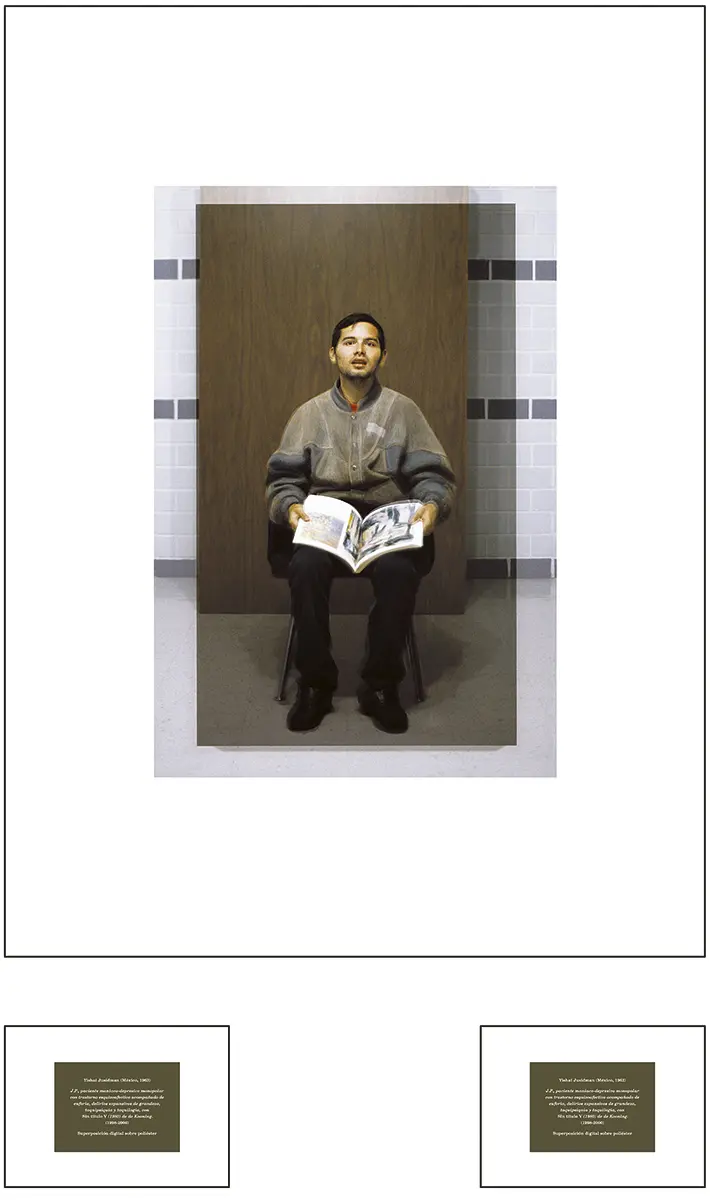
In Mutatis mutandis a group of digital photographs depict the characters from Bajo tratamiento. For these images, Jusidman has digitally combined the original photograph used in the creation of the painting and the image from the finished painting itself. The resulting optical effect is very peculiar. As Richard Kalina writes in the show’s catalog: “The paintings in Bajo tratamiento transmit a certain disconnectedness as well as an air of autumnal melancholy... In contrast, the juxtapositions in Mutatis mutandis are at the same time more literal and more prosaic (as photographs tend to be), and even then they are considerably weirder.”
“The series Mutatis mutandis is an exercise in contrasts, where pre-existing contents from my own work are processed into new forms, which in turn articulate new contents. The purpose of those digital juxtapositions is to contrast certain characteristics of the original photograph (the graininess, the general diffuse quality, the cold light) with the brushstroke, the outlining, and the warmth captured in the painting. Such contrast brings these qualities to the fore, animating the plastic meaning of the work in the same way in which a painter exploits the contrast between a given color and its complement, between background and figure, between image and matter,” according to Jusidman.
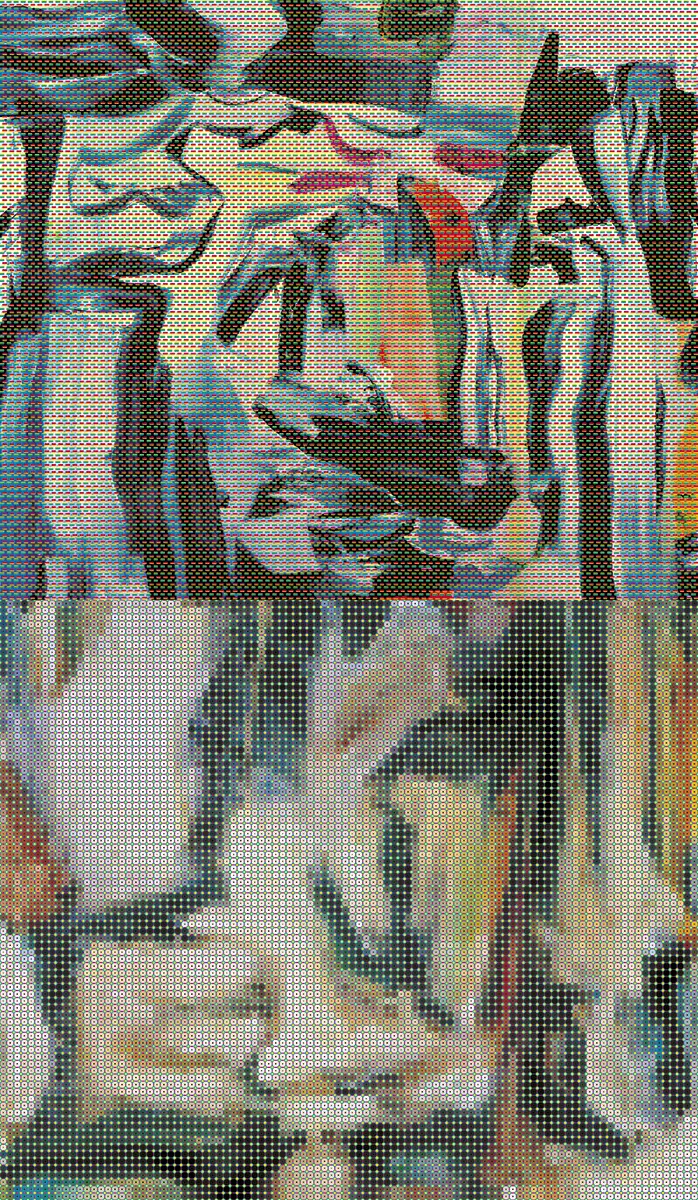
In the same series, Narcisos incorporates the paintings selected by the patients themselves in “Bajo tratamiento,” and with which they were portrayed in that series: the selection of a Velázquez, a Morandi, and a De Kooning goes without saying. In the top section, we see a digital treatment of the painting, and in the bottom section, we see its “reflection” taken from Jusidman’s version in Bajo tratamiento. Narcisos takes on the challenge of managing the impression in a large-format plotter. Jusidman used an electrostatic printer with an offset pattern. By highlighting the contrast between the effect of the rosette and that of the pure color surfaces, as well as between the image and geometric pattern, the artist gives the medium a new, surprising spatial quality. Although the tale of Narcissus points towards a useless love for the virtual, this painting, which brings to mind Op Art, activates a range of reflexes and reflections around the material dependence of pictorial effect, in other words, its mode of production.
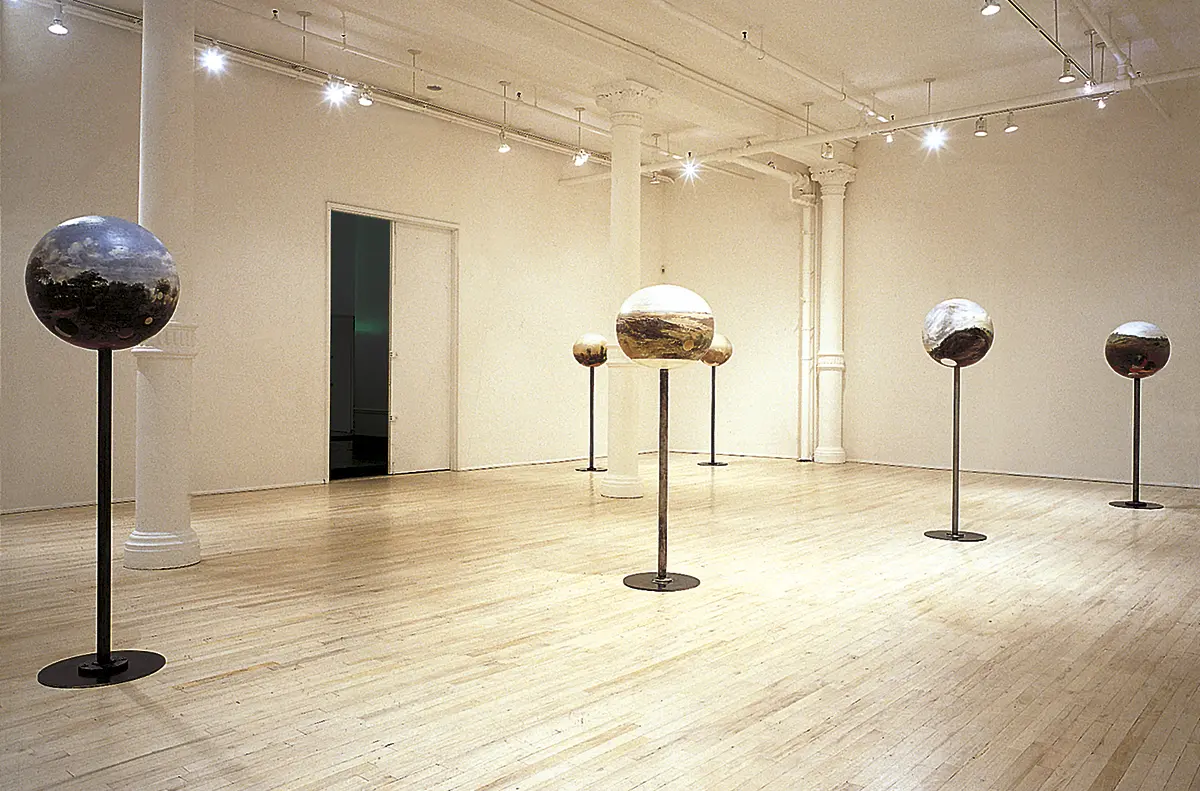
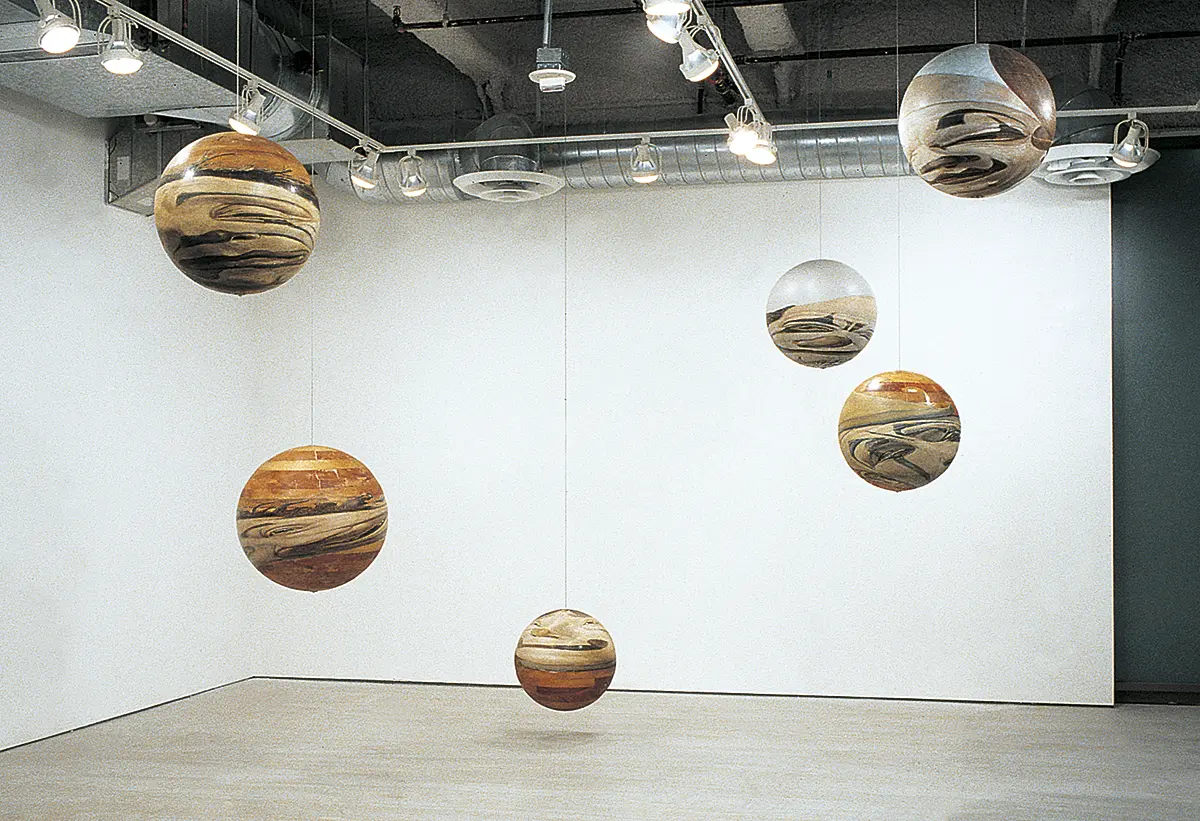
An interest in articulating the qualities of space and art-historical references is already found in the Astrónomo series of 1987–1990 when the artist painted —on spheres— landscapes taken from the history of naturalism by artists from the seventeenth-century Dutch masters to Monet. To paint landscapes on a spherical surface already implies, of course, highlighting the relationship between pictorial and physical space. This transition is resolved more ambiguously than in a work on a flat surface: in the first place, the painting’s surface is physically curved but the subject is taken from a flat picture plane; and in the second, a pedestal supports the sphere rather than a frame to separate the physical from the virtual space. The issue of framing would reappear in Mutatis mutandiss in a series of tapestries produced at the Taller Mexicano de Gobelinos, Guadalajara.
A similar enterprise of weaving copies of paintings into tapestries had been established in London in 1727, with the previously-mentioned Jacob Christoph Le Blon. He used a method that only employed threads in three primary colors and thus reduced the maximum amount of information to a minimum code —a kind of primitive digitalization. Significantly, Jusidman echoes the same impulse.
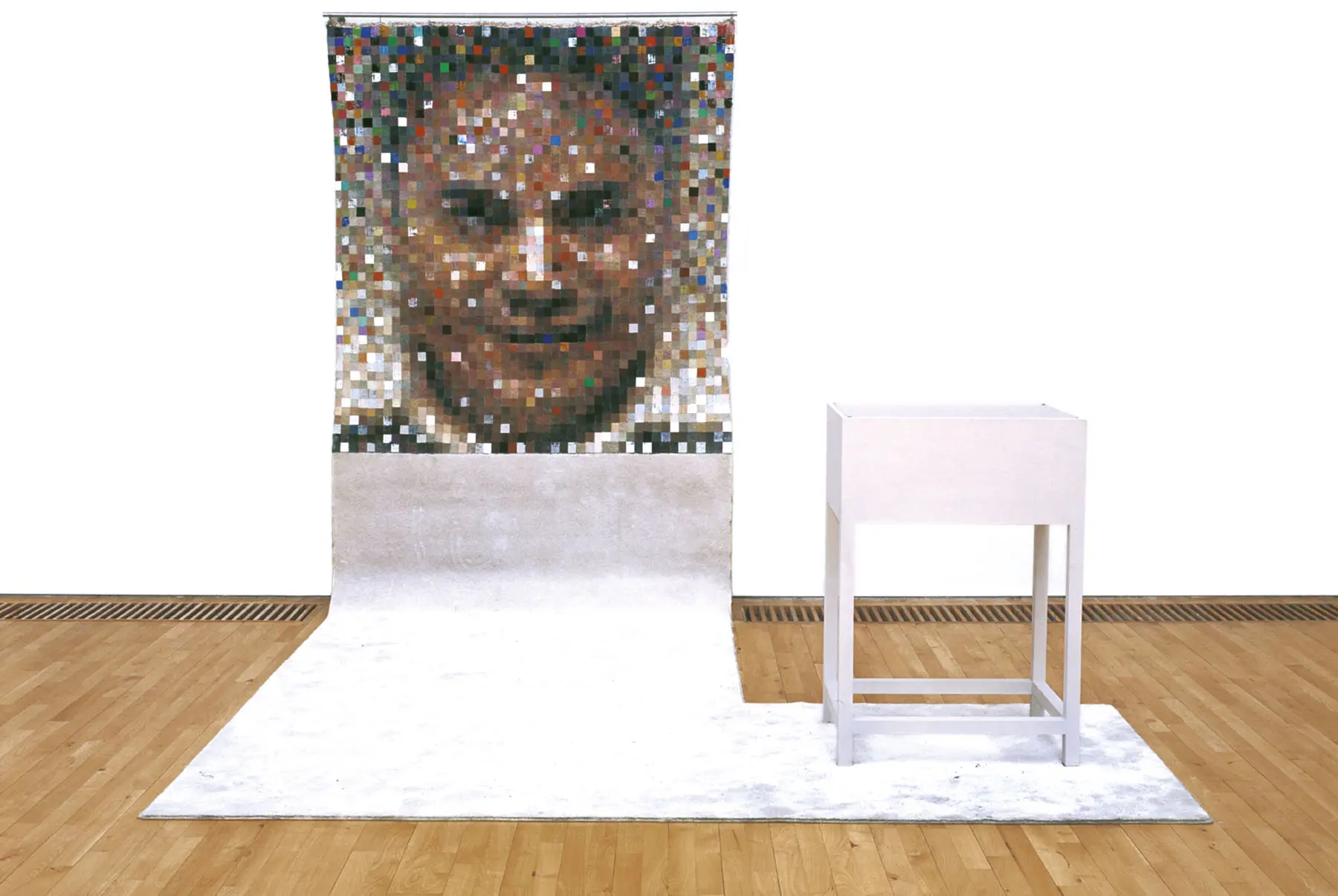
“The weaving of a tapestry relies on a process that is similar to digitalization: a specific number of colors is chosen for the worsted and, restricting himself to just that range of colors, the weaver mixes the yarn until achieving the closest resemblance to the original. By transferring the low-resolution digital image of the patients’ faces to a tapestry, I wanted to highlight the tactile quality and the material presence that tapestries share with paintings. Once the tapestries were created, I decided to paint on them in order to introduce the contrast between the surface of acrylic color and the dyed textile background, in this way both adjusting and enriching the work’s spatial effect.”
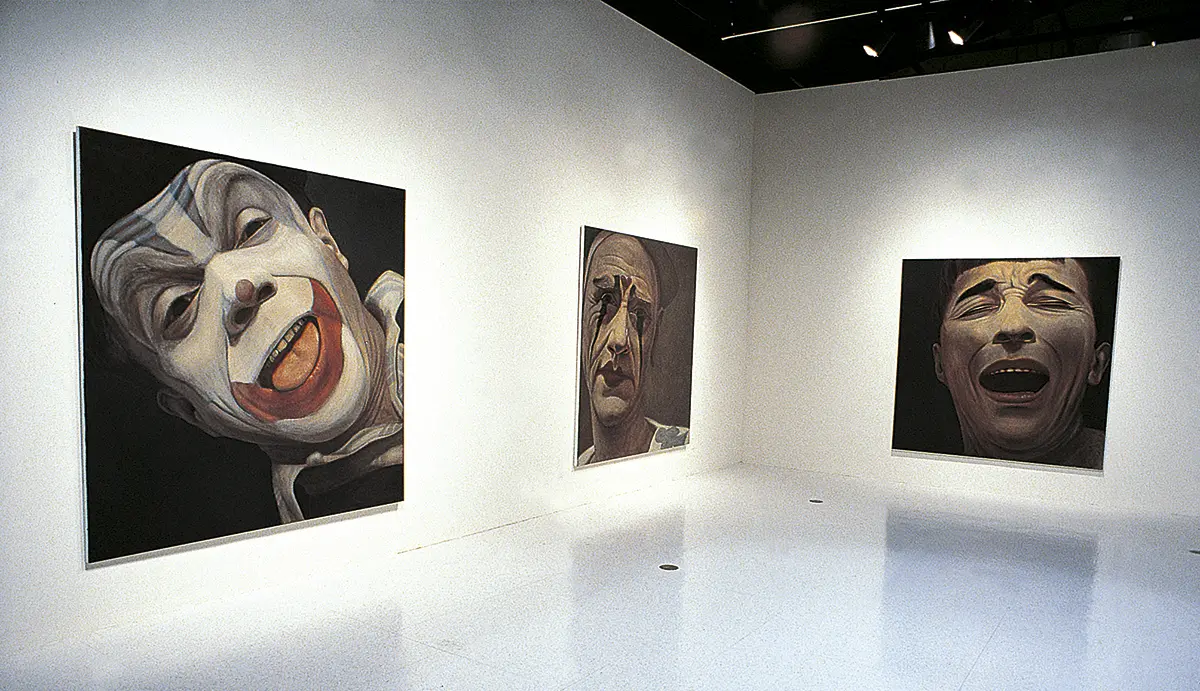
The analytical emphasis on the character of plastic and the psychological effects of these large-scale portraits reminds me of the 1990–1991 series “Payasos,” with its overly painted and overly expressive faces. For Jusidman, the complement to the strategy of painting on a tapestry was to introduce a length of colorless carpet on the floor. This carpet, he says, functions as a frame that establishes the border separating the pictorial space (color) from the physical space (colorlessness). The viewer becomes assimilated to the space of the carpet and his or her physicality is highlighted. The mounting of these tapestries ends in a display case that contains the same book the character held in his or her hands for the portrait. Each book has been altered by the artist in order to incorporate information relevant to the Bajo tratamiento project, thus articulating the work’s contextual framework.
“Ever since the Renaissance, the kind of frame we are used to —around the painting’s edge— has been a convention with a very specific optical purpose: to establish the painting’s virtual space. As modern painting emphasizes its own material quality, that kind of frame has become more problematic, its size has diminished, and it has tended to disappear. And as art becomes more “conceptual,” we have gotten used to a different kind of frame: the explanatory text that circumscribes the conceptual perimeter. The carpets, display cases, and books that accompany the tapestries in Mutatis mutandis are there to frame the work optically and conceptually. Contrary to appearance, these works are not installations; they are strictly pictorial works, and they require a particular frame in order to articulate their particular pictorial character.”
Similar lengths of carpet and display cases frame Mutatis mutandis: Sumo, a series of large format abstract geometric paintings, very formalist and very elegant, which in truth have a figurative foundation. Each composition is nothing more and nothing less than a background from Sumo, the series about wrestlers. The photograph that motivated the previous work is now presented in a display case, facing the new painting, so that our appreciation of the latter is supplemented and altered by the footnote in the bottom part of our visual field.
“A large segment of twentieth-century abstract art shared the Romantic idea of an aesthetic immediacy, the assumption that the painting would be revealed whole under the spectator’s static, contemplative gaze. In Mutatis mutandis: Sumo, I wanted to emphasize the fact that the spectator’s gaze, like the painter’s, must be dynamic, and inquisitive. I tried to provoke this way of looking at art earlier in Esferas-payaso, 1991–1992, and the almost-monochromes of Geishas, 1992–1993. A work of art entertains us insofar as it activates our eyes and our mind, our judgment, and our knowledge. Contemplation is best left for a TV screen.”
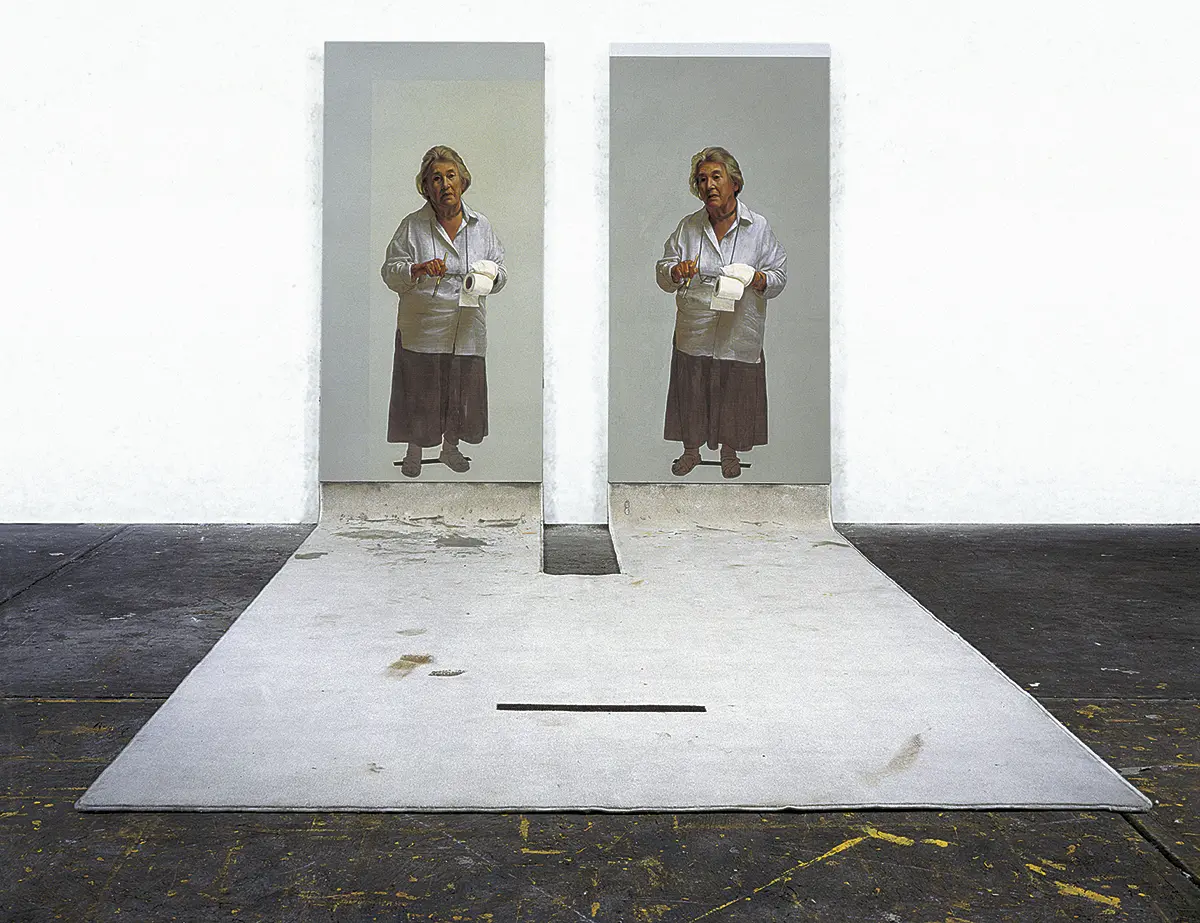
It is precisely the painter’s gaze that interests Jusidman —and us— in his most recent work, Pintores trabajando. Jusidman quips that, after painting clowns, geishas, and psychotic patients, taking on painters was only a matter of time. He tells us that his intention was to capture the moment in which a painter steps back from a work in progress, pauses, and examines the results so far.
“I wanted to capture that moment from the point of view of the work in progress, and to achieve that I pointed cameras at the artist from each side of the painting. Both cameras took a picture just as the painter stepped back. I used each pair of photographs to create a double, life-size portrait with the purpose of readapting, in the exhibition space, the relationship between the painter, his work, and the cameras. In Pintores trabajando the length of the carpet invites us to stand on a line drawn at the precise distance that separated the portrait’s subject from his work. In turn, the distance between the portraits is the same as the distance between the cameras; the space that opens between the two portraits is exactly the space occupied by the work in progress.”
Confronted with an unfinished painting, the viewer and subject enter into a kind of communion. He cannot see us, but he sees his work; we can see him, but not his painting. He wonders what do we see when we look at him; we wonder what is in his mind.
“I remember an Australian ritual I saw a long time ago depicted in a magazine: a nude aborigine knelt in front of a mound of mud raised to his height as a kind of totem. The mound was covered with geometric patterns in ochre and red sands and the pigments continued on the ground, forming an optical bridge to the man’s body, which was also covered with the markings. I was impressed by the intensity of that man’s physical and spiritual involvement with his painting. I believe there is nothing like that in the Western tradition. Without expecting us to be suddenly free of our cultural context, I realize that in Pintores trabajando I’ve tried to motivate the viewer to become involved in the work, in our tradition but with a similar intensity.”
Although Jusidman thinks of himself as a very traditional painter who deals with well-established painterly issues and themes, he is the antithesis of the reactionary artist. His work makes clear that painting can absorb current technology as well as it absorbs its own history and that as long as it continues to make use of new materials and executes new strategies to grow, it will remain in good shape. In the end, the obvious answer to the question of “to eat or not to eat” is, without a doubt, “to eat.” To the question of “to paint or not to paint,” the answer is equally obvious.
MARÍA LLUÏSA BORRÁS
Art critic.