
Although few artists seem to practice it, one of the most intriguing lessons about scale is that sometimes work can be stronger when rendered in a smaller size. Alejandro Mazon is unafraid to make dense, bold statements in intimately scaled works whose pristine execution, tight lines, and intense colors place them in the same universe as Persian miniatures and Flemish oils. As he has before, with these works Mazon has chosen to juxtapose different themes and cultural references to create evocative non-narratives. These images may often be discordant and personal and are rarely explicitly related. Such dreamlike, episodic imagery has led to inevitable comparisons with Frida Kahlo, although in truth this comparison seems somewhat facile.
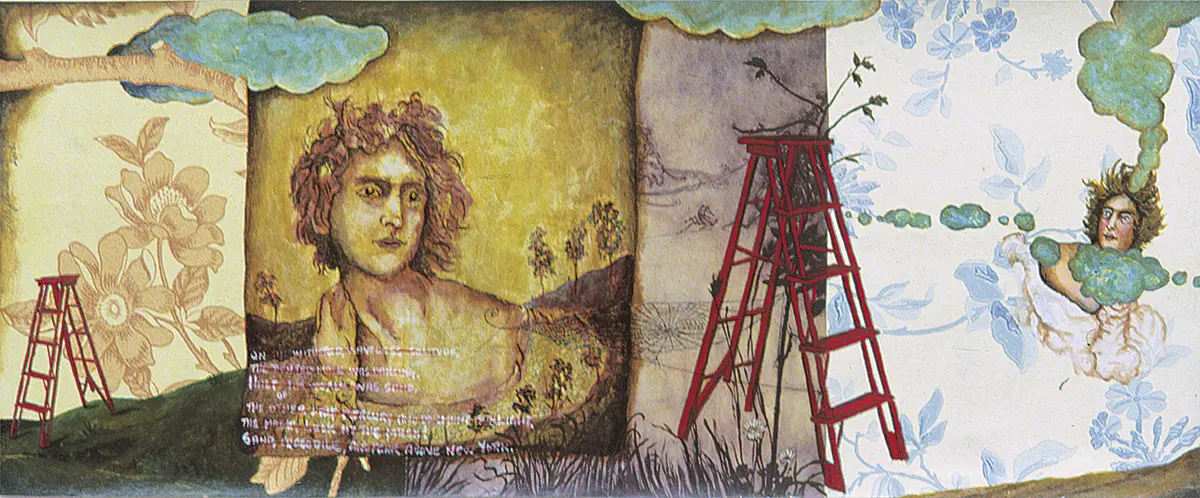
Mazon’s current exhibition showcased works that presented a new stock of characters. These forms span history as well as the history of art. This suite of pictures retains the intimate scale and evocative figuration of Mazon’s earlier pieces, but these works have been further enlivened by their backdrops, which are from vintage printed papers. The background papers activate all of the images and are mostly wallpapers from the 1940s and origami papers from the 1930s. In some works, like The Myth and the Master, the figures and ground blend with subtle nuance. Others, like The 4th Feeding, fragment the pictorial space through the polyphony of different scraps of paper pieced together. Arranged as long friezes or cosmic discs, the works are populated by a recurring set of symbols that are at once personal and accessible. Mazon adds to this visual dynamic by continually shifting the figure/ground structure of his works. Using the most contemporary of pictorial means he continually affects an esthetic that simultaneously is antiquated, historically validated, and tongue-in-cheek.
With this series, Mazon finally seems to have come into his own. Works of this scale and style risk appearing too precious or clever, but Mazon shows a self-awareness of his own practice. Some of the art-historical figures he includes in these pieces have been previously seen in artwork by Cindy Sherman and the Starn twins, among others. Other artistic references that Mazon incorporates include Blake and the English Romantic tradition in general. The appropriation of genteel art forms (antique paper and miniature painting) to cast into question historical scenes that are sometimes unpleasant is a strategy that he shares with Kara Walker. Like Walker, Mazon deepens his investigations into colonialism by working from both sides of the fence.
Strictly speaking, none of Alejandro Mazon’s strategies in this exhibition have been pioneered by, or are unique to him. In fact, the idea of looking at another body of artwork predicated upon appropriation and collage, and informed by post-colonial rhetoric could sound potentially tiresome at this point. Yet the very encyclopedic nature of Mazon’s references, the wit with which they are employed and combined, and the freshness of their execution show that the artist’s methods have much life in them yet.
JOHN ANGELINE