
Violence has been a recurring subject throughout the history of art. The spatiotemporal projection of themes such as war, suffering, death, sickness, or disasters is unlimited. Suffice it to recall the flag of Ur, Bonampak’s murals, the rape of the Sabines, Saturn devouring his children, Warhol’s electric chairs, Álvarez Bravo’s death laborer, scenes of firing squads, horror, starvation, dismembered or quartered people… Despite such a full gallery of bellicose representations, Alejandro Vidal (Palma de Mallorca, 1972) gazes upon everyday life in the city and, surrounded by urban and suburban chaos, turns surprisingly in the direction of confronting violence from an actively aesthetic perspective.
At the alternative gallery espaciotres, Vidal presents two large-format photographs and a video projection on a wall or, during working hours, on a monitor. ¿Why the latter? Because it is not a conventional exhibition space but the editorial offices of the magazines Travesías, Gatopardo, and DF. The magazines’ editors and employees carry out their daily work in the same space where the pieces are exhibited. Francisca Rivero-Lake, espaciotres’ director and curator, points towards a new way of exhibiting art while at the same time forcing us to question the devalued status of our locus laborandi. We can live surrounded by works of art, in the same way, we can exhibit art in a space that is not pragmatically designed for that purpose. The results are excellent for the general public, for the magazines’ employees, and for the artist himself.
The images presented now are the result of an investigation Vidal is undertaking about self-defense manuals, martial arts, and the analysis of the state of repressed aggression in which most city dwellers live. However, neither Vidal’s photographs nor his video represents violence in evident ways. What we perceive is just a latent form of aggression, dealt with in ways that are no less impactful for being ambivalent. One 2 x 3-meter plotter print shows an escalator in the middle of a wooded landscape. Three young boys are engaged in what appears to be a brawl; we cannot extract a coherent narrative from an observation of the image, and it remains open to multiple interpretations. There is no blood or evident punches. On the contrary, Vidal’s photograph features an almost classic sense of order, a neatly orthodox and linear treatment, despite the artist’s ironic intention.
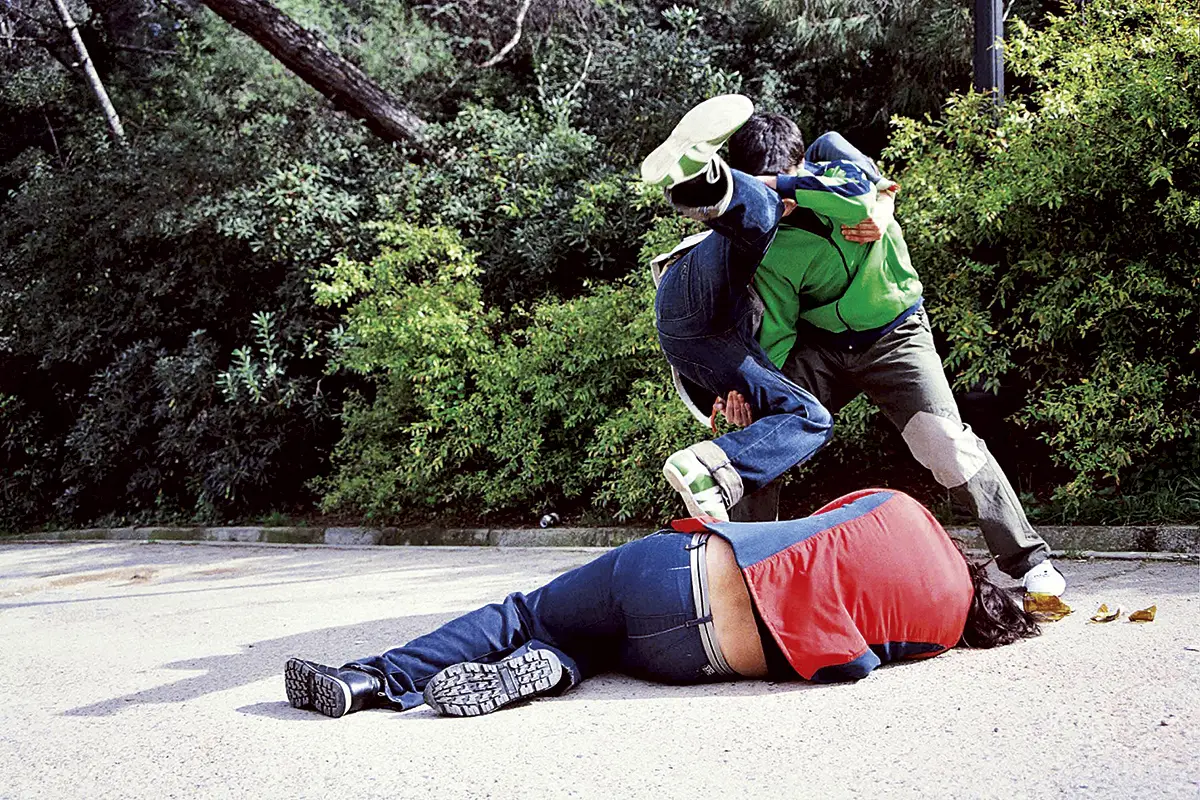
In the second photograph, two boys are tied up in a fight over another body, which lies on the ground alongside a shattered glass bottle. Again, there are no traces of blood, wounds, scratches, or any physical damage noticeable in the combatants. This leaves the viewer with feelings of ambiguity and a lack of empathy toward these adolescents, who, it is evident, are hurting each other. This piece, in a smaller format, is printed on photographic paper, framed, and covered with glass. It is as if Vidal shoots “clicks from a distance,” evidently distancing himself from the object of his study but with an almost morbid fixation that is captured in the frozen instant.
In Vidal’s video, two fighters engage in what seems like a dance, to the sounds of Gorecki’s Third Symphony. In slow motion, a martial arts instructor and another young boy follow a choreography without victory or defeat. Their interlocked bodies summarize Vidal’s idea of what a “culture of fear” has wrought in our society: the more fear the system instills in us, the lighter our values become. Hence Vidal presents a definition of contemporary human beings as violent, submerged in violence, in a violent world where the law must be broken in order to survive.
LUZ MARÍA SEPÚLVEDA