As we crossed the door into this exhibition, located on the second floor of what used to be the home of the Condes de Lombillo and today houses La Casona,1 it was impossible to suspect that the drawing of a heart on a wall, similar to the one executed by Antonio Eligio Fernández (Tonel) in 1980 to illustrate the 100th issue of Revolución y Cultura magazine, “weighed” on our heads.
In this way began Conversación con la primera carga, Tonel’s recent show in Havana, made of two installations. One that shared its title with the whole exhibition, and a second one titled Héroes de Baikonur.
The first installation brought together a large number of seemingly unconnected elements. The relationships between these elements were not explicit enough to facilitate our usual, comfortable exercise of interpretation.
Three large-format drawings executed directly onto walls, different kinds of reproductions (a commercial manual on electric fans, pages of scientific illustrations from Fernando Ortiz’s book Contrapunteo cubano del tabaco y del azúcar, one etching,) a video, and a flimsy construction placed in the center of the gallery, among other objects, were part of Conversación con la primera carga.2
The heart we mentioned before gave us our first clues. It could be that word from the realm of boleros, of seedy bars where people flock to dissolve their pain in alcohol, while others whisper their desire in each other's ears; a prelude to an intimate but furtive encounter in any shady corner or in the first halfway appropriately unlit spot they can find.
But his Tonel’s heart was more than that; it was, as the language of the street has it, “the pump.” A pump that not only takes on the job of distributing blood around the body or alludes to passion or to caring, but also refers to the little engine that steals water when the public system is weak and does not reach certain houses perhaps marginal and of course extremely peripheral. But above all, it is the expression used in danceable popular music when the singing voice calls on the keyboard, the piano, the base, and, in general, all the percussion instruments to provide a strong discharge, a good shake; the is the moment of greatest excitement among the dancers, the summit of what we call the recholata, and the language of the streets translates as despelote (a free for all.)
It was however the video placed atop a rough pedestal that held the keys to understanding the interplay of associations proposed by Tonel. The narration (according to the artist, a conversation), but especially a point-counterpoint exercise, was structured in small segments essentially filled with songs by Juan Formell and Los Van Van and José Luis Cortés and NG La Banda, two musical groups that are hugely popular inside and outside Cuba.
But, in essence, the most interesting visual dialog was the one established between the fragments of La primera carga al machete,3 supposedly an eyewitness account of the beginning of our wars of independence, and one or another scene from the film María Antonia,4 showing both conflicts and the visual characteristics of certain marginal areas in relation to the process of materialization and the actual functioning of an anthropologically oriented piece by Tonel titled Homenaje al agua con azúcar. This 2001 piece created a hybrid environment with some elements in a historical vein and also a window for the public to peek into the contemporary, featuring as a kind of joke the sweet mixture of water and sugar that has mitigated the nation’s hunger and its fatigue —this is to say, the Cuban people’s hunger and fatigue— from the earliest moments, and where past and present intertwine constantly in relation to the survival instinct.
Crucial moments of the film interacted in each fragment of the video; particularly, that of Manuel Octavio with the construction of the environment that finally was Homenaje al agua con azúcar. We could see the placement of each log in the process of construction of that atmosphere and each one of its detail, and also inserted in an organic way were other fragments of Tonel’s works such as that Cuba of País deseado or II Retrato como intelectual orgánico homenaje a Gramsci. These elements, filmed in color, contrasted with the silence of the strong (and violent) images in black and white of La primera carga.
The atmosphere recreated by Tonel was articulated around an aesthetic linked to those places where survival is precarious and from where the artist imbibes things related to the inventiveness and the improvised design of the humblest sectors of society, which always develop ingenious alternative solutions to their needs.
But Tonel is not telling us somebody else story. His work, his family, and himself are committed to it. Culture is the territory that makes possible the interconnection of the dissimilar and where history is dissected as a process seen not only in time but also in the exhibition of its promiscuous present. Things and situations coexist at the same time they juxtapose with one another.
It becomes evident that Tonel’s work possesses the richness of suggestion, at times even of the ellipsis, in connecting things that seem to have nothing to do with one another. Indeed, History was the central character in his exhibition. On the one hand, a history that is narrated on the basis of certain continuities, such as that which allows us to establish a relationship between those blacks who were granted freedom but whose true freedom could only be achieved with a machete. The descendants of those slaves who were the protagonists of the first machete charge are those who later cut sugar cane in the sugar plantation, who live in the solares, and who form baseball teams. They are the ones playing music and making the songs that create an environment, as the artist put it to me one July afternoon.
While in his first installation, Tonel engages in a close dialog with history, after transforming it into his main character, in Héroes de Baikonur he plays with history, positing a series of fictions, for certain issues that are localized in what we can conceivable call reality, particularly our reality.
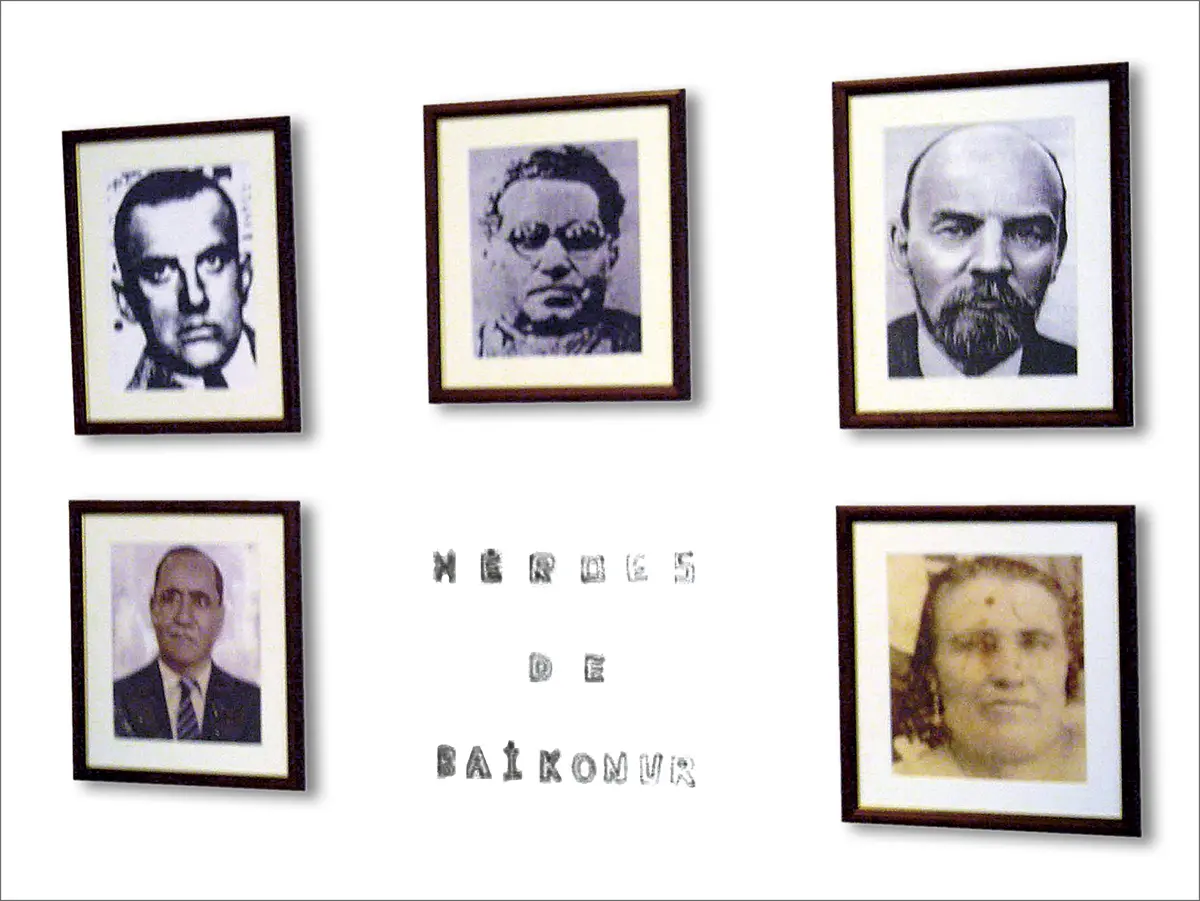
Tonel placed each one of the details of his installation as though it were a segment in a science museum. A picture of his grandfather Antonio leading an international group of space scientists (Cuban, German, Soviet, and American.) The picture was supposedly taken during the celebration of the successful launch of a rocket they had built, which took off from the Marianao neighborhood on September 24, 1976, and returned successfully to Baikonur in Kazakhstan, in the former Soviet Union.
These are some of the “facts” we glean from the narration accompanying the photograph, handwritten by the artist, where Tonel intermixed different degrees of fiction with elements that attested to the veracity of the game he had invented. It is highly suggestive that the so-called Héroes de Baikonur were Maiakovsky, Gramsci, y Lenin, alongside the artist’s paternal grandparents, Carolina and Antonio. The first three are public figures touched in various but decisive ways by Marxist philosophy and had a close relationship with the repercussions of the October Revolution; Tonel’s grandparents are private figures who were in some way touched by the same events. Around a figure resembling a space rocket (it is, it seems, the fuel tank for a Mick 21), that survives somewhere in our city, Tonel built the grid of a revealing tale about the impact of the USSR on Cuban culture and history. A school and an enormous park just outside the city are named after Lenin; we celebrated the Soviet leader’s birthday and his image was to be found not only in the offices of our high-ranking politicians but also in many worker’s homes.
We only need to remember these facts passingly to realize the imprint of Soviet culture on several generations of Cubans, from our grandparents to ourselves, a phenomenon nevertheless attenuated for those born during the last two decades.
Inside a display case, Tonel placed a series of family objects (from Radar-brand shirts to pins, some given to the artist during his student days) that insisted on situating the impact we have alluded to in a more private connection, relating to the artist’s family from a playful, unencumbered perspective. Towards this goal, he also used photographs that, contrary to our assumptions, questioned the alleged objectivity that is attributed to him as an expression of reality or truth.
It is true that Maiakovsky could very well have coincided on a city tram or on any street with the artist’s grandparents, perhaps also with mine; maybe their gazes crossed paths, maybe they ran into each other on a city corner.
Everything is possible in Tonel’s narratives. Perhaps it was Lenin who signed the Surrealist Manifesto, as he tried to prove with a page from a book where Lenin’s handwriting is compared to Tzara’s. Many threads connect these spaces, these men, these objects, and these places; perhaps they are as real as those ink drawings offered by Tonel, where many of the artifacts launched from Baikonur were almost alive.
NOTES
1. One of the galleries conforming Génesis Galerías de Arte.
2. The drawings mentioned, besides El Corazón, originated in previous ones, executed in ink and construction paper, and are: El bien dotado and ¡Al machete! both from 1991.
3. La primera carga al machete, fiction with documentary aspirations, by Manuel Octavio Gómez, 1969.
4. María Antonia, is a 1991 film by Sergio Giral.
CARIDAD BLANCO