
In celebration of master Carlos Cruz-Diez’s 80th birthday, homage is paid to his trajectory as a pioneer of graphic design in Venezuela. The exhibition brings together a selection of culture-themed posters from the collection of the Foundation of the Carlos Cruz-Diez Museum of Prints and Design.
The graphic space of the poster has captivated audiences for years, as it synthesizes communicative functionality and aesthetic criteria, being an expression of collective art in its delicious urban nature. Cruz-Diez, one of the precursors of the kinetic art movement in Venezuela, is a tireless researcher, never exhausted by the versatility of color, plane, space, and time in an ambivalent key that conjugates the materialization and de-materialization of these elements, turning them into an aesthetic event.
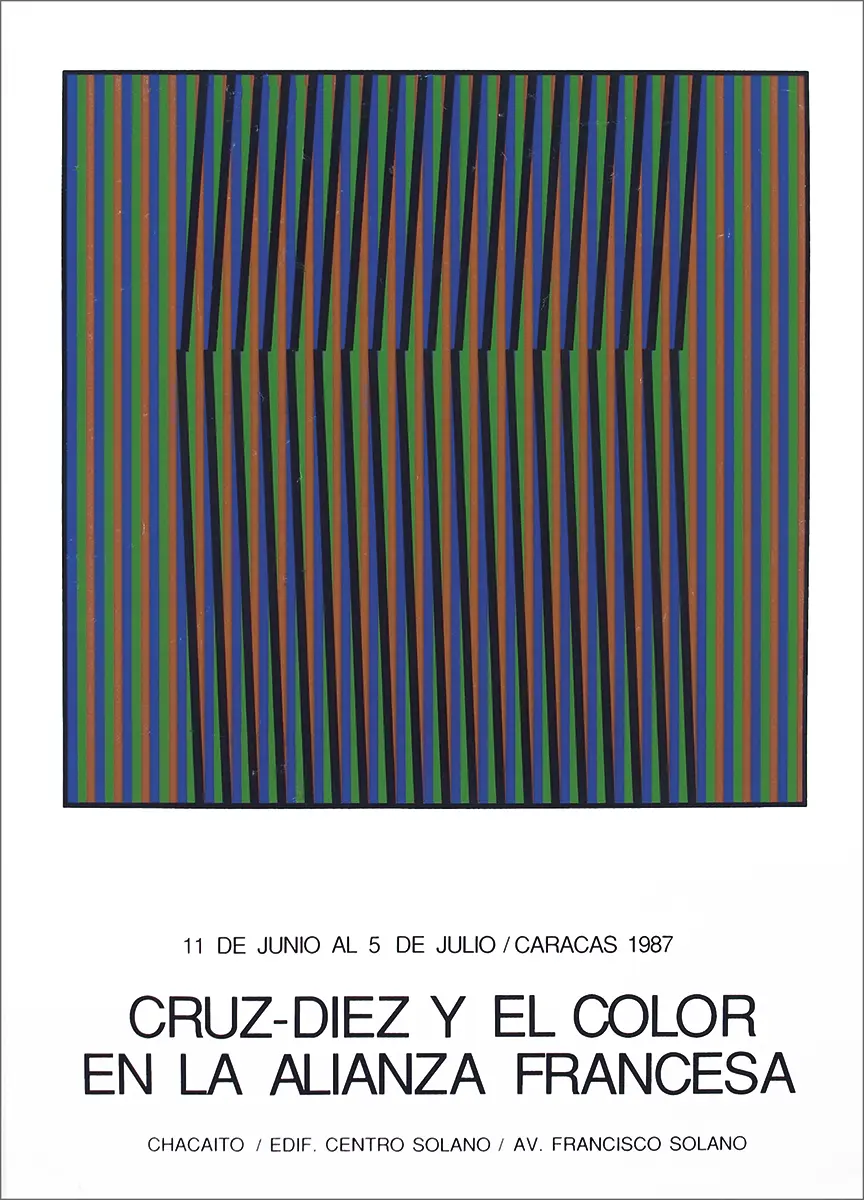
Unlike drawing, etching, and painting, which harmonize subject matter, aesthetics, and artistic components with ample freedom, posters must bring together all this aesthetic content and still serve a practical, utilitarian, and informative purpose. They must project symbols and motivations, as well as taste, with the idea that viewers will be pleased and identify themselves visually in decoding quick-read messages filled with iconographic richness, the precise economy of expression, eloquence, and sensorial attraction. In this show, we witness the challenges faced by Carlos Cruz-Diez in pleasing while informing, developing a synthetic language through a brilliant optimization of space and of chromatic effects always sensitive to movement.
Cruz-Diez began his career as a maker of cultural posters in Venezuela while studying at the Escuela de Artes Plásticas in Caracas, in the 1940s. During this period he developed his potential as an illustrator, publicist, and designer in important newspapers and magazines. From this moment he worked as director and founder of the Venezuelan subsidiary of the American advertising firm McCann Erickson, where he remained for six years, setting a precedent in the field of graphic design in the country. Cruz-Diez is a professor of typographic design at the Universidad Central de Venezuela’s Journalism School. There he has imprinted on generations of students the importance of design in visual education and its practical and synthetic usefulness for aesthetic enjoyment.
Under the influence of international trends such as the avant-garde and the inclusion in the design of photography, psychology, and advertising, several Venezuelan artists have worked in the field of visual communication. Besides Carlos Cruz-Diez, important figures during the twentieth century have been Leoncio Martínez, Alejandro Alfonso Larrain, Pedro Ángel González, Mateo Manaure, Jacobo Borges, Alirio Palacios, and Santiago Pol, among many others. The last two, Palacios and Pol, played an important role in Venezuelan poster art. This creative field evolved, developed, and was consolidated particularly in the 1960s. Cruz-Diez did not remain in the margins of this process; he created exceptional posters that display his talents as a graphic designer. His research on color, movement, and harmony, coherent with his kinetic inclinations, is immortalized in several serigraphic and lithographic posters filled with an eloquent synthetic and visual force. At the same time, we discover a born designer who is able to divest from his kinetic referents and adapted the issue he is to communicate following criteria that are pertinent to the cultural occasion being promoted: a communicator who solves the remittance of a message through resources taken from graphic design. Thus, Cruz-Diez alters formats (triangular posters) or uses diagonal typography to create innovative layouts that result in beautiful spatial propositions and distinguish him as his personal signature.
ELISA RODRÍGUEZ CAMPO