
San Juan’s Mehr Licht gallery, dedicated to presenting the work of foreign artists in Puerto Rico, offered a selection of canvases by the young painter Cecilia Lueza, a native of Misiones, Argentina who makes her home in Miami. The show, open from August 7 to August 28, 2003, highlighted the figure as the principal motif in every composition. Inspired by the art of Francis Bacon, Lueza emphasized in an interview her interest in creating a pictorial reality evocative of the immaterial, the ethereal, and the phantasmagoric. Yet, while Bacon does come to mind when studying Lueza’s canvases, her work differs from the Dublin artist’s in significant ways. Bacon’s oeuvre is characterized by a tormented, sometimes abject imaginary, as well as by the value he places on the relationship between space and the figure in his compositions. The sinister, the abject, or the disgusting, Bacon’s starting points in some of his compositions, are not explored in Lueza’s work. Lueza has insisted that she doesn’t want to recreate in painting a heartrending, sad, or morbid reality, but to suggest or evoke a world of the imagination.
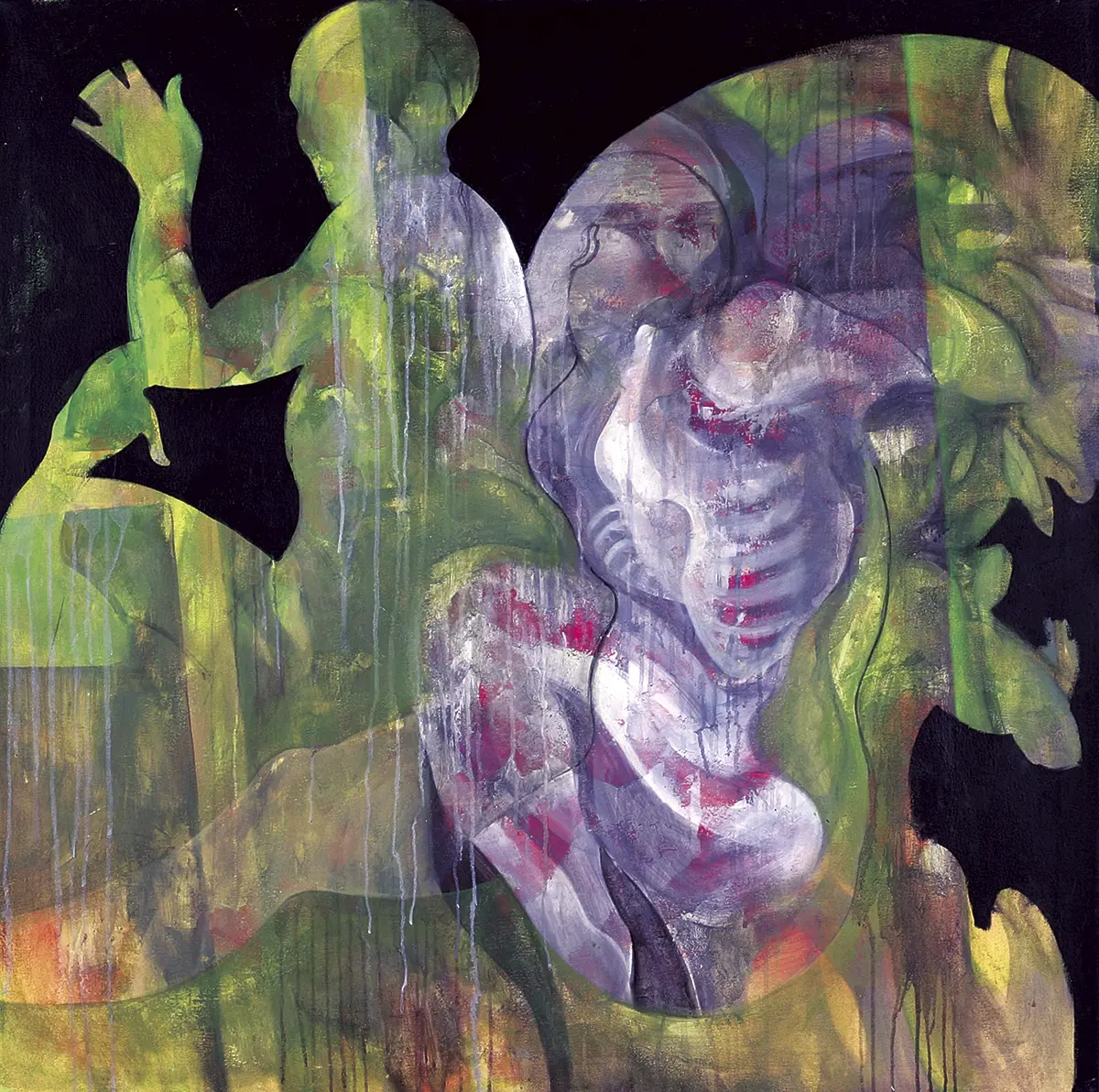
That being said, Lueza’s art shares with Bacon’s the presence of blurred, diffused figures, suggestive of a corporeity that is not flesh-and-bones. Interestingly, the body’s immaterial quality is achieved in some of her canvases through the use of a brush overloaded with pigment, while in others it is the product of transparent layers of color that, in turn, let us see the others underneath. Lueza seems to take from Bacon the use of white and gray to accentuate her figures’ transparency or immateriality.
One review in El Nuevo Día1 suggested that Lueza seeks to recreate in spatial terms a new and distinct reality. La dimensión inaudita, the show’s title, doesn’t seem to refer to the pictorial space or to the search for a space different from that of the Renaissance or of Cubism. The figures’ immaterial quality evokes a dimension that is not that of concrete reality. A dimension that is not suggested by the pictorial space, but by the figures themselves. Canvases such as Levedad and Hidden have abstract art as their spatial referent, fields sometimes divided by solid colors in contrast to the transparency that defines the figures. Indeed, in many of these canvases figures appear juxtaposed and parallel to the pictorial plane. In others, like Levedad, they appear oblique to the plane. Lueza’s art, an example of a Postmodern-era gaze, builds on formal and conceptual achievements of the past. La dimensión inaudita is a poetic vision, but not a new dimension in spatial terms. The inaudito, the unheard-of, seems to be conceived on the basis of the avant-garde tradition.
In her interview with us, Lueza commented that landscape is not important for her pictorial conception. Argentina, Florida, or the Caribbean are not referents associated with her work. On the contrary, Lueza is interested in an anonymous referent and in universal themes that both painting and literature have incorporated since antiquity. By disassociating itself from any specific place, La dimensión inaudita leaves behind history, geography, and identity. It assumes them from an artistic idea attuned to globalized propositions. No spaces or characters are represented, but a space and a collective. These undefined faces, those acephalous bodies, the imprecise gender, and the absence of personality among what is represented, are not characteristics of an art interested in exploring the psychology of what it portrays. La dimensión inaudita does not deal with an ethnic group, a segment of society, or a nationality, but with non-individual humanity outside time, a historical and relevant space for the world of feeling and imagination, a dimension we can move into in order to leave everyday reality.
La dimensión inaudita asserts the exploration of human impulses independently of religious, political, and artistic beliefs. This thematic content, added to a formal conception enriched by the interplay between monochromatic and contrasted ranges of color, between static figures and figures in movement, and between precise and evanescent contours, makes it possible to enjoy art without discomfort. Lueza’s art seeks to go after the harmonization of opposites, in that imaginary dimension where irony and human pathos have no place but nevertheless appeal to the individual and serve life.
NOTE
1. Venegas, Haydée. "Hacia otra dimensión, Lueza. Arte y Cultura." El Nuevo Día. August 15, 2003.
INGRID MARÍA JIMÉNEZ