
El jardín de Dafne, an individual exhibition of Cecilia Paredes’s work, surveys in large part the artist’s recent production: from the shawl woven with lucky bones (Recursos Humanos para la Obtención de lo Divino) to molds of torsos, hands, and feet, and photographs where the human body enacts the most diverse metamorphoses.
Perhaps the myth of Daphne was announced already in those images where the artist’s own body acted out a symbiotic relationship with vegetables or animals; perhaps it was suggested in the image of a woman tree; perhaps it was prefigured by the analogy between feet and roots, hands and branches. It is not fully unexpected for this review of Paredes’s trajectory to refer to the myth of the nymph who prays for a transformation as a defense against harassment by the god.
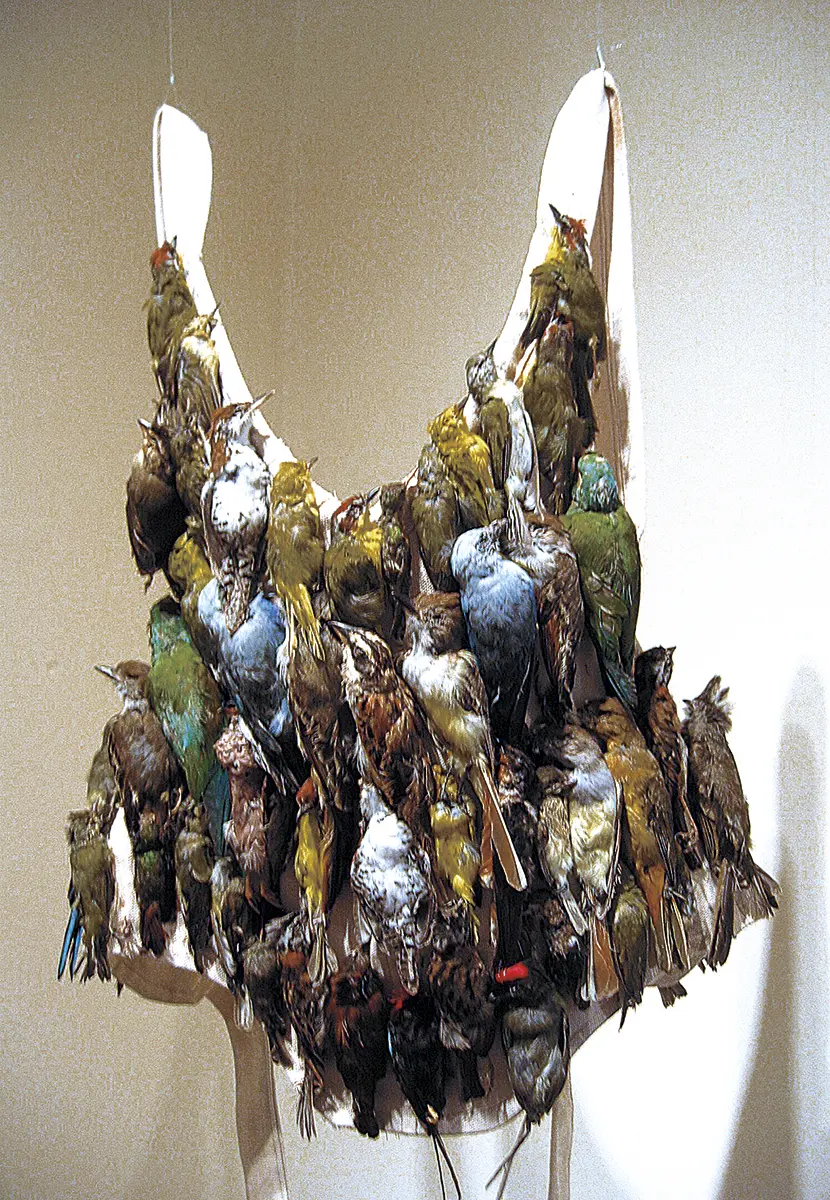
A certain desire for protection and defense traverses the work of this Costa Rican-based Peruvian artist, a desire frequently expressed by means of a scrupulous order and the will to collect and classify. As if needing to make possible a correspondence between things, Paredes arranges groups or series: of seeds, of bones, of embalmed birds, or of any other elements. Perhaps this obeys the promise or claim offered by the order itself. The practice of collecting attempts to construct an identity (even if it is a fictitious one).
But why this search for “relatedness”? In a recent text about the artist, Rachel Weiss has written that “To a degree, it is a matter of describing isolation, and in a sense, it is the kind of isolation that comes from exile. She finds herself inside a social body to which she can never fully belong. The hope for unity, expressed as a dynamic between human beings and nature, gradually becomes a diary log of the accumulated fact of the lack of unity."1
Seen from this perspective, Cecilia Paredes’s works appear as the statement of a utopia —the reconciliation of Man and Nature. The ideal dimension of such a relationship is eloquent enough in the titles of some of her pieces: El sueño, Chaleco de la suerte, and Blusa para el acto de volar, among others.
On the other hand, her desire for protection has also been expressed through garments, and coverings that give comfort. Sewn to thorns, chrysalis, firefly wings, embalmed fish or birds, a series of dresses, vests, and blouses they generate intense poetic spaces.
But a garment is, in the end, mutable. This is perhaps why the artist displaced that unstable border from the garment to the skin itself. In this way, the body becomes a point of attachment to nature, the site where metamorphoses occur: armadillo, serpent, skunk’ or deer, leaf, flower. From the dress to the skin, the artist offers now her own body as the battleground for the encounter of Man and Nature.
Thus, her photographs —close in their conception to those of Cuban artist Marta María Pérez Bravo— are executed as the mise-en-scene of a formal austerity, in a location devoid of spatio-temporal referents.
Finally, a group of pieces in El jardín de Dafne looks back to Paredes’s torsos, hands, and feet sculptures. But while in previous works, like the ones she presented in her show Rutas Alternas (MADC, 2000), Cecilia Paredes incorporated organic elements to resin molds of her hands and feet, so that branches, lichens, and roots substituted for bones, muscles, and nerves, she now seems to be exploding such affinities. In her recent works, roots exceed the body to embrace it.
Cecilia Paredes’s works are often characterized by their fragility, by the fine line between the durable and the perishable, where death itself seems always about to appear. With her recent bronze sculptures, however, that logic seems to have been reversed. Daphne’s metamorphosis is definitive, and laurel is the symbol of immortality; hence, perhaps, the use of bronze.
However, this material refers also to a sculptural tradition marked by its strong vocation for temporal transcendence. On the other hand, and before that durable character, what seems less pertinent is the excess of narrative in some of these works, less imbued with the visual and symbolic tension usual in Cecilia Paredes's work.
NOTE
1. Rachel Weiss, Lo diverso de lo ordinario, Cecilia Paredes, Centro de Fotografía Universidad de Salamanca, Spain, 2003, pp.25-26.
TAMARA DÍAZ BRINGAS