
Daniel Bottero. Recent Works was the last individual show presented by Elite Fine Arts before it closed its doors for good this past September. Argentinean artist Daniel Bottero continues his series on cities, a subject he has been exploring for some time, through which he attempts to visualize the relationships and events human beings create with each other and with the urban spaces they inhabit.
His previous series, Red Tears, which was created as a memorial for the events of September 11, 2001, in New York, made clear Bottero’s interest in both highlighting aspects of the city that its own inhabitants tend to overlook in their constant movement and presenting city dwellers with a new awareness of their environment.
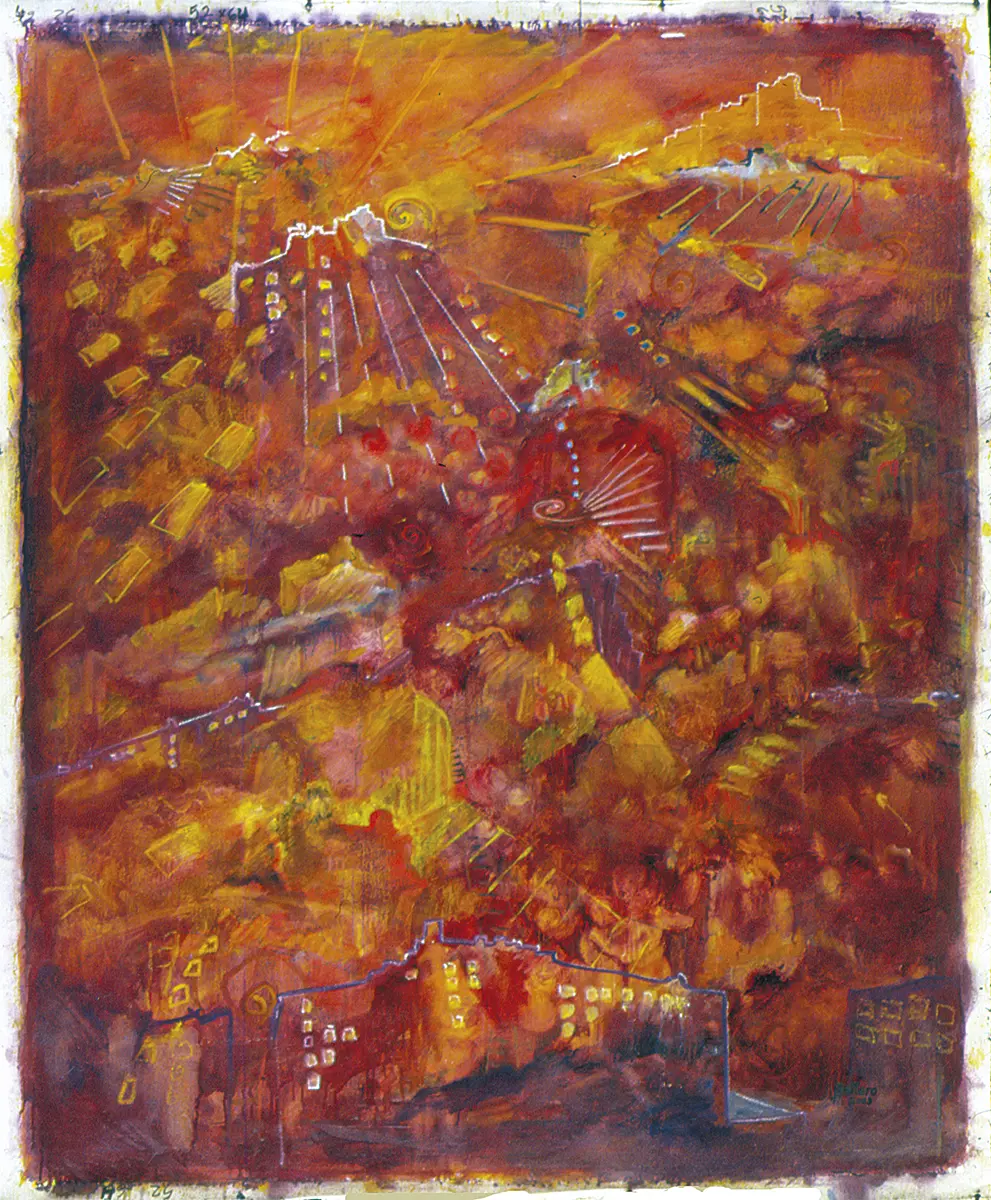
In his recent works, Bottero once again engages cities as a subject, drawing them as places of light where human beings can find many answers, and even as inner spaces of mysticism and energy. Although Bottero’s painting moves back and forth between figuration and abstraction —with a stronger tendency towards the latter— elements like color reinforce the concept of ambiance. The prominence of color in this artist’s work needs to be emphasized here: his use of color points to the different states of the human spirit and the different concepts he is trying to express; in some cases, color even becomes the protagonist in an individual piece or an entire series.
To his use of color, Bottero adds design elements that work symbolically, such as the spiral that represents either creation or a sense of ending, depending upon how it is positioned. Structurally, Bottero’s work is organized in ascending order; all the elements are positioned so that the viewer must direct his or her gaze to the painting’s upper portion. The artist wants us to look up, metaphorically in the direction of God. This creates a juxtaposition of the earthly and the spiritual realms and gives his work a religious connotation. In this vein, the constant presence of stairs and stairways obeys and responds to the idea of ascent. The presence of the sun in many of his works is sketched by simple lines symbolizing its rays and appears as a summit in imitation of popular religious images.
After Red Tears Bottero’s work reflects a new conscience and new themes of a better world and a new reality, and leaves the viewer with an optimistic message. The artist interprets an alternative city, granting it the possibility of becoming a space or a pathway toward a different world.
MARISOL MARTELL