When considering the visually congested world in which we live, sympathetic amnesia seems not only an immediate symptom but also a subconscious survival mechanism. On the other hand, “habit is a great deadener,” as Samuel Beckett’s Vladimir comments in Waiting for Godot. How do we protect ourselves from the excesses of our intricate material reality and at the same time remain consciously un-numbed by it? Scrutiny, selection, and creative re-contextualization are perhaps the best way to deal with both tendencies at once. By choosing a soon-to-be-forgotten news item, the artist Jorge Macchi (Buenos Aires, 1963) extends the memory of the given event, but, by reconfiguring the informative logic and actual existence of his chosen material, he offers the viewer an alternative way of perceiving daily reality —one which, ironically, triggers greater interest in the original issue.
In this exhibition, Macchi revealed the extent to which he was prepared to rescue transient memories —that is, those unforgotten by all but those directly involved in the event. The meticulous craftsmanship immediately perceived in his work is itself an act of resistance against both the immediacy and the abruptness of contemporary visual information and urban life in general. It is a lesson in quiet contemplation for all of us who are inextricably caught in its whirlwind.
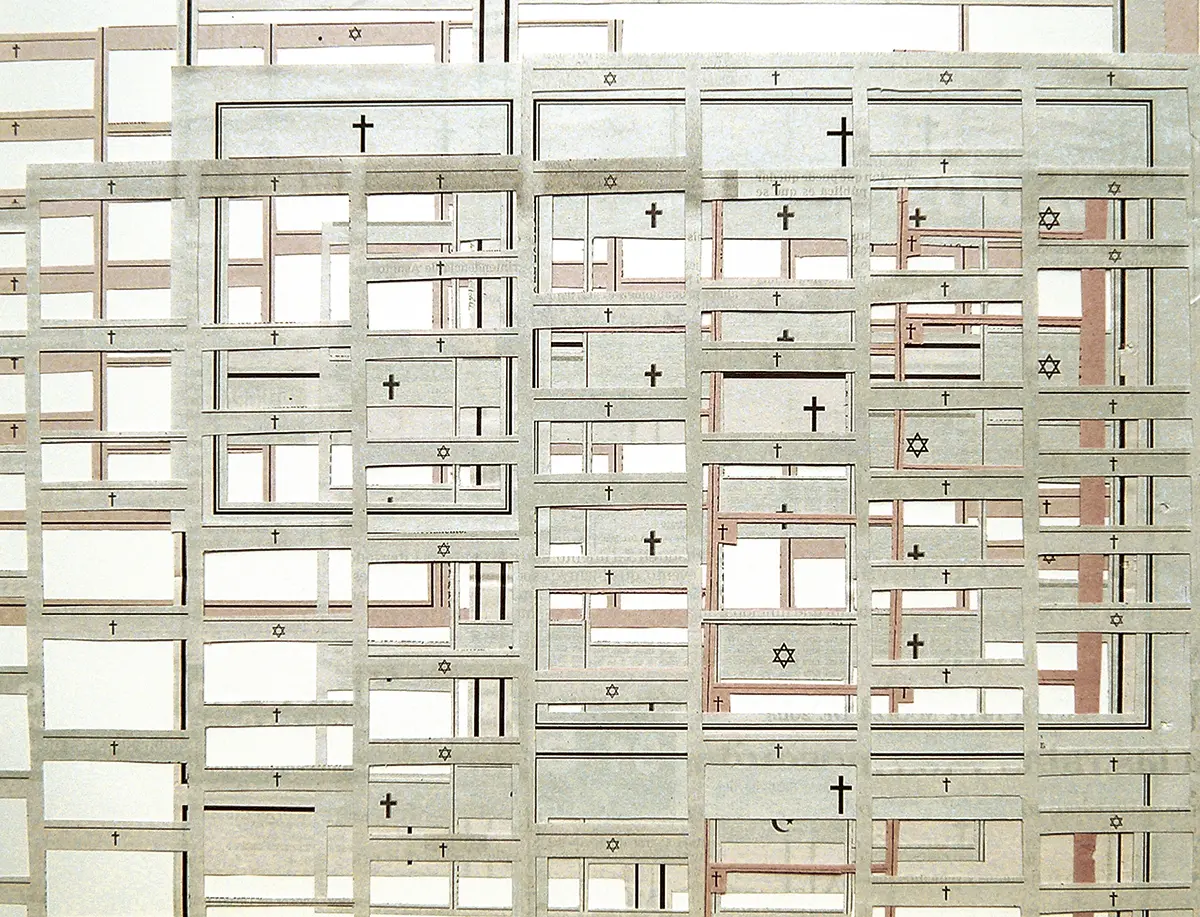
Monoblock, 2003 is a clear example: cut-out, strips of pages of newspaper obituary notices were superimposed to reveal, through the rectangular incisions made by the artist, a funerary pattern composed of religious symbols (crosses, the star of David), and a formal structure that echoes graveyards and individual tombs. Measuring 93 x 73 cm, the entire composition resembles a block-like building whose windows provide unequivocal visibility to death. The work has a unique aesthetic appeal, which does not fail to draw attention to its origin: reported deaths, sad or impersonal obituaries, and the personal content revealed in public spaces or inhabited structures.
Libro de Citas (Book of Quotations), 2003 is another beautifully poetic work composed of newspaper material: two white pages joined by the image of opening and closing quotation marks cut out from the newspaper. I instantly read the work as an illusion to the reported news —so much to say and so little to apprehend— or to the everlasting paradox of meaning: there is so much and so little to be said. The words between the quotation marks have been cut out and an empty rectangle remains.
Macchi’s work is not only poetic, but it also springs from a metaphysical tendency related to Jorge Luis Borges’s fiction and the Calvinesque fable. The construction of Guía de la Inmovilidad (Immobility Guide), 2003 is formally similar to that of Monoblock —layers of cut-out pages are superimposed to create new configurations. In these works the pages were taken from street maps. Every city block between intersecting streets has been cut out to create a complex web whose density is produced by the layering of several pages. Macchi’s map finally achieves three-dimensionality, but it is very different from that of an architectural model. Rather, it is an insubstantial, or “empty” volume reminiscent of Borges’s labyrinths, Italo Calvino’s invisible cities, and the superstring structures of theoretical physics. It is a mesh of directions, also akin to the impenetrable branching of a tree —endless possibilities, or chance encounters?
In Intimidad (Intimacy), 2002 eight identical white balconies were attached to the gallery wall vertically and at regular intervals from each other. This sculptural installation with a minimalist, Donald Judd-like aesthetic (albeit delicate and light), rose to the height of an average person (overall, 175 x 30 x 8 cm). On the ground floor of the gallery, it stood almost directly opposite a gigantic shoeprint pasted onto the wall. While the balconies form a precise geometric model, the individual markings of the shoeprint sprawl outwards. What is the relationship between the architectural contrivance and the ephemeral traces we leave in passing? In Intimidad the aluminum and wood structures that supposedly provide a breath of fresh air for apartment residents while paradoxically emphasizing their lack of space, are fixed human supports several meters above ground level. The shoeprint marks of earth and glue drawn on the wall evoke the transitory side of life, precisely that which does not remain behind and cannot be supported —thus the title of the work, Fuegos de Artificio (Fireworks), 2002–2003.
A car accident viewed from six different overhead angles will be interpreted disparately depending upon who saw what from where. In Accidente en Rotterdam (Car Accident in Rotterdam), 1998 (six photographs, each 56 cm square), a black car and a white car collide forming a right angle. Macchi, who works with video and photography as well as sculpture, drawing, painting, and installation, clearly understands the ambiguous quality of the lens. A well-defined shadow in the shape of a cross emphasizes the geometric configuration of the cars, but their physical relationship may also be a platform for further symbolic readings, where opposition (black and white colors, intercrossing angles) and inevitability are in question, as are the curious dimensions of the surrounding area in relation to the toy-like cars.
Macchi’s works pose several questions, but the answers will not be found in a single answer. The answers are not conclusions or solutions, but reflections, possibilities, and triggers of the imagination where reality and fantasy are in constant contact.
VERÓNICA CORDEIRO