
Havana-based Cuban artist Alexis Leyva Machado, better known throughout the world as Kcho, has his sensitive relics: the favelas, ranchos, or shanties that characterize Latin American cultural society. He showed them for the first time 15 years ago without much in the way of plastic elaboration but as a result of the process of appropriating a reality paraphrased onto the level of the artistic. This facet is known. Paraphrasing as a thematic and plastic resource progressed and went through a number of stages, to become a few years ago a complex conflict-resolution mechanism, to resolve on the basis of “…a universe filled with small islands that are ideas,” in his own words.
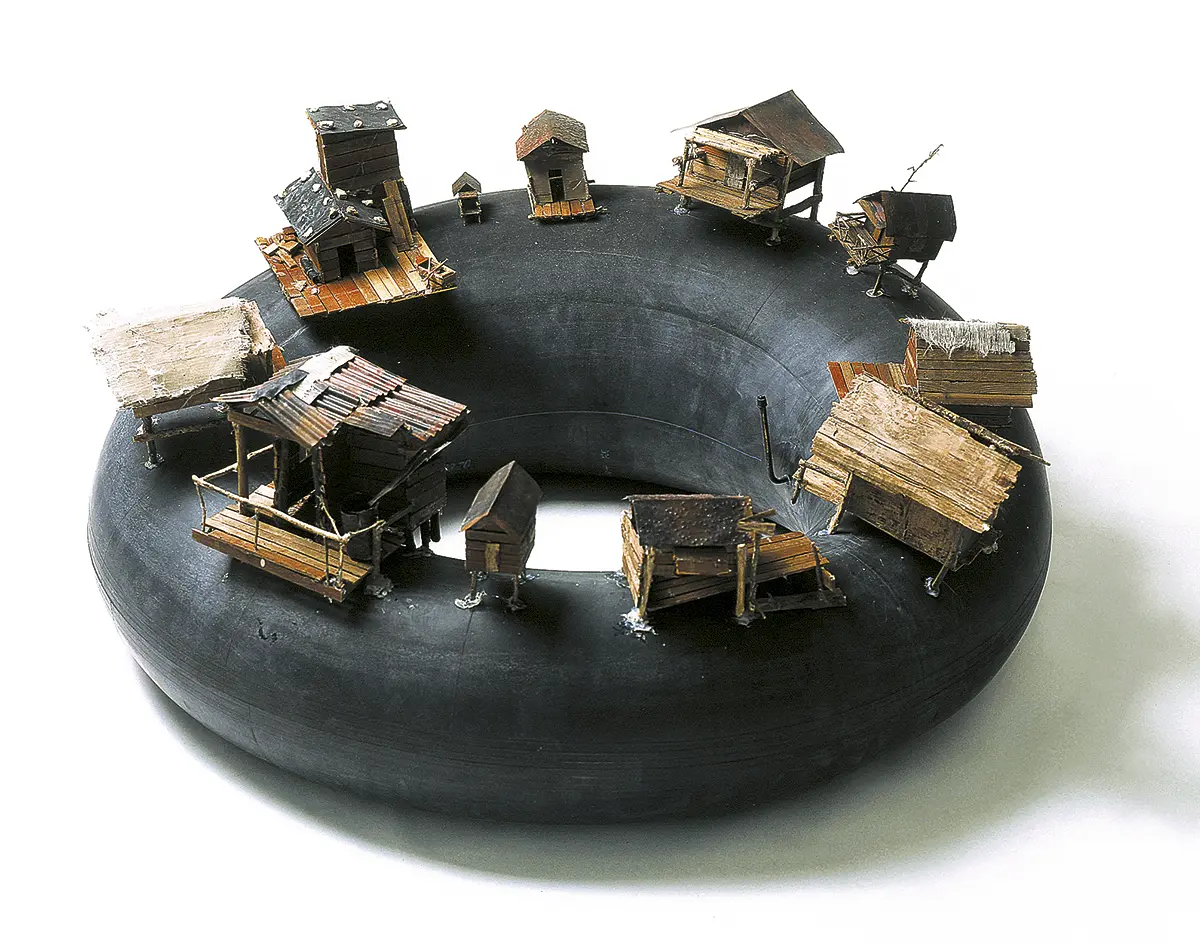
Archipiélago, a show that implies the idea contained in the works seen at Maracaibo’s Galería Ruiz, could be considered a synoptic tour of what has happened in his work since the earliest beginnings. We find the favelas, the oars, Lam’s jungle, and Tatlin’s tower, now conjugated into a plastic language of sepias, dirty whites, and stained blacks, a range of colors that is as limited as it is effective in its isomorphic action with the subject. A solitary universe developed by the artist from a tribal, gregarious way of life (Kcho is extremely generous, his friends say). To investigate the surroundings, interior and exterior to himself, is creative action based on the rescuing of memory through the exploration of the object with ontological arguments. The first idea is to reconstitute those who populate that reality he is interested in, in order to elevate them to a different context. Metamorphosis, paradoxically, generates a reduction of its social fracture as a protagonist element. Objects that characterize a sector of society’s everyday life —favelas, boats, oars— behave as characters in migrations and archipelagos, part of a society that makes them homogeneous within its real reality. Kcho creates a discourse, useless in appearance, about art, which, however, inscribes itself as a protagonist in a universal history.
An excellent draftsman, the artist behaves as the sculptor who handles plane and three-dimensional resources with utter precision. In the new work he is beginning to show, the space of drawing becomes sculptural space, and vice versa. The principle is simple. The counterpoint process modifies the appearance of the represented object in the case of a canvas and of the real object represented in the case of a sculpture. Thus, the miniature favelas supported by a true tire, thanks to the artistic creative act, are transformed into an imaginative event in order to transform reality into appearance. The initial signification is neutralized by bluntly showing its signified’s humility. Kcho presents reality as a dream that in a process of rectification turns it into unreality, the simple decision of substituting one reality for another process where the importance of his propositions resides. Without eliminating or substituting the object’s physical qualities, the same operations that occur in the decision to use a “found object” is able to replace its context and relieve its meaning. The same occurs with the switch of one material for another; for instance, the small house copy in cardboard, wood chips, and tin fragments, mounted on an inner tube that is lopsidedly overinflated. Generates another image, now in bronze.
As a thematic and plastic proposition, Las Migraciones made way for Archipiélagos, a philosophy of the obvious. The artist becomes, in both cases, a communicator, objects become characters who facilitate communication with the viewer. In an exchange of meanings expressed by their own interlocutors, the influx of a current sensitive to the subject becomes visible in a perceptible atmosphere only on the basis of the information obtained from real objects and their content. In this way, Kcho presents a visual proposition that contains multiple meanings.
BÉLGICA RODRÍGUEZ