
The state of Zulia is an engine of social and cultural development in eastern Venezuela. Maracaibo, its capital, is in turn an open, modern, and vital city where the art market thrives through the significant cultural activity of its museums, art institutions, and galleries. Galería Moro is a prominent focal point in this lively circuit. It recently celebrated its ninth year of uninterrupted effort in the promotion of contemporary Venezuelan artists with the first Maracaibo exhibition of works by Luis Lizardo. The show brought together a selection of photographic miniatures— the recent foray of an artist widely known as a painter —and a group of lyrical paintings that reflect his usual abstract style.
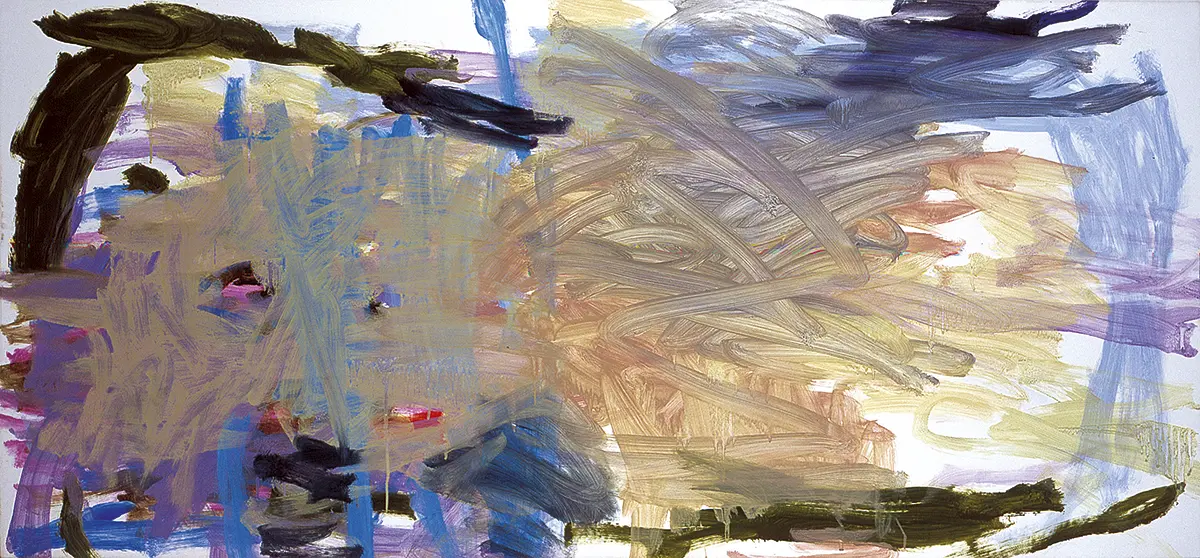
Luis Lizardo (Caracas, 1956) belongs to a generation of artists who remained committed to painting at a time when the general trend in the arts was to move away from traditional genres. Working against the grain of supposed exhaustion of expressive and discursive potential in the arts that was summarized by the idea of “the death of painting,” since the 1980s Lizardo has devoted himself to building a pictorial universe that is both close to abstraction and related to a contemplation of the natural world —a universe where the subtle colors of the earth and its vegetation are veiled forests that are open to multiple readings. Lizardo’s works allow for an infinite number of interpretations: as inner landscapes, introspective journeys, fields of peace and isolation, representations of tropical foliage and reflecting pools, or simply, the experience of the tangible pleasure of color. They are open spaces in which the viewer’s participation is sensorial and emotional. Lizardo is our guide on a fantastic expedition and offers his large canvases to us as tours of a subtle, intimate region that invites contemplation.
The pieces presented at Galería Moro are selections from Lizardo’s most recent work. Large paintings with a pale background to which the artist has applied deep layers of green and ochre tones produce the effect of translucency and the illusion of depth simultaneously. These works are dominated by soft chromatic gestures and blotches, an alternation of light and shadow that generates the sensation of levity and evokes a natural presence that we are unable to recognize clearly, even as it envelops us.
Lizardo’s photography is exhibited in the gallery’s last and most intimate room, parallel to the large-format works. It is an experimental body of work from his 2002 series Miradas de bolsillo and comprises small, miniature-like images made with a Polaroid. In these pieces, the painter acts as a photographer and attempts to move away from mere genre labels. Choosing to portray everyday objects, landscapes, and faces, Lizardo drives photography away from its condition of objectivity and brings it closer to abstraction. The spontaneity and out-of-focus quality of the shots favor the interplay of dissolution and levity, as does the scale of their format, which makes it difficult to identify the image and its referent in the real world, and instead imbues it with subtle attributes. In this way, the two axes of the works on exhibit are fully apparent: these paintings and photographs are the work of a single artist and belong together in a world where chance and order intersect is the source of that pulsing, magical murmur we call art.
SUSANA QUINTERO