
Transistoria, a transition through History in 5 installations, is among the important events in 2003 in Caracas. It is a complex work, a symbiosis of visual arts and painting resolved in five spaces, where, as art critic Víctor Guédez explains, “…the encounter of the transitory and the retro-progression of art becomes the conceptual crux on which Margot Römer’s strong temperament and Josefina Benedetti’s iridescent sensibility are affirmed.” Visual artist Römer was in charge of the piece’s visual conceptualization, structure, and inter-media resolutions, while Josefina Benedetti took on conceptualizing its electro-acoustic spatial lamentation. Perfectly integrating sense and sentiment, music and visual elements offer a complex and complete act of creative understanding, one in which the past becomes contemporary. The artists undertake a journey through the history of art in the figurative sense, with a “Male-Female Being” as its protagonist symbolically summarized in Nietzsche’s dictum: “I am every man in History,” which appears in seven languages in space number five: Greek, Italian, Latin, French, Russian, Spanish and English. The sentence, as a visual chorus, appears to repeat itself ad infinitum through the red, sensual lips of a mouth resolved in soft sculpture and posed on the floor. An unending litany.
Interrogations and answers regulate the five-space sequence. A past history taken to another one, in the midst of development, poses the issue of a plastic and semiotic relationship between emblematic symbols of Western culture, ripped apart in its plenitude by the cruel and overwhelming reality of today’s everyday man. Such theme is present through the organization of tensions between the object of contemplation (caryatids, an assassinated Marat) and the unlimited cultural space into which the viewer is invited: the space that belongs to the viewer; the space that is, itself, the viewer.
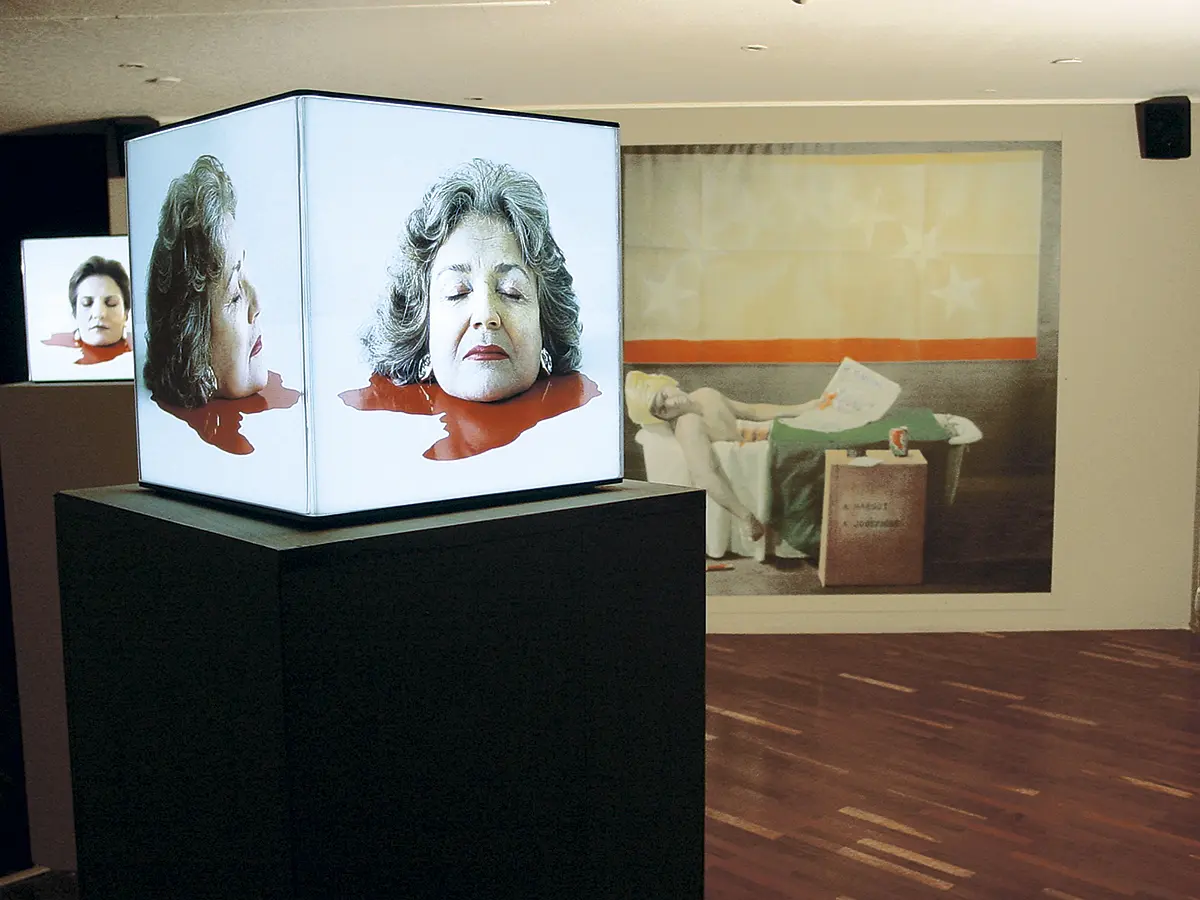
Two characters move around the interrogation of a nonexistent body, columns supporting the head on each of their pools of blood and it only appears in the tenderness of Römer and Benedetti’s first communion pictures, taken by surprise by a long serpent that wraps itself around a church bench (did the little girls kneel on it to receive God?), and in the nakedness of a Marat who, while resting (?) covered in blood and reading El Nacional, has as witnesses of his startled absence a table on which a cell phone lays and a Coca-Cola can; a curtain with the seven stars of the Venezuelan flag hangs on the wall. In the first one, the noise produced by a motorcycle interrupts at times the beauty of the Hellenistic Greek music that lulls the caryatid-pennons and the three-dimensional reproductions with monitors for heads that show them as sopranos.
A contradictory aesthetics oscillating between the old and the new, the old brought into the new, and vice versa reveals some subtle imprints of modern Man’s life. Traces of a life hindered by the introduction of elements that are not recognized as aggressive, even though they are: the roar of that motorcycle, the TV set, the serpent, and Marat, among generalizing “symbols” of contemporary life, piles of bricks contained by a yellow ribbon: danger, do not cross, the mouth red and soft. The duality of meaning, Man’s contradiction before the history of art, and the other one, the one that is properly his. Similarities and analogies in the rigorous rationalization of a socio-cultural concept that dominates the immensity of Man’s ontological and phenomenological territory.
First Hagamos acto de ausencia, the paradox of a classical presence with the caryatid-video; second Mateo 16,18, the Renaissance in giant photographs of the dome of Saint Peter and the two artists in communion, the serpent several meters long (what to do about Christianity?); third ¡Oh Terror!, a Republican Neoclassicism (today’s Venezuela?); fourth Suprimetismo, Suprematism and Malevitch, photographs of both artists one white on black, gagged, and the other black on white, blindfolded, flanking the square with pieces of brick and the yellow ribbon (violence?); and fifth Yo soy todos los hombres de la historia (the supreme I). The group of five installations, which constitute a single piece, analyzes and interrogates History as a matter of circulating currents with Man as its protagonist. It does so on the basis of physical, psychological, and perceptual observations, simultaneously related to its exterior and interior space. History is always the same in its “immortality.” But it changes as it moves through time, Römer and Benedetti say that with these five “immortal” moments they create a document in contemporary dynamism, a “manifesto” of active resistance. The evident associations with current events underlie the piece as sensible signals that reach the imaginary of those who see and hear the electro-acoustic sounds designed for each space, from Hellenistic music, Bach’s Passion according to St. Matthew, all the way to the Beatles, Daniel Santos, Faure, Elton John and the Venezuelan guarachero Billo Frómeta, among others. Integration in a real sense of music, architecture, and visual arts, beginning with the proposed concept. Emblematic and symbolic integration in the sense of the figured themes. Transistoriedad does not modify History, in this case, it turns History into what it is, a document of its time.
BÉLGICA RODRÍGUEZ