
The exhibition is titled The dark skin of Light. The photographic work of Mario Cravo Neto brings together 24 silver gelatin photographs, in large and medium formats, thematically inscribed within Latin America’s Modernist school. The work of this Brazilian artist is not a register of exterior spaces as the stage of composition; it emerges instead from an inner search that reflects the artist’s interests and personal beliefs. Cravo Neto executes his works in the intimacy of his studio, creating compositions that are based on the heterogeneity of features that is characteristic of Latin America.
In a shadowy environment, the artist details hair, textures, feather arrangements, and pores, elements of a language filled with visual differences, similar to the syncretic and variegated atmosphere of his native São Salvador da Bahía de Todos os Santos, in Brazil. His skillful manipulation of lights and shadows provides a range of tonalities, gradations, and polarities that capture and seduce the viewer’s attention. The extreme contrast between shades becomes radical and determinant. However, an invisible filter seems to balance the frontal clash of opposites, integrating each blotch, each detail, and each segment into the format, unifying the compositional whole.
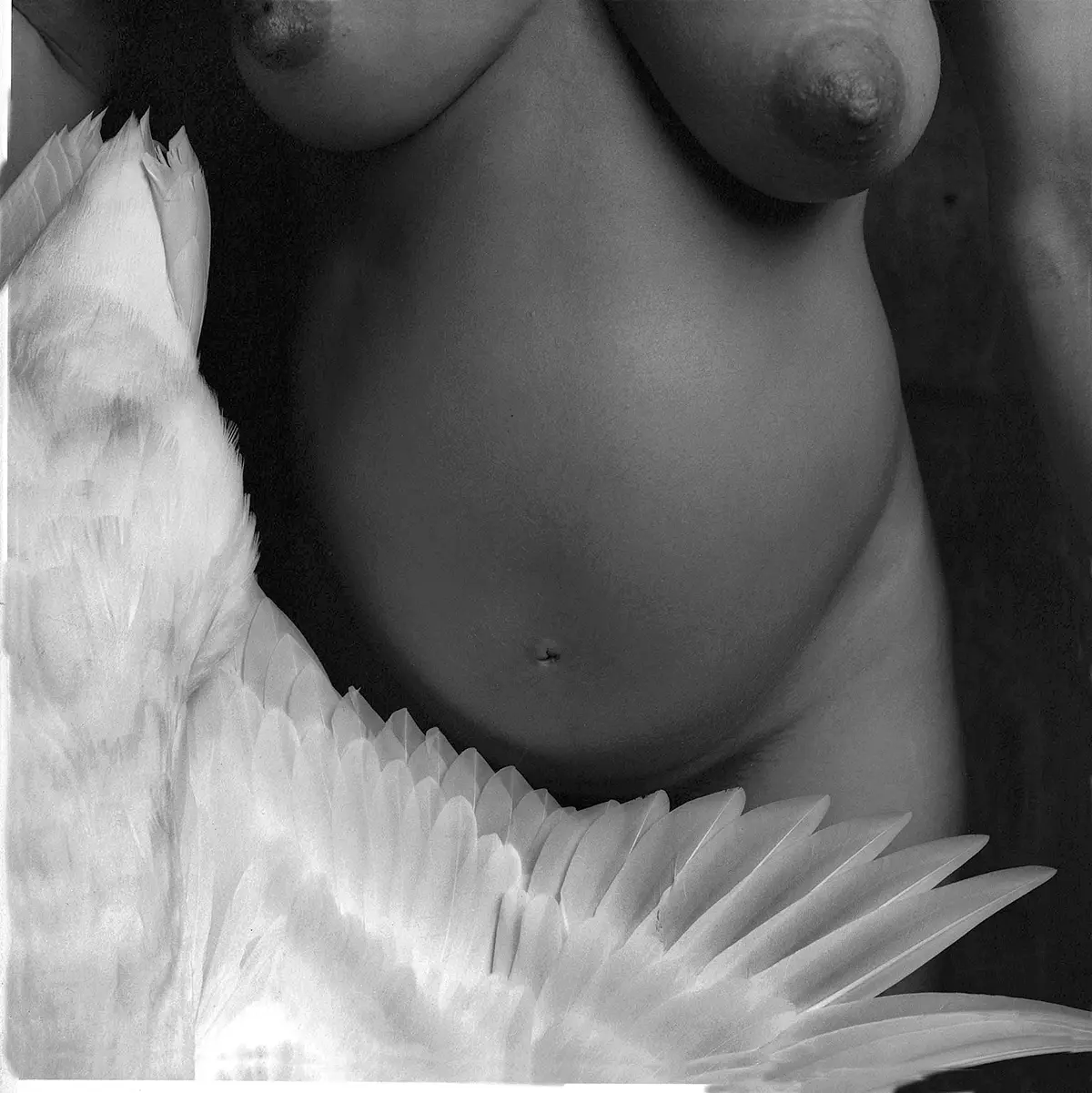
Fernando Castro, the exhibition’s curator, puts it this way: "His mastery of photographic lighting similar to that of a cloister, often brings forth the sculptural qualities of his thematic elements, while his use of photographic techniques such as depth of field turns the print’s flat surface into something dreamlike and tactile. Through the precise conjunction of skills both technical and formal, Cravo Neto gives his images of animals, ritual objects, and human bodies an aura of mystery" (Fernando Castro: “La oscura piel de la luz," in Primer mes de la fotografía. French Embassy to Venezuela. Caracas, 2003. p.13.) His photographs Sacrifice V, Ángela e Lukas, and Torso Com Penas Brancas, both from 1989 (50.3 x 61 cm,) are a veritable display of the skills Cravo Neto has perfected over the years. The same skin that has been the object of prejudices, discrimination, praises, or disparagements, becomes eloquent in describing scenes inspired by Yoruba myths, and shamanic rituals, in macumba and candomblé. Cravo Neto has been able to masterfully and with utter subtlety thread together the photographic technique of black and white with his chosen subject: the mestizo legacy and the defense of tradition. Torso Negro Com Cal, 1988, (97.5 x 97.5 cm), and Tinho, 1990, (50.3 x 61 cm,) are examples of the ethnic inscription the artists make insistent reference to. His close-up framings constitute another recurring resource used by Cravo Neto to explore, distill, and monumentalize his figures. In recording bodies, objects, and often incomplete scenes, the photographer guides viewers in a reading that involves them emotionally and intellectually, making them participants in his discourse and inviting them to complete with their imagination and to recreate, their memory and their knowledge of what has been announced in the photographic plane. These creations, rich in images and in optical subtleties, remit us to the confluence of races brought about by the conquest of the Americas and to mestizaje as the consequence of the encounter of three cultures: European, African, and Amazonian. Through his camera’s viewfinder, Cravo Neto brings us closer to that magical, mysterious, poetic world of the bahiano feeling and the Brazilian soul, an amalgam of mixtures and lived ancestral traditions. With the exhibition The dark skin of Light. The photographic work of Mario Cravo Neto at the Museo de Bellas Artes de Caracas is part of the First Photography Month, Caracas 2003, an event held between September 25 and October 25 thanks to the support of businesses and public and private institutions, coordinated by the French Embassy in Venezuela.
GLADYS YUNES