Miguel Florido’s is a meditative opus: canvases that according to the artist emanate from observation and introspection, from a vision of the object as an extension of the creator himself. The young Cuban artist arrives in South Florida after achieving success with important North American collectors at Art Chicago. Entirely self-taught, Florido has already had monographic exhibitions in Texas, Panama, and in Havana’s Galería La Acacia. His work has been featured in ARCO and ArteBA, and it has been seen in San Juan, Barcelona, Paris, and Amsterdam.
The three series comprising Sueños y esperanzas at Cernuda arte (Cuerpos sin vida, Puerta azul y Papeles) let us discover a quiet world where the genre of the still life is not used as a boastful display of technical virtuosity. Here, it is a link to nostalgia and to metaphysical explorations of presence. His last series, Papeles, with references to Claudio Bravo’s Paquetes and, above all, to the work of Dutch artist Cornelius Norbert Gisjbrechts, maintains Florido’s characteristic paucity. His silence is not only the product of a grammatical discipline but also of the austerity of his vocabulary and the transparency of his approach, which is becoming ever more clear.
Florido’s desire for transcendent presence and meaning is made manifest in the orchid of Sólo Tú (2003), in the banana leaf of Aún aguardo tu presencia (2002), and in the portrait of Yo siempre enamorado de ti (2002). On first reading, that presence suspended in Florido’s atemporality serves as a metaphor for the love that marked so profoundly the life of the young artist. Cohering with the idea of “vanitas” explored in his work, Florido puts us in contact with the idea that the physical companionship and the union that comes as consequences of love are ephemeral and fleeting. This is the creator of graphos to bridge distances, dissipate separation and absence, and reflect on the brevity of convergence.
On a second reading, the work of Miguel Florido can be seen as a very revealing case in the study of Cuban visual culture. Geographically and physically isolated from official centers of instruction such as ENA, ISA, and San Alejandro, as well as from the capital city’s official artistic life, Florido has looked into the overlooked Spanish roots of Cuban-ness, appropriating in a very personal way the language of Zurbarán and Sánchez Cotán. A trip to Madrid allowed him to deepen his raid into the Baroque.
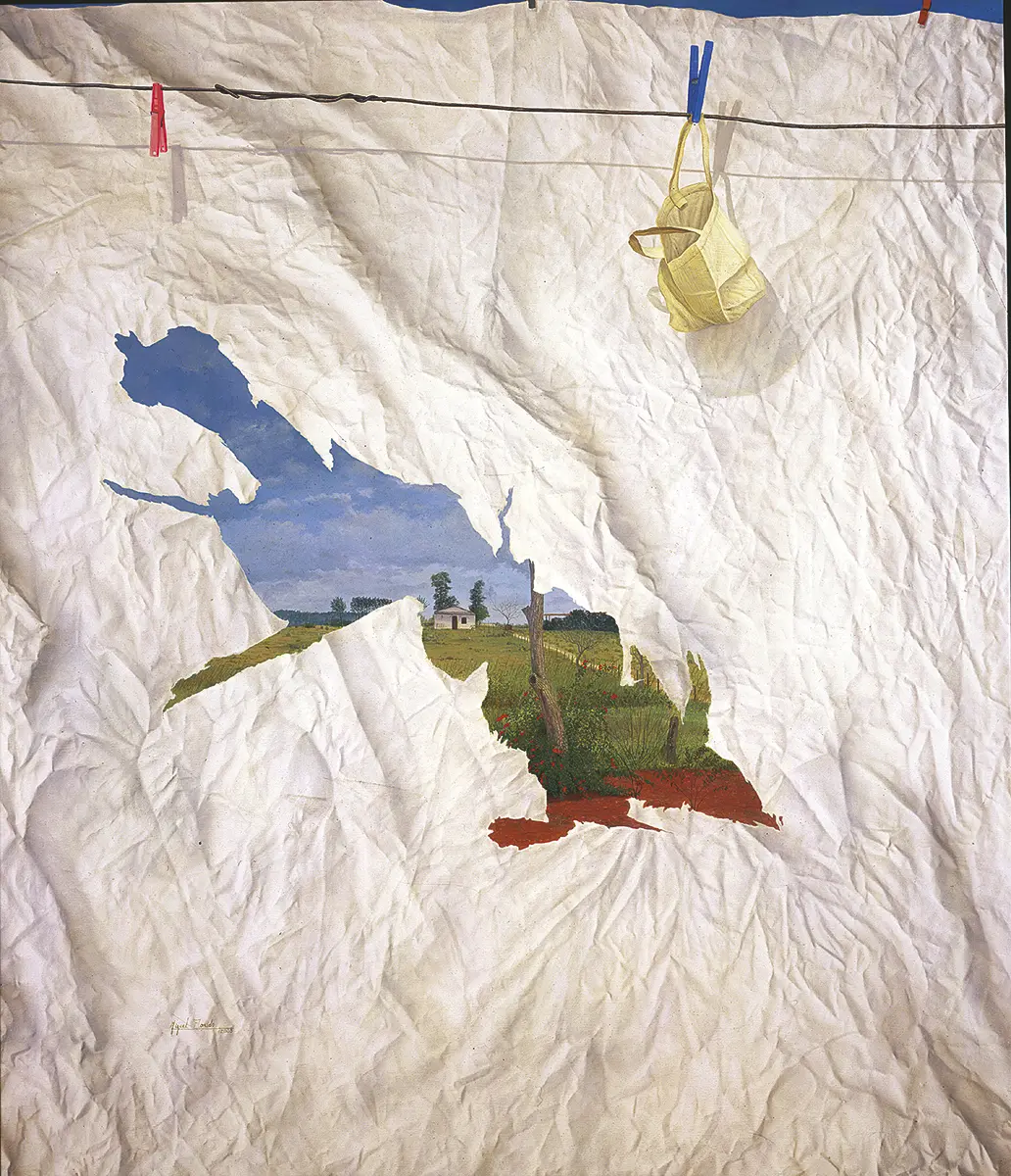
A third approach reveals the nationalist aspect of Florido’s work. The Cuban flag appears in Sueño o esperanza (2002) and in En un rincón del corazón (2002), of his series Paquetes. The island’s profile is featured in Tendido de esperanza (2003). The still lifes in the series Puerta Azul and those in Cuerpos sin vida are composed of typical fruits from the Cuban countryside, which the artist picks up in his immediate surroundings in San José de las Lajas. While these can well be affirmations of national identity, Florido suggests an opening towards the hope for another presence: that of a reconciled and harmonious national identity.
Finally, a deconstruction of Florido could very well take us to the artist's logo-centric desires, his need for a “transcendent meaning,” to his nostalgia for epistemological and metaphysical equipment to guarantee his philosophical, religious, and affective edifice. This is his artistic labor and his lyrical motivation. His search feeds into poetry. His efforts drive him deeper into the language of silence.
JUSTO J. SÁNCHEZ