Venezuelan artist Milton Becerra holds a singular place in the history of art in Latin America, a continent where the memory of pre-Columbian cultures, of its icons and myths, is an ever-present resource brought to the fore by means of very diverse approaches, visions, and interpellations. This Parisian show of works by Becerra is characterized by an excellent curatorship (despite the limited space available,) and comprises a large number of pieces (twenty-six small objects, four drawings in medium and large formats, fifteen suspensions (Drops), and three murals “sculptures”). Its artistic and conceptual coherence bears witness to an affective harmony between Milton Becerra and the past that is both distant and recent, something that not even Paris’s cold and gray intellectualism has been able to alter. Such coherence also confirms the artist’s precocious commitment to a hardly consensual path and his persistence in a search where artistic desire fuses with the participative proximity of his own origins.
Milton Becerra divides his life between Paris and Venezuela, traveling often to the Amazon region. In the course of his journeys throughout the world (which are not limited to the Americas) Becerra finds stones and objects that will be used in his work. Through groupings and superpositions, the artist creates new, modern icons, idols, charms, or effigies, most of them not anthropomorphic, linked both to the sense of a physical gesture (polishing, touching, building, making and unmaking) and to an inherited and revivified knowledge where the vanities of exoticism are always absent. Be it a roll of coins, a small wax replica (of Jeff Koons’s piece currently at the entrance of the Guggenheim in Bilbao) tiny idols, or pre-Columbian ceramic fragments, Becerra’s objects gather to form a whole with the help of pieces of rope or leather that keep them together. Of these encounters, which are not fortuitous, new objects are born. Becerra seldom uses materials from contemporary technology. His preferences, barely changed over twenty years, focus on stone, raw or cooked clay, sand, ropes, glass, feathers, and pre-Columbian ceramics, besides brief symbolic incursions in which he uses bank notes, coins, and the like. The human hand knows no rest. Becerra, omnipresent and overcharged with imagination, interrogates tirelessly his own culture, scrutinizing identities forged by time.
Becerra’s work situates itself at the neuralgic point of a cultural mestizaje currently associated with a kind of modern hybrid, reflecting on the one hand the nature of post-colonial societies in the Americas and, on the other, the phenomenon of what the French historian Serge Gruzinsky, in a recent essay attempting a definition of “mestizo thinking,” calls a “planetary language.” Thus, for Becerra, aesthetic creation takes the form of aesthetic thinking that traverses the territory of a mestizaje of forms and images.
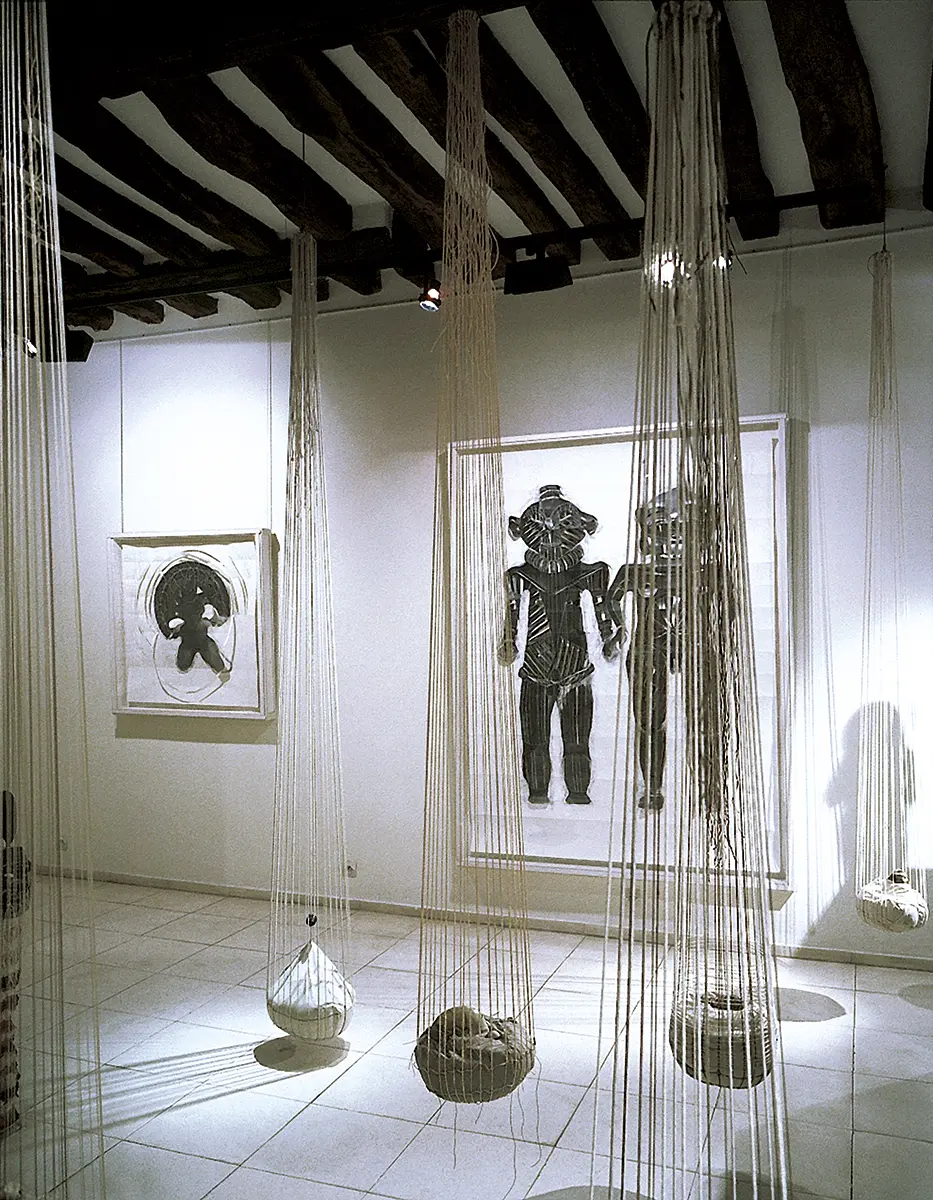
Becerra’s work is neither “archaic” nor “primitive.” His creations respond instead to goals in which the concepts of culture, otherness, and modernity answer one another and come together, while the artist remains faithful to his material and spiritual sources. The practice and repetition of certain manual gestures, linked to the values of time and origin, give shape to the essence of his art. After polishing, Becerra’s aesthetic and gestural vocabulary is enriched by braiding, knotting, sewing, and trimming, activities all of them which building and unbuilding universally give rhythm to and feed the creative act through the ages. Unlike Colombian artist Nadín Ospina, who uses pre-Columbian art in a parody of mestizaje in the context of a globalized mass culture where North American images such as Mickey Mouse or the Simpsons predominate, Milton Becerra immerses himself anew in high culture as part of a ritual or the practice of a cult, in the manner of Cuban artists José Bedia and Ana Mendieta. His proposition not only seeks to innovate the way we look at a foundational and always living —albeit threatened— past, but it also prompts us to reflect on a process of hybridization that moves incessantly forward, both in the construction and the de-construction of civilizations, and in artistic ideas and artistic creation. The fifteen suspensions Becerra calls Drops attest to the sense of balance already present in the display case’s small groups, through the rope’s tension and the thread’s texture, smooth or wrinkled. These “nests” of a sort are weighed down by “objects” formed by groups where the rope rests on a bed of sand or skin, or on a “pillow” made by the artist using raw cloth patches sewn together. In these works, there isn’t a single color that hasn’t been selected by nature. Becerra’s “drops” vibrate in their verticality while a kind of musical density is created in the bunches of lines to accompany the paradoxical effect of opposing weight and lightness, the empty and the filled-in.
A great serenity emanates from this coherent series, through which the reality of the artist’s communion with the worlds that inhabit him blows and circulates. In Becerra, unlike what happens with a large number of Latin American painters who leave away from their countries of origin, distance does not exacerbate feelings of neo-national identity or a facile peri-exoticism. What we find in him is a sense of minimalism accompanied by that kind of prudence and moderation that drive him to preserve his personal experiences only what is essential, recreating “cults,” “deities,” or “rituals” as an homage to an endangered reality.
The presence of four large drawings in lead and wax crayon bestows new humanity upon the whole exhibition. Milton Becerra finds his inspiration in small pre-Columbian ceramic statuettes, which he draws on medium-and large-format papers. Shown here for the first time, these drawings show how, through the technique of trimming, the artist penetrates the body's internal structure and de-structures it, only to recompose it later in his original geometry. It is an equally slow and painstaking endeavor that adds to the previous ones (polishing, knotting, braiding, or assembling,) where trimming becomes also a ritual act. Each one of the small strips of paper is elevated (similar to the work of Brazilian artist A. L. Piza) and Becerra also saws certain loose parts of the body, emphasizing the flotation effect, very close to kinetic art. Halfway between drawing and “sculpture” thanks to their three-dimensional character, these papers, whose graphite material is extended, sfumatto-ed, erased, and kneaded, reveal the emotional intelligence in Milton Becerra’s gaze upon a world that is alive and lost at the same time. Forms recognized, redefined, and restructured by the artist create another world, one where the erotic is present through metaphor (stones polished for hours, groups of “organic” shapes, the alternation of emptiness and fullness, firmness and softness,) but rarely explicit. However, one piece set apart from the group questions us: mounted on a translucent glass base through which electric charges circulate, a small pre-Columbian idol sculpted in stone delicately poses its hands on its breasts and calmly enjoys a pleasure that nobody will ever be able to erase.
CHRISTINE FRÉROT